The Systems Thinkers
Bags as nodes with documented roles, and the gaps between them left uncovered on purpose.
- Volume
- 05
- Order
- № 07
- Read
- 3 min
- Published
The Systems Thinker cluster occupies the Zero-overlap strict end of Use-case Discipline, typically paired with the Locked-in end of System Stability. Where the Preparedness cluster asks “what might I need?”, the Systems Thinker cluster asks “what role does this bag serve?” - and expects a clean, specific, non-overlapping answer. The carry system is designed infrastructure. Each bag is a node. Each node has a defined function. The total system covers all use cases without redundancy, and the gap between roles - the scenario not covered by any bag - is a known, acceptable void, acknowledged and decided upon rather than discovered by accident.
This is a meaningfully different relationship to GAS than the Preparedness cluster has. Where the Preparedness carrier may acquire a new item because a new use case presents itself, the Systems Thinker is more likely to resist acquisition because the new item doesn’t fill a documented gap. The purchase question is: what role does this fill, and is that role currently unserved? If no gap exists, the acquisition is deferred. This makes the Systems Thinker a slower purchaser, not a less engaged one [PLACEHOLDER: poll N / wave date].
The ecosystem builder treats the carry system as a designed whole. Each bag has a documented role. The total system covers all foreseeable use cases without overlap. The ecosystem builder can describe, without hesitation, what each bag is for and what would happen if it were removed: which use cases would become unserved, which other bags might absorb them temporarily, whether that absorption would be acceptable. The system has been thought through. It is not the result of accumulation; it is the result of design.
The role-graph obsessive has externalized the system design. There is a diagram - it may be a whiteboard photograph, a note-taking application export, a napkin-sketch photographed and saved - in which the bags are nodes and the use cases are edges. The optimization is ongoing but bounded: the graph is not constantly redrawn, but it is consulted when a purchase is considered or a retirement is contemplated. The role graph is not obsessive in the clinical sense; it is a reasonable tool for managing a complex multi-bag system and the obsessive label is the community’s own affectionate term for the behavior.
The zero-overlap strict holds a position that sounds austere from the outside: a bag cannot serve two roles, and if it does, one of those roles must be reassigned to a dedicated bag or acknowledged as unserved. The gym bag is not the weekend bag. The camera bag is not the commute bag. If the commute bag is pressed into camera service, that is a system failure - not a catastrophe, but a signal that the system has a gap. The “one opening system per use case” principle, which argues that each access requirement in a carry system should map to a dedicated and correctly-specified opening, is the guiding text for this behavioral position.
Field marks of the Systems Thinker cluster: will describe a bag retirement as “it was doing two jobs and neither well”; can produce a role map on request, with genuine enthusiasm; finds GAS less compelling than other clusters do because the purchase criteria are already specified in the system design; takes longer to make purchase decisions because the spec is precise, not because the decision is harder. The bag is a function. The function is known.
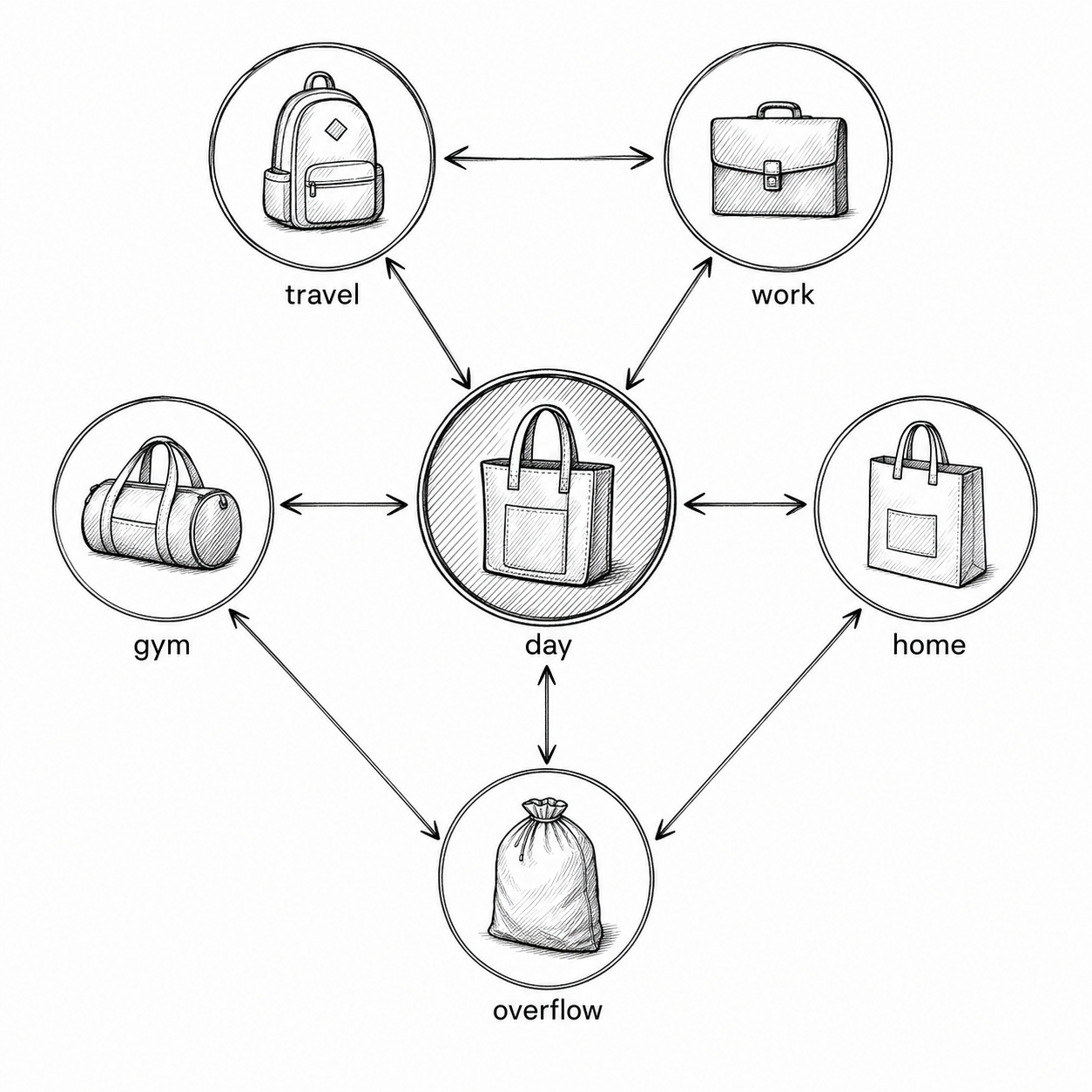 Roles, not favorites. Illustrative only.