The Searchers
When the rotation keeps changing and the search is the mode rather than a phase.
- Volume
- 05
- Order
- № 06
- Read
- 3 min
The Searcher portrait names the Perpetual-search end of proposed System Stability. Its useful distinction from being temporarily between bags is the relationship to revision: a changing rotation can be treated as a worthwhile activity rather than an unresolved problem. A twelve-month history might help explore that distinction, but no cutoff or tested marker separates the two here. In the portrait’s register, the search is not a phase. The search is the mode.
This requires some interpretation. In a discussion organized partly around finding the right bag, it might seem that everyone is a Searcher. But posting a question does not reveal a durable relationship to the outcome. Locked-in names the possibility that the variables have converged and further comparison is unnecessary. Searcher names the possibility that trying remains worthwhile even without a final answer. Neither label establishes what people would admit if pressed. Work changes, wear, availability, and simple curiosity can all reopen the question. The essay describes a distinction worth exploring, not the membership of two measured camps.
The perpetual-upgrade cycle names an argument in which the current bag remains functional while an alternative promises to resolve a friction point. Failure is not required to justify considering a transition. Use may reveal awkward access, an uncomfortable load, or a role mismatch that a spec sheet did not make apparent. Equally, the promised improvement may fail to materialize, or create a different problem. No sequence of purchases has been audited here, so the essay cannot certify that each upgrade solves a real need. It can distinguish revision after experience from the assumption that a functional object must remain the best available answer forever.
The Final-Bag-Again poster names the tension in the phrase “I think I’ve found my final bag.” Repeating such a claim would be an observable trace if a study examined a contribution history with appropriate care; this book has not done that analysis. Sincerity is not observable from the phrase alone. Still, a revised conclusion need not expose dishonesty in the earlier one. A bag can satisfy the current brief and cease to satisfy a later brief, or reveal friction through use. The “final bag” joke is useful because it leaves room for that revision without turning it into a character flaw. BST (buy/sell/trade) offers a practical route for changing a rotation; its existence does not prove the prevalence or motives of this portrait.
The BST regular treats the BST marketplace not as a failure mode but as a functional component of the carry system. BST - Buy/Sell/Trade, as defined in resale-community vocabulary - allows a rotation to be refreshed without necessarily accumulating: sell what has been moved past, buy what invites curiosity, trade toward another configuration. This portrait asks about circulation rather than a typical number of bags. Fair pricing, condition disclosure, and a useful review can matter regardless of shelf size. A positive review and a subsequent sale are not inherently contradictory, though neither guarantees the reviewer’s motives. The bag can be good without being the final bag.
Possible field marks of the Searcher portrait: WTB (want to buy) posts in BST threads; a positive review followed by a sale; a shelf section described as “might come back into rotation.” These could suggest revision, but cannot establish an enduring search mode without context. A sale might answer a financial need or a changed commute. A box need not be a failure. It can be an archive.
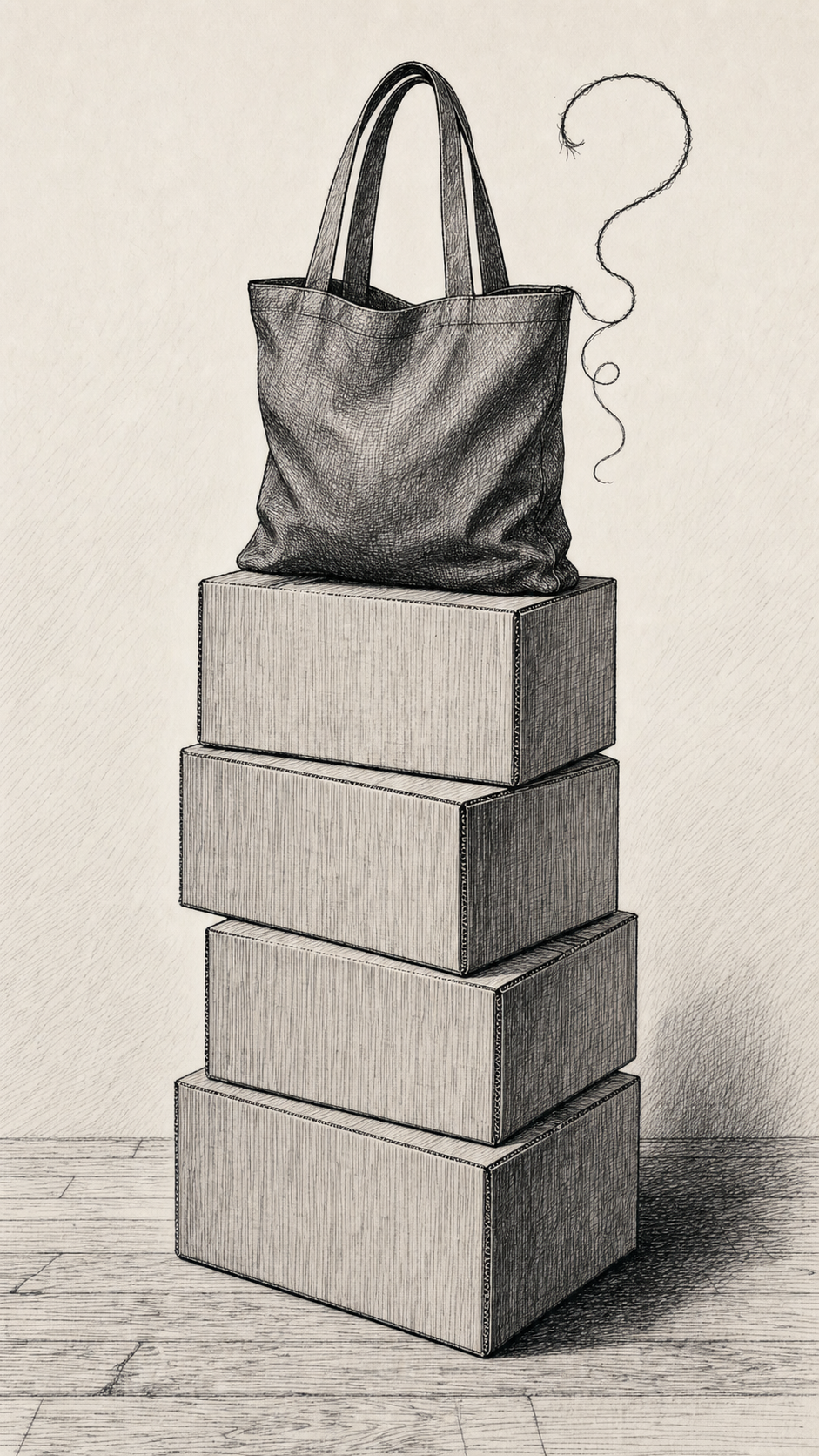 The stack is the journey. Illustrative only.