Where Archetypes Overlap
Compound strategies, porous portrait edges, and the limits of reading communities through five axes.
- Volume
- 05
- Order
- № 08
- Read
- 3 min
Five proposed axes offer a conceptual space for comparing strategies. The portraits in Chapters 2–6 are editorial selections within that space, not positions where measured scores concentrate. No distribution, centroid, or cluster boundary has been estimated. The descriptions overlap because the strategies can coexist: a small load does not prevent a large shelf, and a technical vocabulary does not require a changing rotation. Dolnicar’s cluster-analysis guidance offers a useful warning against mistaking an analyst’s partition for nature’s own categories. Here the caution applies even earlier, before there is a dataset to partition. Describing a decision along several lenses may be more useful than choosing a portrait label; the appendix supplies questions, not coordinates or an assigned type.
Some compound strategies make useful contrasts in an essay, without establishing how common they are or whether they form distinct groups.
The Spec-Fluent Minimizer carries little while asking a great deal about it. This combines the weight-weenie argument with a datasheet-reading approach: consider face fabric weight per square meter, compare the cost of lighter constructions, find a 30-litre bag technically interesting and practically unnecessary. The compound strategy is not contradictory. Knowing about materials and choosing to carry very little of them are logically compatible. That compatibility does not establish empirical co-occurrence, a correlation, or the frequency of this portrait.
The Preparedness Systems Thinker combines coverage with an explicit justification for each role. A dedicated rain poncho pouch fits the argument when rain coverage is a named requirement, not because the owner forgot to be minimal. Every bag is asked to have a role. Every role is asked to have a rationale. A large use-case space and a refusal of overlap can support a large system, but do not establish that this portrait owns the most bags. Its response to a smaller-system proposal is a useful design question rather than an attributed personality trait: which role would you like to leave uncovered?
The Searching Spec-Fluent rotates through bags while reading the spec sheet on each one. The upgrade cycle is materially literate: the new acquisition is evaluated against the old one on specific dimensions - face fabric construction, zipper family, internal volume efficiency - and the retirement is justified with reference to specific shortcomings that the new bag addresses. The search is not casual or uninformed. It is an ongoing materials evaluation. Each bag is assessed carefully; the fact that the assessment concludes “this bag has been superseded” is a conclusion, not a rationalization.
The Locked-in Chemistry-blind combines a settled bag choice with little interest in naming its materials. A bag that continues to work need not create a reason to investigate face fabric denier. This is a coherent strategy, not a seven-year biography assembled from a sample. It also raises a visibility question: discussion centered on comparisons and purchases might overlook satisfied carriers who have no new recommendation request. That is a possible selection effect, not evidence that these carriers rarely post or are underrepresented. The answer “the same bag as last time” deserves conceptual room even when no thread is needed to explain it.
Community framing provides context for questions, not evidence of how members score. r/onebag’s focus on single-bag travel makes load constraints a natural topic. r/ManyBaggers’ broad interest in bags makes ownership and role design reasonable topics. r/ThePerfectBag’s name invites questions about what “perfect” would mean, but cannot demonstrate a concentration of Searchers or Spec-Fluent carriers. Membership overlaps; readers need not post; topic emphasis need not describe a typical participant. Even a voluntary survey recruited from these spaces would not automatically represent their members, much less all bag users. The community names help locate discourse, not establish a population taxonomy.
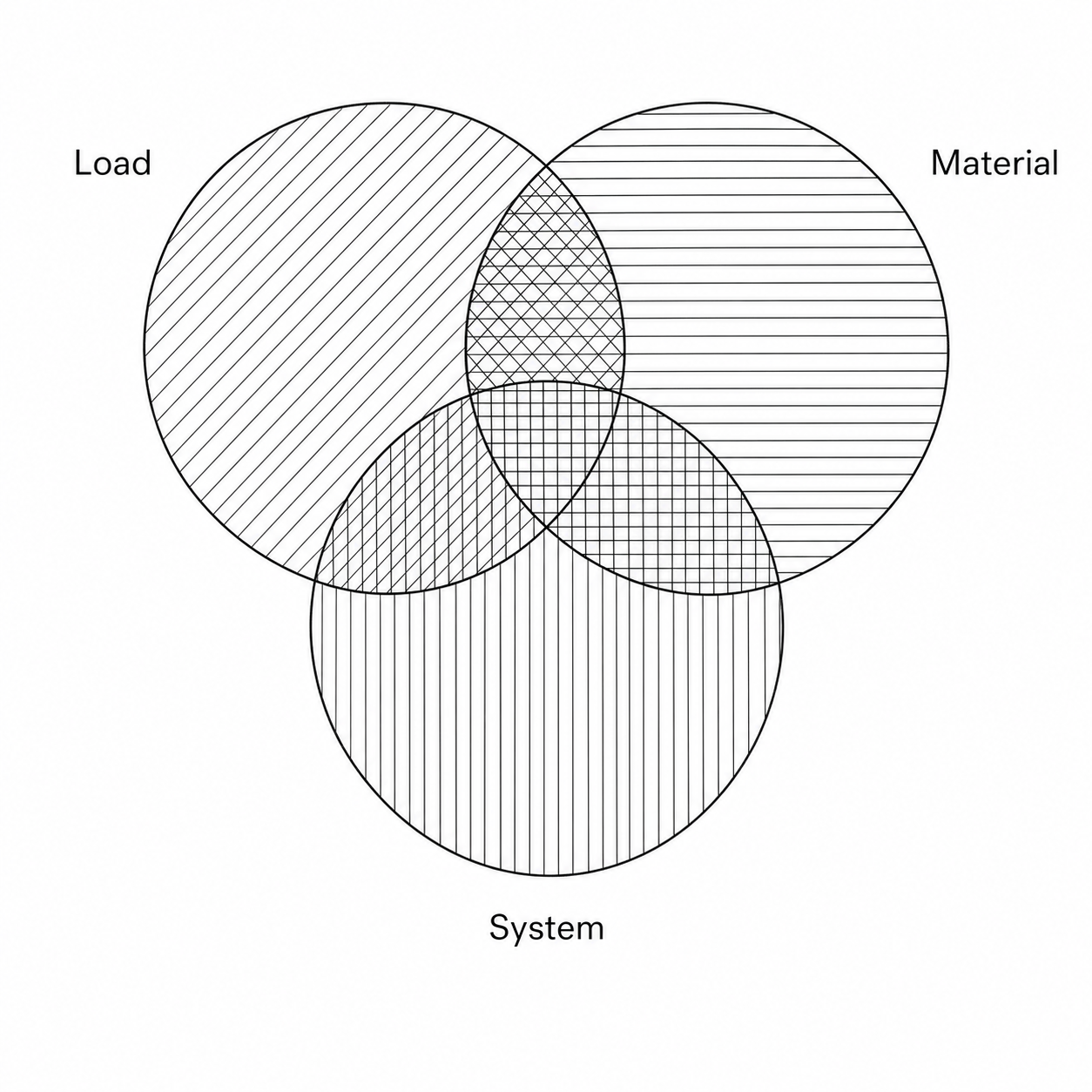 Strategies overlap. Illustrative only; not a respondent plot or measured distribution.