My Closet Is Worth 164 JanSports
Proposal: measuring bags in JSE (JanSport SuperBreak Equivalents).
- Volume
- 06
- Order
- № 08
- Read
- 3 min
- Published
Collection field note, November 21, 2026.
Once you spend enough time in this hobby, dollar amounts start to lose their edge. A $280 daypack stops registering as expensive and starts feeling like a reasonable mid-tier daily driver, while a $400 travel pack just feels like the normal cost of admission for decent harness geometry and technical fabric.
To bring some perspective back to the conversation, I’m proposing a standardized community unit: the JanSport SuperBreak Equivalent (JSE), pegged at a fixed nominal baseline of $40 USD.
Why the SuperBreak? Because it is the universal baseline of functional carry. Millions of people haul one through high school, college, and daily commutes without ever thinking about Cordura denier, AquaGuard zippers, or suspended laptop sleeves. It holds your stuff, it survives years of abuse, and it costs forty bucks. Everything we buy past that point is a deliberate choice for better ergonomics, materials, organization, or just the fun of the hobby.
The $40 peg is a proposed fixed reference, not a promise about today’s SuperBreak price.
How it works
To keep JSE useful as quick shorthand instead of an accounting exercise, the rules stay intentionally simple:
- Fixed baseline: 1 JSE = $40 USD. No inflation adjustments.
- Retail only: ignore sales tax, shipping, and temporary discounts so the math stays clean and comparable across posts.
- Clean rounding: nearest tenth for single bags, nearest whole JSE for full collections. Add unrounded retail values first, then divide and round the collection total.
JSE = retail price in USD ÷ 40.
This is strictly a unit of scale, not a quality metric or a judgment on how anyone spends their money. Calling a bag “7 JSE” doesn’t mean it is seven times better than a JanSport, nor does it mean it isn’t worth buying. It just translates carry-world pricing back into something concrete.
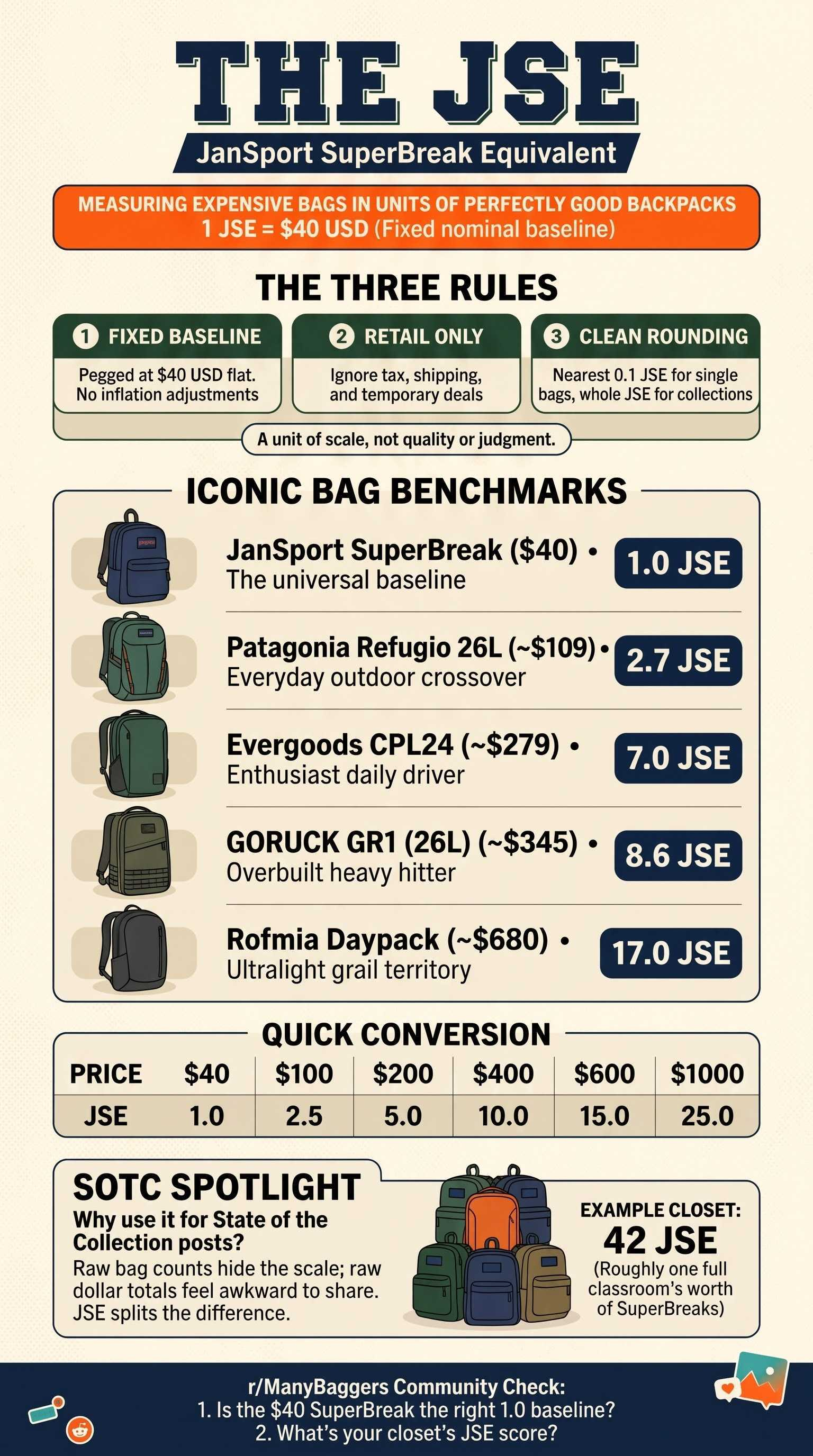
The supplied community infographic. Product drawings are illustrative, not product photography. The 42 JSE example closet is separate from my 164 JSE collection.
Quick reference scale
These are approximate prices supplied for this proposal, not verified current retail quotes. Prices vary by version, market, and date; the JSE baseline stays fixed.
| Bag | Approx. retail (USD) | Cost in JSE |
|---|---|---|
| JanSport SuperBreak | $40 | 1.0 JSE |
| Patagonia Refugio 26L | ~$109 | ~2.7 JSE |
| Evergoods CPL24 | ~$279 | ~7.0 JSE |
| GORUCK GR1 (26L) | ~$345 | ~8.6 JSE |
| Rofmia Daypack | ~$680 | ~17.0 JSE |
Quick conversions: $40 = 1 JSE; $100 = 2.5 JSE; $200 = 5 JSE; $400 = 10 JSE; $600 = 15 JSE; $1,000 = 25 JSE.
Putting it to use on my own closet
Where JSE really shines is collection reporting. People are understandably hesitant to drop exact dollar figures in a State of the Collection post, and raw bag counts don’t tell the whole story when one person’s five bags cost $300 total and another’s cost $2,500.
Going first to model the format, and rounding to the nearest whole unit: my current collection sits at 164 JSE. Seeing it framed that way is weirdly grounding. I don’t regret the bags, but realizing I own the equivalent of 164 SuperBreaks is a much funnier, clearer reality check than staring at a spreadsheet total.
JSE makes a total easier to picture, not private. Anyone can multiply it by $40 to recover the approximate retail-value scale.
Two questions for the carry community
- Is the $40 JanSport SuperBreak the right reference baseline, or is there another bag that better represents the universal “1.0” of backpacks?
- Would you actually use JSE as shorthand in reviews and SOTC posts? And if you’re willing to run the numbers, where does your current collection sit?