The Household System
Sorting the stash by behavior, not by virtue.
- Volume
- 02
- Order
- № 07
- Read
- 5 min
- Published
A grocery bag system is not optimized like a “onebag” travel kit. It is a role graph, or in the carry-bag idiom an “ecosystem”: a small set of jobs, each with a single incumbent material class, and a stash that holds duplicates of each class against the day the incumbent gets demoted or lost.
The body / shell / pouch architecture from carry-bag taxonomy has a direct analogue here. The roles route by trip type and load, not by aesthetics. One detail collapses immediately: the access-system axis that animates enthusiast carry language (“rolltop” vs. “clamshell” vs. “panel-loader” vs. side-entry vs. magnetic-buckle) has no household counterpart. Every bag in this book is a top-loader. The Half-Mil is the only edge case, and even there the rolltop is a property of the dispenser, not the bag.
The roles
Cart-to-trunk. The walk from checkout to vehicle. Loads are short, mixed, occasionally heavy at one corner (a cluster of cans, a glass jar, a six-pack). Incumbent: the Stretch Sack: the household “daily driver”, owned by accumulation, not by purchase. Carry mode is the wrist-loop dangle: handles twisted once, sack pendant from the wrist, free hand for keys. The role rewards drape and yield, both of which the Stretch Sack delivers and the Rustle Sack does not.
Trunk-to-kitchen. The walk from vehicle to counter. Loads are now consolidated; geometry matters more than total mass, and carry mode shifts from wrist-loop to two-handle top carry (Big-Blue, both straps in one fist or one over each shoulder for a multi-bag run). Incumbent: the Big-Blue. The Stretch Sack handles the no-corner case as an alternate, but the role still routes to a single primary so the rotation feedback stays legible.
Cold-chain / freezer haul. Insulated bags are out of scope for this book; they are a different material story (foam-cored composite, often with a film inner liner). Bracketed and named here only so the role does not collide with the others. The Stretch Sack is not an incumbent for cold chain.
Return-to-store, film-recycling drop-off. The terminal pathway for PE film. Incumbent: the Half-Mil bundle, balled up and stuffed into one sacrificial Stretch Sack, returned to the front-of-store drop-off bin on the next grocery run. The Rustle Sack ends here too. This is the role most household systems forget to name; without it, the drawer simply grows. Compostable bags do not belong in this bundle. They are not PE, and routing them to film drop-off is contamination, not recycling.
Kitchen and bathroom can lining. The recurring indoor-trash role: small bathroom can, kitchen tall-can, the receptacles that need a fresh liner per fill. Incumbent: the dedicated can liner in the appropriate gauge band (typically a hexene-LLDPE star-seal liner in a 0.7 to 1.0 mil window for kitchen-tall, lower for small bins). Reused grocery Stretch Sacks remain a credible second life for the smallest bins but are not the role’s primary incumbent; the failure modes (hem tear, drawstring channel rupture, asymmetric wet load) are exactly what dedicated liners are engineered around. The role is also where the compostable bag routes when, and only when, the household actually feeds a curbside or drop-off organics program that accepts certified compostables.
Garage, yard, and demolition haul. The outdoor, sharp-cargo, UV-exposed role: leaves and yard waste, deep-clean purges, weekend project debris. Incumbent: the contractor bag in 2 to 6 mil black PE, carbon-black-pigmented for UV. This is the only role in the household that routinely sees jobsite-grade gauge film, and it is the only role where the bag’s color carries chemistry (carbon black as the UV stabilizer, not the styling choice). The role rewards thickness, accepts flat-seal geometry on its terms, and does not pretend to be a kitchen liner.
Move-day, garden, heavy haul. Soil bags, plant pots, books, anything that wants to corner-load a panel. Incumbent: the Big-Blue, on purpose, from new (the household “Holy Grail” being a bag you cannot really pursue, because it has already arrived in triplicate from the IKEA checkout you did not plan to make). The role is exactly what woven PP tape was designed for.
Gift, occasion, single-trip dignity. Incumbent: the Boutique Kraft, kept briefly for relay. The role does not reward reuse; the bag is a delivery mechanism, not infrastructure. Carry mode is the two-hand bottom support: one hand at each lower corner, ribbon handles ornamental: the same finale a heavily loaded Sunday Kraft eventually demands once the handle patch starts to lift.
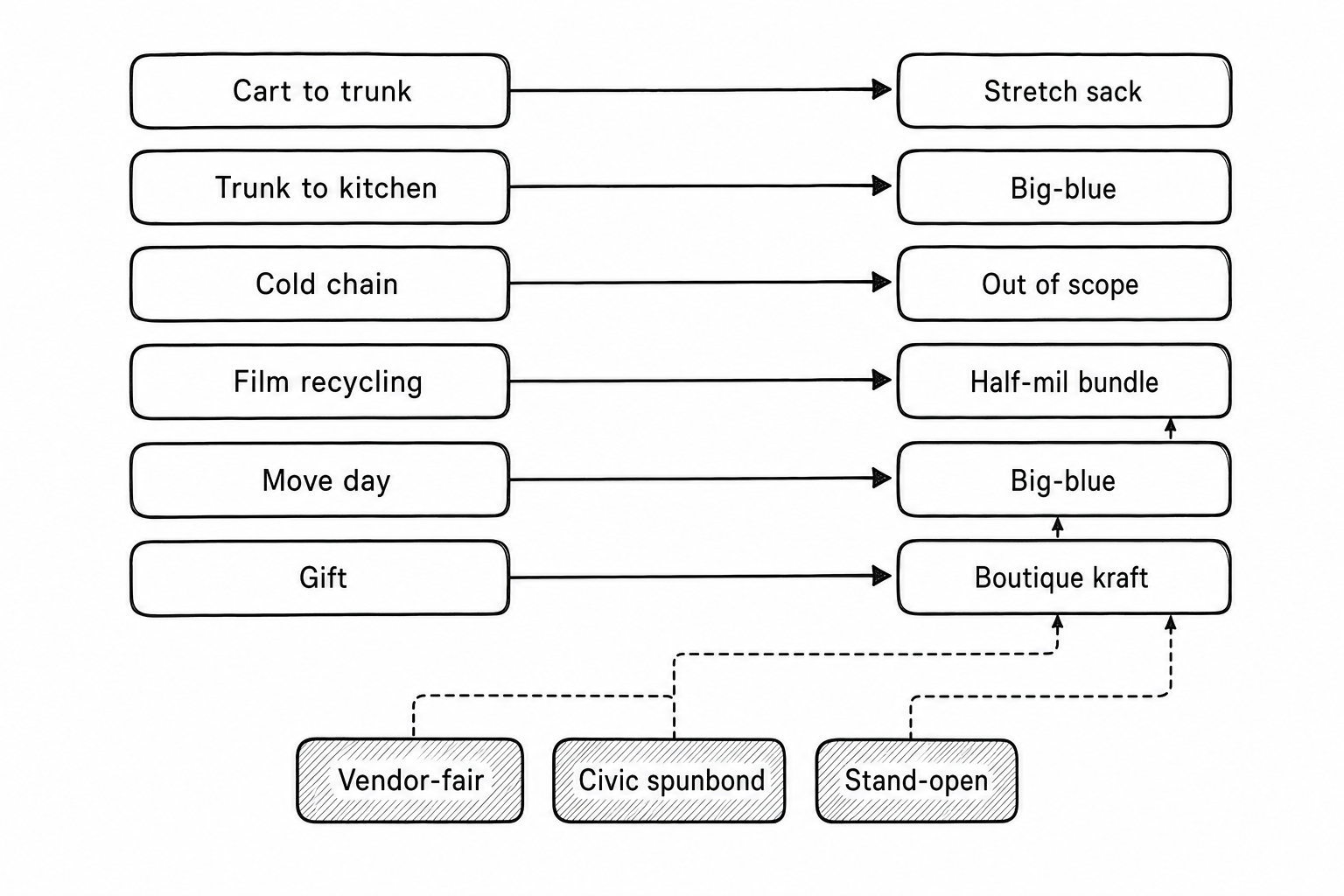
Trip-type to material incumbent: the household rotation. Illustrative only.
One incumbent per role
The system fragility shows up the same way it does in any overloaded rotation: two incumbents per role create a choice; choice creates indecision; indecision routes back to “grab whatever is on top.” Two woven totes for trunk-to-kitchen would make every trip a small decision. One incumbent per role removes the decision and makes the rotation feedback legible: when the Big-Blue starts UV-bleaching at the rim, you can see it because there is only one Big-Blue you are watching.
The Vendor-Fair Stiff is not an incumbent. The Civic Spunbond is not an incumbent. The Stand-Open Stiff is not an incumbent. They are the second-class polymer that the system tolerates because the drawer keeps producing them; their job is to be available for the trips the incumbents do not feel like taking, and to be demoted gracefully when their turn ends.
The hardware debate that occupies the carry-bag world flattens the same way the access debate does. No household bag in this book has a zipper, so the “YKK” vs. generic argument has no home here, and “zip pulls” as a category of taste evaporate entirely. The household hardware vocabulary is the one already covered upstream: rivet vs. bartack vs. weld at the strap base (Ch. 3), and twisted-cord vs. flat-tape vs. die-cut at the kraft handle (Ch. 5). The closest analogue to a fabric-tag callout is the print stamp on the bag bottom: “Thank You! Have a Nice Day!” is the household YKK, and it is on the wrong face of the sack.
Earned demotions
Demotion is the single feature that distinguishes a stash from a system.
- A Vendor-Fair Stiff that started showing seam creep was demoted in early 2024 to garage tier as a workshop bin liner. It still works; it no longer enters the kitchen.
- A Stand-Open Stiff that arrived with a holiday gift was role-converted from “tote” to “donation bin” inside its first week, on stiffness grounds. That is an earlier demotion than most retail bags get.
- A Boutique Kraft with a die-cut hand-hole tore on the second trip and was retired immediately to the under-sink scrap bin, where it spent a month receiving carrot peelings before being recycled.
- The Half-Mil bundle goes to drop-off the moment it bulges past the volume of one Stretch Sack. That is the rule that keeps the drawer finite.
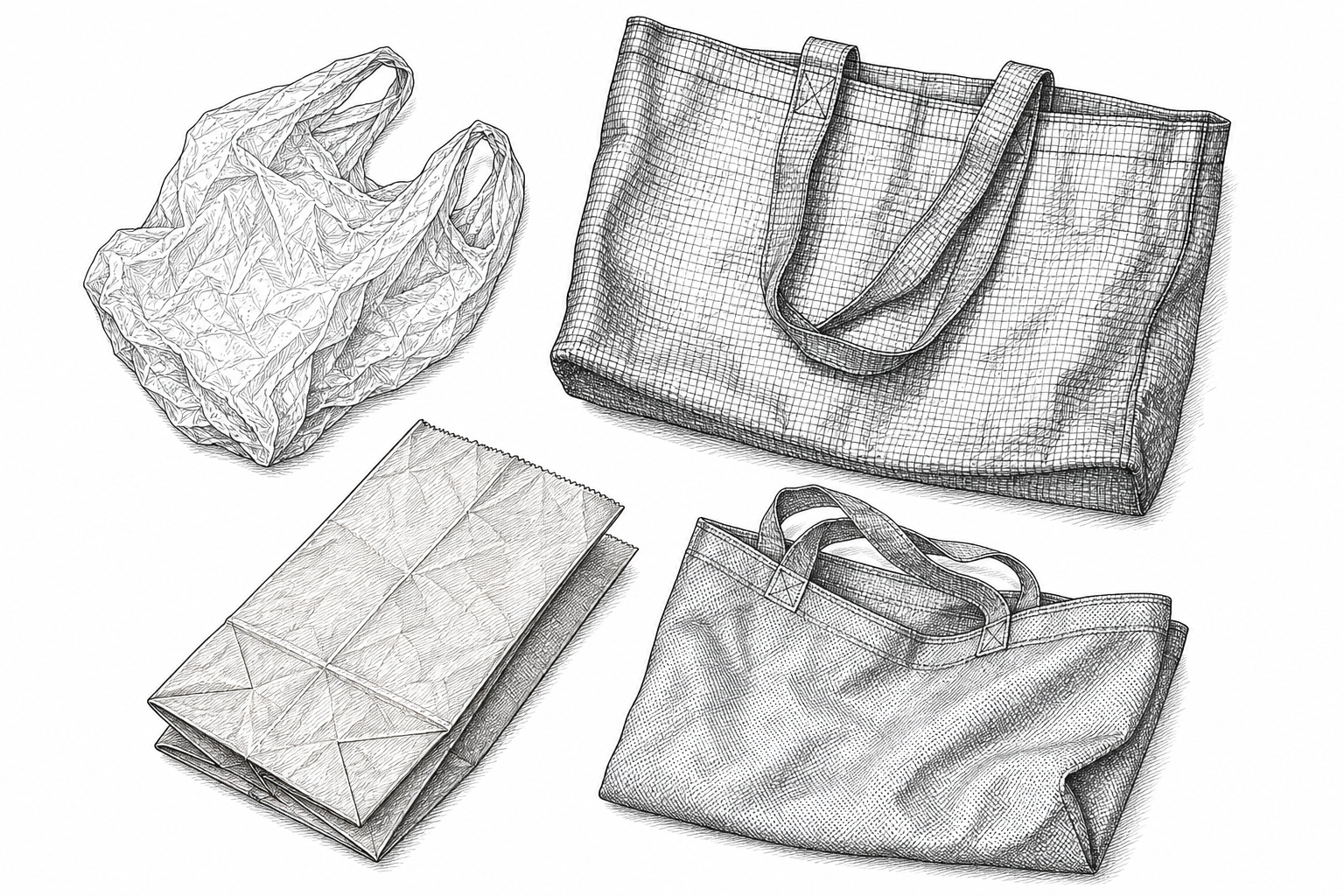
Role-by-role rotation. Not minimal, but legible. Illustrative only.