Home Bags
Carry without looking like you're carrying.
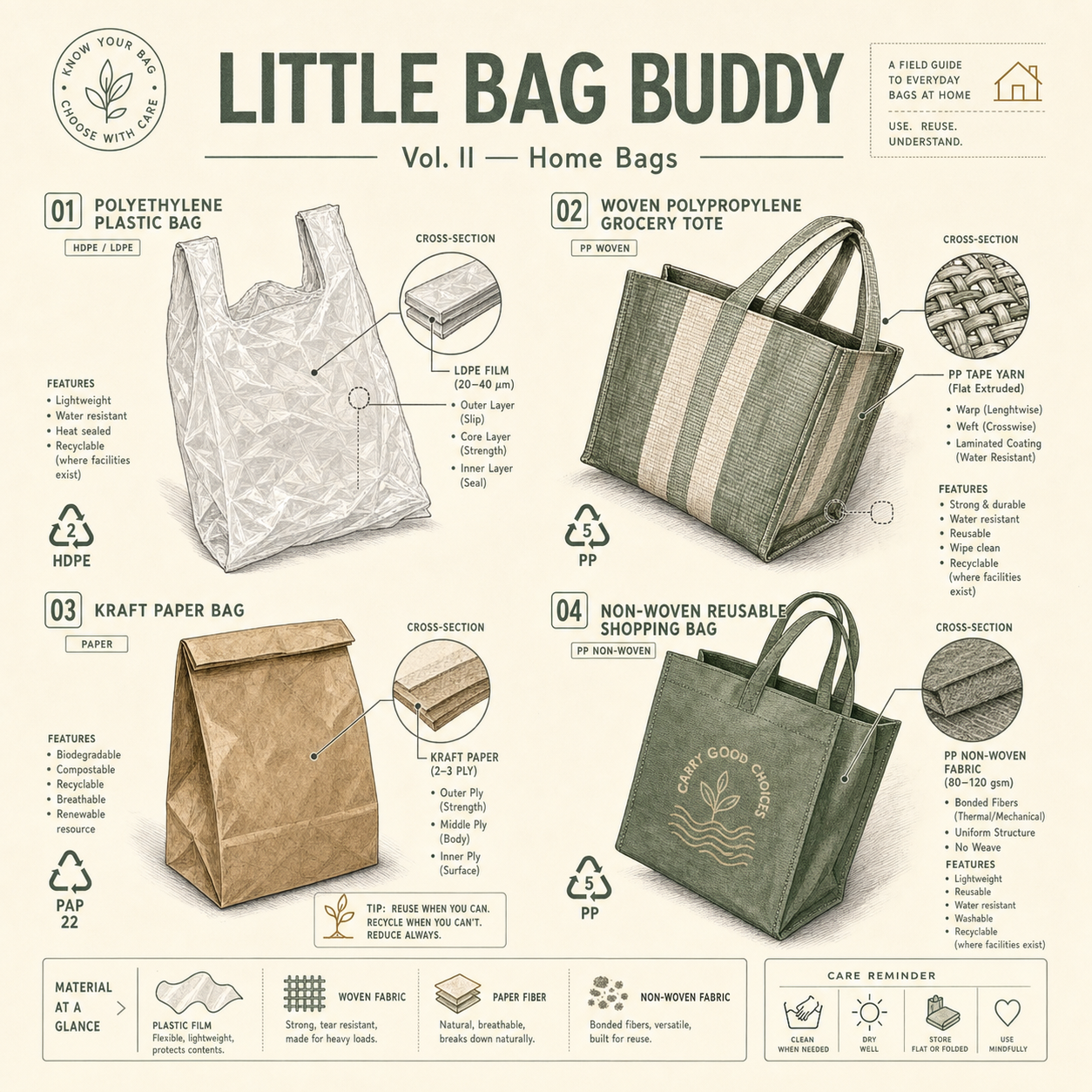
Most carry literature is about bags you choose. This volume is about bags that arrive: the drawer to the right of the fridge, the hook on the back of the broom-closet door, the stash that no one curated but still teaches material behavior under load.
Table of Contents
- № 01
The Stash Lesson
How a stash teaches material behavior under load.
2 min - № 02
Polyethylene Film
Thin, stretchy, recyclable in theory; what decides it in practice.
4 min - № 03
Polypropylene, Woven and Knit
Cheap, sturdy, photo-degradable; why it cracks at folds.
3 min - № 04
Polypropylene, Non-Woven Spunbond
The 'reusable' tote that is plastic in costume.
5 min - № 05
Paper and Kraft
Fiber, sizing, and the afterlife of brown bags.
3 min - № 06
The Household System
Sorting the stash by behavior, not by virtue.
5 min - № 07
The Arc
Why home bags get judged by chemistry, not story.
2 min - № 08
Household Inventory at Time of Publication
Specimen-by-specimen rotation snapshot.
2 min - № 09
References
Sources, primaries, and rabbit holes.
2 min
№ 01
The Stash Lesson
How a stash teaches material behavior under load.
- Read
- 2 min
- Tags
- prologue
This bag system does not start with a purchase decision. It starts with accumulation.
In my house the stash lives in two places: the drawer to the right of the fridge, and the hook on the back of the broom-closet door. Thin film sacks balled inside other thin film sacks. A blue woven tote folded around three more blue woven totes. Two promotional non-wovens that came home from events I cannot reliably reconstruct. A kraft sack from a farmers-market run last September, kept because the cord handles are nicer than they need to be.
Nothing in there was bought together. The drawer arrived by errands, take-out, store policy, weather, and the back seat of someone else’s car. That is the point. The stash is more honest than most curated kits because no one curated it, and it still teaches material behavior: creep under load, tear initiation at the handle root, embrittlement after a long summer in the trunk.

The drawer to the right of the fridge. Illustrative only.
The lesson of the stash is not minimalism. The lesson is finite roles, plural specimens. One sack is enough for the walk from cart to trunk; the drawer holds forty because supply is easier than sorting. The drawer-and-broom-closet hookup is, in the carry-bag idiom, a “bag shrine”, assembled by accident rather than on purpose, but structurally the same shrine. This book exists to name what those specimens are made of, so the next sort routes through chemistry instead of vibes. By the end you should be able to look at a balled-up sack in your hand and read its polymer, gauge, weave, bond, or fiber, and predict roughly how it will fail.
Part One: The Materials
The next chapters walk the materials in reading order:
- Polyethylene film: thin sacks and load behavior in the carry tier.
- Polypropylene, woven and knit: the blue totes and weave failure.
- Polypropylene, non-woven spunbond: promo totes and bond patterns.
- Paper and kraft: sack fiber and handle peel.
We open with polyethylene film.
№ 02
Polyethylene Film
Thin, stretchy, recyclable in theory; what decides it in practice.
- Read
- 4 min
Polyethylene (PE) is the default plastic of thin bags: grocery sacks, produce rolls, dry-cleaning film, kitchen and can liners, and jobsite contractor sacks. It is built from repeating –CH₂– units, the simplest stable carbon backbone in commodity plastics. The same polymer family covers the half-mil produce sack you tear off in the aisle and the six-mil black bag a roofer stuffs with torn shingles. Density, comonomer chemistry, and process discipline do all the work between those extremes.
Industrial PE comes in several densities. The ones that matter for bags:
- LDPE, low-density polyethylene. Branched chains that cannot pack tightly. Soft, flexible, tough in puncture for its thickness. The classic grocery-bag hand.
- LLDPE, linear low-density PE. Common in modern film blends; strength and sealability at lower thickness than LDPE alone.
- HDPE, high-density polyethylene. Straighter chains pack tightly. Stiffer, crinklier film. The thank-you sack that sounds like rustling foil is usually HDPE.
Why density matters: chain branching and packing change how film responds to stress. LDPE and LLDPE film tend toward stretch and yield; HDPE tends toward instant loud crackles and higher modulus. Same polymer, different hand.

Chain branching and packing in LDPE vs HDPE. Illustrative only.
From pellets to blown film
Pellets are melted and extruded through a die. Many grocery films are blown film: a molten tube inflated like a bubble, cooled, flattened, then sealed into sacks. Thickness is measured in mils (thousandths of an inch) in the US, or microns elsewhere. Household bags vary by retailer generation and local legislation.

Pellets to bag: blown film extrusion process. Illustrative only.
Stress whitening and orientation
When PE film yields under strain, polymer chains rearrange and microvoids scatter light. The result is stress whitening: pale streaks along a stretched handle, a faded patch around the corner of a heavy can. That whiteness is diagnostic. The bag is telling you it has already spent some of its fatigue budget.

Stress whitening as a fatigue diagnostic on LDPE film. Illustrative only.
Gauge perception, or why louder feels stronger
Hand-feel is unreliable as a strength estimator, and HDPE is the reason. The thin thank-you sack feels substantial because it crackles and stands up under its own stiffness; the thicker LDPE grocery sack feels flimsy because it drapes and absorbs. In practice the HDPE sack is often the lower-gauge of the two. Stiffness comes from molecular packing, not from mass.
This matters because retailer thickness rules and bag-fee programs in much of the US and EU pushed retailers up the gauge ladder, sometimes by switching polymers and sometimes by going thicker on the same one. A heavier LDPE sack feels closer in dignity to a real reusable, even when its actual reuse count before failure is one or two more than the rustle sack it replaced. The hand says strong; the chemistry says fewer trips per gram.
The household read: trust gauge over crackle.
UV and heat
PE oxidizes under prolonged UV. Film stored outdoors goes chalky and splits along creases. Heat accelerates creep, especially in LDPE. Never trust a sun-baked trunk sack with glass bottles. The handle that held a watermelon last spring will not hold a kombucha next August.
Recycling stream honesty
Most curbside programs want HDPE bottles and LDPE film handled differently. Film usually belongs to store drop-off streams (the “plastic film recycling” bin near the entrance), not the curbside cart. Rules vary by municipality and this book will not pretend a universal bin. The materials lesson is narrower: PE is recyclable in principle, and collection economics decide whether your ZIP code participates.
Film in the inventory
There is never one film sack. There are thirty, with incompatible branding, balled into each other. Three archetypes do all the work.
The Stretch Sack. LDPE or LLDPE grocery carry. Drapes around contents. Yields visibly before failing. The honest one. Mine routinely come home with two-liter bottles or glass jars, and the survivor of last winter’s olive-oil run still works for kitchen-trash duty: stress whitening at both handle bases, no holes, structurally sound. The Stretch Sack is the only film in the drawer with a credible second life.
The Rustle Sack. HDPE thank-you film, the one that sounds like a snare drum on a grocery run. Stiff, lower drape, lower puncture tolerance for the same gauge as a Stretch Sack. Mine die fast. The last one tore at a corner three trips in, on a normal load, with no obvious provocation. Rustle Sacks travel best as the inner liner for small kitchen bins, where their stiffness is finally a feature.
The Half-Mil. Produce roll, the ultra-thin film torn off a roller in the produce aisle, often around half a mil thick (hence the name). LDPE or LLDPE blends, optimized for cost and tear-on-perforation. Single-trip on principle. Most of mine fail at the produce-roll perforation itself, which is the design intent: tear cleanly from the roll, then split tidily after one use.

Film as thin structure. Illustrative only.
№ 03
Polypropylene, Woven and Knit
Cheap, sturdy, photo-degradable; why it cracks at folds.
- Read
- 3 min
Polypropylene (PP) is a polyolefin like polyethylene, but built from repeating propylene units. The backbone carries a pendant methyl group that changes packing and melting behavior. Result: higher melting point than PE, stiff when thick, and in fiber form unusually fatigue-resistant for its weight.
Woven PP is where the bags in this book stop pretending to be soft film and start behaving like sheet structures: loud when flexed, stubborn under tensile load, honest about where stress concentrates.
From pellets to tape yarn
The specimen most people picture when they hear “woven grocery tote” is not a brand. It is a geometry. Call it what it is: the Big-Blue.
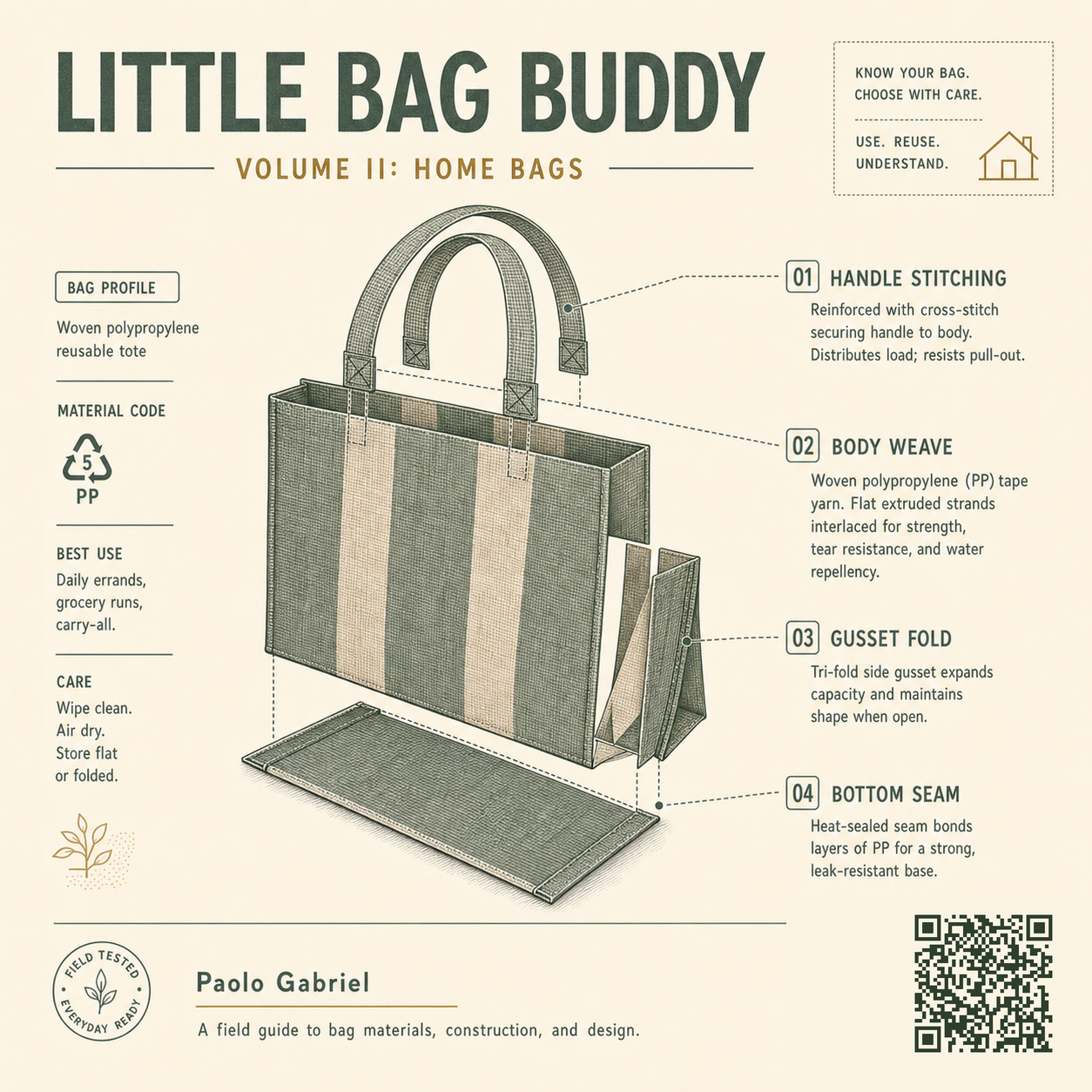
The Big-Blue is a boxy, large-format tote built from flat tape yarns extruded from PP pellets and woven in plain weave (over-under repeat) into a sheet that behaves less like cloth and more like flexible plate. It crinkles. It holds rectangular cargo without apology. It carries awkward loads (soil, pots, gallon jugs, anything that wants corners) because the weave distributes tension across warp and weft like a grid.
Mine entered the house in 2019 as the companion purchase to a bookshelf and a lamp. Stainless rivets at the strap bases. Tape wide enough that a thumb can feel individual strands under load. No romance: just capacity. It still moves furniture, still hauls garden waste, and still survives summers in the trunk.

PP tape plain weave: over-under grid structure. Illustrative only.
A Big-Blue rarely dies at the panel.
Where Big-Blues actually fail
Straps attach where geometry demands honesty: stress concentrates at points and seams. In woven PP, failure initiates at stitching: thread elongation, seam creep, rivet tear-out. All of those long before the broad tape field ruptures. Forensic inspection of a retired Big-Blue usually finds the fuse at thread or seam, not at the fabric itself. The tape looks heroic; the junction tells the truth.
Rivet vs. stitched straps
The single most predictive durability tell on a Big-Blue is how the strap meets the panel. Three patterns recur:
- Riveted attachment, often through a reinforcement patch. Stainless or brass rivet plus a doubled tape backer. The load path is mechanical, not adhesive, and the failure point shifts from “thread” to “panel material around the rivet.” That is a much later failure.
- Bartacked stitching, dense block stitching at the strap base. Strong when fresh; the fuse migrates back to thread elongation under repeated peak loads.
- Hot-welded or ultrasonic bonding, common on cheaper totes where straps are fused into the body without sewing. Cleanest looking when new, earliest to delaminate under sun and load.
If you are picking a Big-Blue off a wall, look at the strap base first. The panel is rarely the question.

Three strap attachment patterns and their failure modes. Illustrative only.
Knit variants
Some large-format bags substitute knitted PP for woven tape: loops instead of an orthogonal grid. Stretchier body, different tear path, same polymer vulnerability stack. Still UV-sensitive. Still seam-limited.
UV sensitivity
PP degrades photochemically even when it looks fine indoors. Antioxidants buy seasons, not forever. After enough porch summers or trunk seasons, woven PP goes brittle at folds: the same corners that used to complain loudly start failing quietly. Color bleach is the early warning.
The lesson is not heroism. Rotation beats favorites. Two Big-Blues in rotation outlast one Big-Blue left to bake on the back deck.
Woven PP in the inventory
Two archetypes recur in my drawer.
The Big-Blue. Large-format woven PP tape, plain weave, riveted handles, high volume. Used on purpose for moves, gardening, and the runs that involve corners. Status: active, plural, slightly sun-tired, riveted strap bases still tight.
The Vendor-Fair Stiff. A second-class woven PP, thinner tape, stitched (rarely riveted), usually picked up free at conventions, fairs, or community events. Kept past usefulness because discarding a structurally functional polymer feels intellectually untidy. Stitch creep arrives early, often within twenty real loads. The two I keep have been demoted to the garage as bin liners after the original handles started to walk.
The Big-Blue is the one I pack on purpose. The Vendor-Fair Stiff is the one I find in the trunk three weeks after the event and feel a small pang about.

Tape weave as architecture. Illustrative only.
№ 04
Polypropylene, Non-Woven Spunbond
The 'reusable' tote that is plastic in costume.
- Read
- 5 min
The non-woven reusable is the bag most likely to outlast the event it advertised. Same polymer as the Big-Blue, completely different sheet logic.
Non-woven grocery totes are usually spunbond PP: molten polymer extruded through a spinneret into fine continuous filaments, laid semi-randomly onto a moving belt, then bonded into a sheet that looks like fabric but has no woven grid. No warp, no weft, no over-under. A direction-blind mat.
From melt to mat
The process is a relative of melt-spinning nylon, with one big change at the end. Pellets melt; molten PP is forced through a multi-hole spinneret; emerging filaments are quenched in air and pulled (drawn) by a downward air stream that aligns and thins them. Instead of being collected and twisted into yarn, the filaments fall onto a continuous belt as a loose web. That web is then bonded into a coherent sheet.
How the bonding happens is the most important variable in your hand.
Bond patterns: read the dots
Three bonding methods dominate household totes. They look different at oblique light, and they fail differently.
- Calender bonding (point-bonded thermal). The web passes between two heated rollers, one of which is engraved with a pattern of small raised lands (often diamonds or ovals). Where the lands press, the filaments fuse into discrete welded points; everywhere else, the filaments stay loose. Held to a window, you see the regular dot pattern that defines almost every cheap reusable tote. Calender bonded spunbond is stiff, papery, and tear-prone along the bond rows because the bond points themselves act as perforations under stress.
- Through-air bonding (TAB). The web passes through a heated air stream that softens fiber surfaces and bonds filaments at their crossover points throughout the sheet. No discrete dot pattern. The result is lofty, soft, drape-friendly, more like a fabric and less like a printed plastic sheet. Through-air bonded totes are the ones that feel suspiciously “fabric-like.” They tear less along straight lines and more like felt.
- Spunlace (hydroentangled). The web is bombarded with fine high-pressure water jets that mechanically tangle the filaments without melting them. Softest of the three, no thermal damage to the fibers, occasionally used in upmarket “fabric-feel” totes, more common in wipes and medical non-wovens. Easy to spot: it drapes like cloth and shows no thermal pattern at all.
The household read: when a “reusable tote” feels like printed cardboard, it is calender bonded. When it feels suspiciously like felt or lightweight canvas, it is through-air bonded or spunlaced. The dot pattern is the tell.

Calender dot, through-air, and spunlace bond patterns at oblique light. Illustrative only.
Basis weight: the gsm band that matters
Spunbond is specified in basis weight, grams per square meter (gsm). The household band runs roughly:
- 40 to 70 gsm: medical, packaging, promotional inserts, single-use shopping bags from some pharmacies. Below “reusable” register.
- 80 to 120 gsm: the standard reusable-tote weight. Calender bonded at this range stands open and prints crisply.
- 120 to 200 gsm: heavier promotional totes, often with stitched or welded edge reinforcement; the ones that get re-used as beach bags or laundry bags by accident.
Above 200 gsm spunbond starts to behave like a rigid sheet and is rare in the household space. Below 80 gsm, the bag will not survive a melon.

Spunbond PP basis weight bands and household use cases. Illustrative only.
TiO2, pigment, and the printed face
White and pastel spunbond commonly carries titanium dioxide (TiO2) as both opacifier and modest UV shield. The TiO2 scatters visible light (the bag looks white) and also intercepts some near-UV, which slightly slows photo-oxidation of the surface fibers. Colored totes use other pigments, sometimes carbon black (excellent UV shield) and sometimes organic colorants (poor UV shield, fade fast).
Printed promotional totes are the worst case. The print sits on the surface as a film of ink and binder, which absorbs UV differently from the unpigmented PP underneath. Over a few summers in a sunny car, the printed face often goes brittle and powdery before the unprinted back panel does. Look at a five-year-old promotional tote and you will see exactly this: faded logo on a still-flexible sheet, with the brittleness and the failed face being the same map.
Stiffness is not strength
Spunbond’s defining trick is that bond density makes a sheet stand open without raising tear resistance. The very feature that signals “reusable” in store, the way the bag holds its rectangular footprint on the checkout counter, is also the failure-initiation map. Stress concentrates at the bond points. A nick at a bond row propagates faster than a nick in a free-fiber zone.
Translation: the stand-open shelf-presence stiffness is not load-bearing structure. It is geometry.
Why spunbond proliferates
Cheap in bulk, printable, light, foldable, thick enough to signal reusable intent. Whether the lifecycle math works out compared to film or kraft depends on how many real trips the bag actually does, which is a function of household routing more than chemistry. The materials point is narrower: the fiber is PP, so UV, fatigue, and bond-pattern rules from above all apply.
Spunbond in the inventory
Two archetypes show up in my stash.
The Civic Spunbond. The boring institutional promo. Stamped with the year and the event, calender bonded at maybe 90 gsm, printed across one face. Mine all came in for free, often as the giveaway holder for the rest of the giveaways. The dot pattern is visible against a bright window. The first to brittle on the print face, the slowest to actually tear through. Status: active, used as light groceries carry, will get film-recycled when the print face powders.
The Stand-Open Stiff. A heavier (likely 130 to 180 gsm) calender-bonded tote, often a retail gift-with-purchase or a department-store seasonal release, sometimes with a stitched edge band and a cardboard insert in the base. Stiffness is the entire pitch. Mine arrived with a holiday gift two years ago and has been excellent at standing open in the closet to receive donations, while being mediocre at any task that involves drape. Status: active, role-converted from “tote” to “open bin.”

Fiber mat without weave grid. Illustrative only.
№ 05
Paper and Kraft
Fiber, sizing, and the afterlife of brown bags.
- Read
- 3 min
Paper sacks are cellulosic: wood pulp fibers hydrogen-bond into a network. Kraft is a pulping process (German for strength) that uses sodium hydroxide and sodium sulfide to dissolve lignin while preserving the long cellulose fibers. The result is the characteristic brown, high-tear sack: longer fibers, more inter-fiber bonds, more tear resistance than the short-fiber pulp behind newsprint.
Tear propagation
Paper fails by tear, not yield. Once the fiber network is breached at a notch (a fold corner, the inside of a handle punch, a crease from being folded flat under heavier bags), energy concentrates and runs. Tear resistance is fiber length plus inter-fiber bonding plus the angle of the tear path. Kraft is good at all three until water shows up.
Wet paper loses hydrogen bonding almost instantly. Water molecules slip into the inter-fiber junctions, displace the hydrogen bonds that were holding the network together, and the sheet collapses to a fraction of its dry strength. Dry kraft is predictable. Rainy parking lots are where the romance dies.

Water disrupting hydrogen bonds in the kraft fiber network. Illustrative only.
Wet-strength agents
Some kraft sacks survive light rain in ways that look impossible for plain paper. The trick is usually a wet-strength agent added at the wet end of the paper machine. The dominant chemistry is PAE resin (polyamide-epichlorohydrin), which forms covalent crosslinks between cellulose fibers that are not water-reversible. PAE-treated kraft retains roughly 10 to 30% of its dry tensile strength when wet, instead of the near-zero of untreated kraft.
You can sometimes feel it: PAE-treated kraft has a slightly stiffer hand and a less papery rustle than untreated. The line between true paper and paper-shaped composite runs through this additive. A grocery kraft that survived a five-minute walk in drizzle did not survive because of the fiber. It survived because of the resin.
Coatings
Some promotional kraft uses clay coatings, wax, or thin polymer films for print gloss or moisture resistance. Behavior shifts toward composite, not pure fiber, and the recycling stream gets pickier. Clay coatings are usually fine for curbside paper; wax-impregnated kraft (the old butcher-paper register) often is not; polymer-laminated kraft (the very glossy gift bag) is often not paper-stream at all.
Handle attachment geometry: where bags actually die
Kraft sacks die at the handle, never at the panel. Three handle patterns recur:
- Twisted-cord handles, glued or stapled to a reinforcement patch on the sack interior. The cord itself is strong; the failure point is the patch-to-sack adhesive bond, which peels away when wet or when overloaded with a swinging weight. The Sunday Kraft mode.
- Flat tape glued handles, common on retail gift bags. Slightly weaker than twisted cord under sustained load, similar peel-failure mode.
- Die-cut hand-hole (no separate handle, just a punched oval through the sack). The cheapest pattern. The fuse is the tear initiation at the corners of the die-cut, where stress concentrates against the grain of the paper. Die-cut hand-holes are nearly always the first failure point on a loaded sack, and the reason most “sturdy paper bag” experiences end at the threshold of the kitchen.
The household read: when picking up a heavy paper sack, watch the geometry under the handle. If the patch starts to lift, you have ten more seconds.

Three kraft handle patterns with failure point annotations. Illustrative only.
Kraft in the inventory
Two archetypes pass through my drawer.
The Sunday Kraft. Two-ply unbleached kraft from the farmers-market and the better grocery runs, twisted-cord handles glued to an interior reinforcement patch. PAE-treated, by feel. Mine survives single trips well, develops fold creases at the base after one or two reuses, and gets demoted to either kindling or under-sink scrap-bin liner around trip three. Status: high turnover, dignified retirement.
The Boutique Kraft. Glossy clay-coated retail gift bag, sometimes ribbon-handled, sometimes tape-handled, often with a die-cut top edge and a cardboard base insert. Optimized for one trip from store to recipient. Mine, when they come home, do exactly one duty as decorative scrap bins before the surface coating starts to rub off in patches. Status: single-use by design, kept briefly for gift-wrap relay.

Tear geometry and fiber direction. Illustrative only.
№ 06
The Household System
Sorting the stash by behavior, not by virtue.
- Read
- 5 min
A grocery bag system is not optimized like a “onebag” travel kit. It is a role graph, or in the carry-bag idiom an “ecosystem”: a small set of jobs, each with a single incumbent material class, and a stash that holds duplicates of each class against the day the incumbent gets demoted or lost.
The body / shell / pouch architecture from carry-bag taxonomy has a direct analogue here. The roles route by trip type and load, not by aesthetics. One detail collapses immediately: the access-system axis that animates enthusiast carry language (“rolltop” vs. “clamshell” vs. “panel-loader” vs. side-entry vs. magnetic-buckle) has no household counterpart. Every bag in this book is a top-loader. The Half-Mil is the only edge case, and even there the rolltop is a property of the dispenser, not the bag.
The roles
Cart-to-trunk. The walk from checkout to vehicle. Loads are short, mixed, occasionally heavy at one corner (a cluster of cans, a glass jar, a six-pack). Incumbent: the Stretch Sack: the household “daily driver”, owned by accumulation, not by purchase. Carry mode is the wrist-loop dangle: handles twisted once, sack pendant from the wrist, free hand for keys. The role rewards drape and yield, both of which the Stretch Sack delivers and the Rustle Sack does not.
Trunk-to-kitchen. The walk from vehicle to counter. Loads are now consolidated; geometry matters more than total mass, and carry mode shifts from wrist-loop to two-handle top carry (Big-Blue, both straps in one fist or one over each shoulder for a multi-bag run). Incumbent: the Big-Blue. The Stretch Sack handles the no-corner case as an alternate, but the role still routes to a single primary so the rotation feedback stays legible.
Cold-chain / freezer haul. Insulated bags are out of scope for this book; they are a different material story (foam-cored composite, often with a film inner liner). Bracketed and named here only so the role does not collide with the others. The Stretch Sack is not an incumbent for cold chain.
Return-to-store, film-recycling drop-off. The terminal pathway for PE film. Incumbent: the Half-Mil bundle, balled up and stuffed into one sacrificial Stretch Sack, returned to the front-of-store drop-off bin on the next grocery run. The Rustle Sack ends here too. This is the role most household systems forget to name; without it, the drawer simply grows. Compostable bags do not belong in this bundle. They are not PE, and routing them to film drop-off is contamination, not recycling.
Kitchen and bathroom can lining. The recurring indoor-trash role: small bathroom can, kitchen tall-can, the receptacles that need a fresh liner per fill. Incumbent: the dedicated can liner in the appropriate gauge band (typically a hexene-LLDPE star-seal liner in a 0.7 to 1.0 mil window for kitchen-tall, lower for small bins). Reused grocery Stretch Sacks remain a credible second life for the smallest bins but are not the role’s primary incumbent; the failure modes (hem tear, drawstring channel rupture, asymmetric wet load) are exactly what dedicated liners are engineered around. The role is also where the compostable bag routes when, and only when, the household actually feeds a curbside or drop-off organics program that accepts certified compostables.
Garage, yard, and demolition haul. The outdoor, sharp-cargo, UV-exposed role: leaves and yard waste, deep-clean purges, weekend project debris. Incumbent: the contractor bag in 2 to 6 mil black PE, carbon-black-pigmented for UV. This is the only role in the household that routinely sees jobsite-grade gauge film, and it is the only role where the bag’s color carries chemistry (carbon black as the UV stabilizer, not the styling choice). The role rewards thickness, accepts flat-seal geometry on its terms, and does not pretend to be a kitchen liner.
Move-day, garden, heavy haul. Soil bags, plant pots, books, anything that wants to corner-load a panel. Incumbent: the Big-Blue, on purpose, from new (the household “Holy Grail” being a bag you cannot really pursue, because it has already arrived in triplicate from the IKEA checkout you did not plan to make). The role is exactly what woven PP tape was designed for.
Gift, occasion, single-trip dignity. Incumbent: the Boutique Kraft, kept briefly for relay. The role does not reward reuse; the bag is a delivery mechanism, not infrastructure. Carry mode is the two-hand bottom support: one hand at each lower corner, ribbon handles ornamental: the same finale a heavily loaded Sunday Kraft eventually demands once the handle patch starts to lift.

Trip-type to material incumbent: the household rotation. Illustrative only.
One incumbent per role
The system fragility shows up the same way it does in any overloaded rotation: two incumbents per role create a choice; choice creates indecision; indecision routes back to “grab whatever is on top.” Two woven totes for trunk-to-kitchen would make every trip a small decision. One incumbent per role removes the decision and makes the rotation feedback legible: when the Big-Blue starts UV-bleaching at the rim, you can see it because there is only one Big-Blue you are watching.
The Vendor-Fair Stiff is not an incumbent. The Civic Spunbond is not an incumbent. The Stand-Open Stiff is not an incumbent. They are the second-class polymer that the system tolerates because the drawer keeps producing them; their job is to be available for the trips the incumbents do not feel like taking, and to be demoted gracefully when their turn ends.
The hardware debate that occupies the carry-bag world flattens the same way the access debate does. No household bag in this book has a zipper, so the “YKK” vs. generic argument has no home here, and “zip pulls” as a category of taste evaporate entirely. The household hardware vocabulary is the one already covered upstream: rivet vs. bartack vs. weld at the strap base (Ch. 2), and twisted-cord vs. flat-tape vs. die-cut at the kraft handle (Ch. 4). The closest analogue to a fabric-tag callout is the print stamp on the bag bottom: “Thank You! Have a Nice Day!” is the household YKK, and it is on the wrong face of the sack.
Earned demotions
Demotion is the single feature that distinguishes a stash from a system.
- A Vendor-Fair Stiff that started showing seam creep was demoted in early 2024 to garage tier as a workshop bin liner. It still works; it no longer enters the kitchen.
- A Stand-Open Stiff that arrived with a holiday gift was role-converted from “tote” to “donation bin” inside its first week, on stiffness grounds. That is an earlier demotion than most retail bags get.
- A Boutique Kraft with a die-cut hand-hole tore on the second trip and was retired immediately to the under-sink scrap bin, where it spent a month receiving carrot peelings before being recycled.
- The Half-Mil bundle goes to drop-off the moment it bulges past the volume of one Stretch Sack. That is the rule that keeps the drawer finite.

Role-by-role rotation. Not minimal, but legible. Illustrative only.
№ 07
The Arc
Why home bags get judged by chemistry, not story.
- Read
- 2 min
The Stretch Sack taught: gauge and stress whitening are the only honesty metrics on a film bag. Marketing copy lives on the receipt, not on the sack.
The Rustle Sack taught: loud is not strong. Stiffness is a packing-density signal, not a load-bearing claim.
The Half-Mil taught: single-trip is a design intent, not a failure. Some bags are perforations all the way down.
The Big-Blue taught: seams are the fuse, panels are rarely first to go. Riveted strap bases buy the panel another decade.
The Vendor-Fair Stiff taught: second-class woven PP is still woven PP. The fiber chemistry does not care which event handed the bag out.
The Civic Spunbond taught: bond pattern is the failure map. Calender dots are the printed version of “tear here.”
The Stand-Open Stiff taught: stiffness is geometry, not structure. The bag standing open at checkout is not the bag that survives a load.
The Sunday Kraft taught: water is a phase transition, and PAE resin is a real chemical answer to it. The handle patch is the real fuse, not the cord.
The Boutique Kraft taught: single-trip dignity is a legitimate role. Composite paper is not paper that failed; it is a different object pretending to be the original.
The drawer taught: this is a “bag shrine”. The carry-bag world builds them on purpose. The household builds them by accident, which is structurally the same shrine.
The intake taught: household “gear acquisition disorder” is involuntary. “GAD”, in the carry-bag world, is a choice. In the household it is a tax: the bag arrives whether you wanted it or not.
The drawer also taught: the “onebag” / “manybag” debate is a false binary. The household runs plural specimens, finite roles: manybag philosophy on materials, onebag philosophy on roles. The tension dissolves at the role boundary.
Technical carry asks which bags earn laminates. This book asks which bags earn rotation. The drawer asks neither; it just keeps producing them.
Little Bag Buddy, Vol. II: Home Bags is written in the same spirit as this series: material vocabulary over grocery myth. Nothing here is sponsored or affiliate-linked. Where municipal rules conflict with chemistry, believe your bin labels.
Reminder: every image in this guide is illustrative only. AI-generated. Not a substitute for manufacturer specs, primary literature, or hands-on examination.
№ 08
Household Inventory at Time of Publication
Specimen-by-specimen rotation snapshot.
- Read
- 2 min
- Tags
- appendix · inventory
Archetypes, not SKUs. Status entries describe role and current condition.

Nine household archetypes: illustrated type reference. Illustrative only.
Capacity is listed in liters and stated first, in deference to the carry-bag convention that the volume number leads the spec sheet. Household capacities are nominal: real-world fill ranges with the operator and the produce.
| Specimen | Capacity (L) | Material | Role | Status / condition |
|---|---|---|---|---|
| The Stretch Sack | ~12–18 L | LDPE / LLDPE blown film | Cart-to-trunk; trunk-to-kitchen (no corners) | Active, plural, stress whitening at handle bases on the older survivors |
| The Rustle Sack | ~6–12 L | HDPE blown film | Trunk-to-kitchen (light loads); kitchen bin liner | Active, fast turnover, recycled at front-of-store drop-off |
| The Half-Mil | spec is roll length, not volume | LDPE / LLDPE produce-roll film | Single-trip produce; eventual film-recycle bundle filler | High churn, single-trip by design |
| The dedicated can liner | ~15–50 L | LLDPE (hexene or octene grade), star-seal, 0.6–1.1 mil | Kitchen / bathroom can lining | Active by SKU, gauge-and-seal selected per can size |
| The contractor bag | ~80–200 L | LDPE / LLDPE, 2–6 mil, flat or gusset seal, carbon black | Garage, yard waste, demolition haul | Active when projects demand it; UV-stabilized for outdoor staging |
| The compostable sack | ~6–30 L | PLA / PBAT or TPS / PBAT blend (not PE) | Organics-program liner where infrastructure exists | Use only with curbside or drop-off compost route; not film-recyclable |
| The Big-Blue | ~71 L (FRAKTA-class) | Woven PP tape, plain weave, riveted handles | Move-day, garden, heavy haul, trunk-to-kitchen (corners) | Active, plural, slightly sun-tired, riveted strap bases tight |
| The Vendor-Fair Stiff | ~15–25 L | Woven PP tape, stitched handles | (Not an incumbent) | Demoted to garage as workshop bin liner after stitch creep, early 2024 |
| The Civic Spunbond | ~18–22 L | Calender-bonded spunbond PP, ~90 gsm | (Not an incumbent) | Active backup; will be film-recycled when the print face powders |
| The Stand-Open Stiff | ~25–35 L | Calender-bonded spunbond PP, 130 to 180 gsm | Standing-open donation bin (role-converted) | Active in closet, never used as a tote |
| The Sunday Kraft | ~15–18 L | PAE-treated kraft, twisted-cord handles | Single-trip groceries; under-sink scrap-bin relay | High turnover, dignified retirement to recycling or kindling |
| The Boutique Kraft | ~4–10 L | Clay-coated kraft, glossy face, die-cut or tape handles | Gift relay (single-trip dignity) | Brief active life; coating powders on second use |
№ 09
References
Sources, primaries, and rabbit holes.
- Read
- 2 min
- Tags
- references
Consolidated list for Vol. II. This bibliography is scoped to the household-bag material set covered in this manuscript.
Polyethylene
- Polyethylene, Wikipedia
- Low-density polyethylene, Wikipedia
- High-density polyethylene, Wikipedia
- Blown film extrusion, Wikipedia
- Plastic film recycling, EPA overview
- Stress-whitening, Wikipedia
- Bucknall, Stress whitening in polyethylene, Polymer (1981)
Can liners, gauge, seal geometry
- Heritage / WAXIE, Can Liners 101 (PDF) - LLDPE grades (butene / hexene / octene), HMW-HDPE bands, mil and micron conventions, star vs flat vs gusset seal geometry, static load tables.
- AAA Polymer, Mil vs Micron - gauge-unit primer for PE liners and contractor bags.
- Pitt Plastics, Can Liners 101 - LLDPE-vs-HDPE liner construction overview.
- LyondellBasell, Fundamentals and Troubleshooting for HMW-HDPE Blown Film (PDF) - high-stalk process, BUR, MD/TD tear balance.
- Sustainable Packaging Coalition, The State of North American Film Recycling (June 2025) - R-PE / R-LLDPE capacity, contamination realities for store drop-off film bales.
Contractor film and UV
- AAA Polymer, What to Look for in Contractor Trash Bags - mil bands (2.0–2.7, 3.0–6.0), failure-mode narrative.
- Cabot Corp, Specialty Carbons for UV Protection and Weatherability - carbon black as the dominant UV stabilizer for polyolefins; particle-size and dispersion dependence.
Compostable and biocompostable films
- European Bioplastics, EN 13432 factsheet (PDF) - industrial compostability requirements: 90% biodegradation in 6 months, <2 mm disintegration in 12 weeks, ecotoxicity, heavy-metal limits.
- ASTM D6400-21, Standard Specification for Labeling of Plastics Designed to be Aerobically Composted in Municipal or Industrial Facilities - North American industrial compostability standard.
- TÜV Austria, OK compost HOME vs OK compost INDUSTRIAL - home vs industrial certification scope; basis for EN 17427, AS 5810.
- BPI, Compostability Certification (Biodegradable Products Institute) - North American third-party certification mark to ASTM D6400.
- Sustainable Packaging Coalition, Understanding the Role of Compostable Packaging (2023, PDF) - share of US composting facilities accepting compostable packaging (102 of ~643 verified facilities) and share of large-city residential programs that route compostables to them (single-digit municipal, low-double-digit private).
- Closed Loop Partners / Composting Consortium, Don’t Spoil the Soil (2024, PDF) - contamination at US composting facilities; conventional plastic is the dominant contaminant, not compostable packaging.
- Specialty Polymer, PHA, PHB, PBAT, PLA, PBS, PCL, and TPS Explained - polymer-by-polymer field reference for compostable film chemistry.
- FTC Green Guides (16 CFR Part 260), full text (PDF) - §260.7 compostable claims and §260.8 degradable claims.
Polypropylene
- Polypropylene, Wikipedia
- Nonwoven fabric, Wikipedia (includes spunbond process)
- Spunbond and meltblown nonwovens, INDA technical overview (industry primer on spunbond, calender bonding, through-air bonding, and spunlace)
- Titanium dioxide, Wikipedia (opacifier and partial UV shield in pigmented PP)
Paper
- Kraft paper, Wikipedia
- Cellulose, Wikipedia
- Wet-strength resin (PAE), Wikipedia (polyamide-epichlorohydrin chemistry behind rain-resistant kraft)
Degradation
Little Bag Buddy, Vol. II: Home Bags, v0.5.0, May 2026, Paolo Gabriel