Polypropylene, Non-Woven Spunbond
The "reusable" tote that is plastic in costume.
- Volume
- 02
- Order
- № 05
- Read
- 5 min
- Published
The non-woven reusable is the bag most likely to outlast the event it advertised. Same polymer as the Big-Blue, completely different sheet logic.
Non-woven grocery totes are usually spunbond PP: molten polymer extruded through a spinneret into fine continuous filaments, laid semi-randomly onto a moving belt, then bonded into a sheet that looks like fabric but has no woven grid. No warp, no weft, no over-under. A direction-blind mat.
From melt to mat
The process is a relative of melt-spinning nylon, with one big change at the end. Pellets melt; molten PP is forced through a multi-hole spinneret; emerging filaments are quenched in air and pulled (drawn) by a downward air stream that aligns and thins them. Instead of being collected and twisted into yarn, the filaments fall onto a continuous belt as a loose web. That web is then bonded into a coherent sheet.
How the bonding happens is the most important variable in your hand.
Bond patterns: read the dots
Three bonding methods dominate household totes. They look different at oblique light, and they fail differently.
- Calender bonding (point-bonded thermal). The web passes between two heated rollers, one of which is engraved with a pattern of small raised lands (often diamonds or ovals). Where the lands press, the filaments fuse into discrete welded points; everywhere else, the filaments stay loose. Held to a window, you see the regular dot pattern that defines almost every cheap reusable tote. Calender bonded spunbond is stiff, papery, and tear-prone along the bond rows because the bond points themselves act as perforations under stress.
- Through-air bonding (TAB). The web passes through a heated air stream that softens fiber surfaces and bonds filaments at their crossover points throughout the sheet. No discrete dot pattern. The result is lofty, soft, drape-friendly, more like a fabric and less like a printed plastic sheet. Through-air bonded totes are the ones that feel suspiciously “fabric-like.” They tear less along straight lines and more like felt.
- Spunlace (hydroentangled). The web is bombarded with fine high-pressure water jets that mechanically tangle the filaments without melting them. Softest of the three, no thermal damage to the fibers, occasionally used in upmarket “fabric-feel” totes, more common in wipes and medical non-wovens. Easy to spot: it drapes like cloth and shows no thermal pattern at all.
The household read: when a “reusable tote” feels like printed cardboard, it is calender bonded. When it feels suspiciously like felt or lightweight canvas, it is through-air bonded or spunlaced. The dot pattern is the tell.
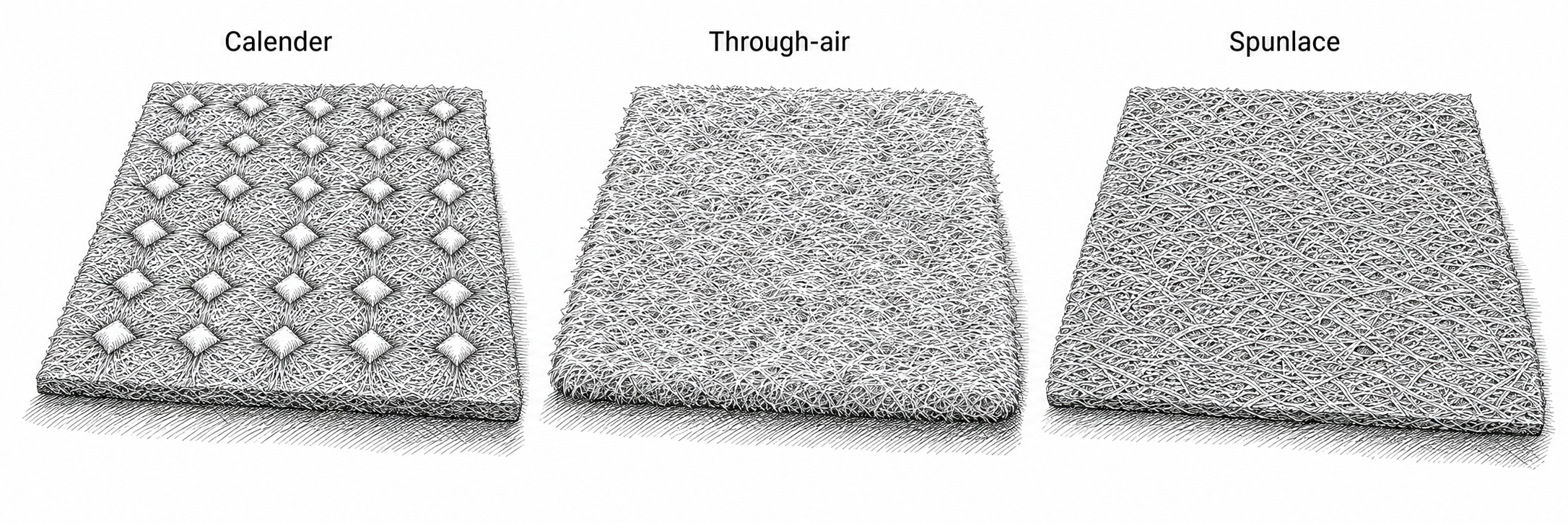
Calender dot, through-air, and spunlace bond patterns at oblique light. Illustrative only.
Basis weight: the gsm band that matters
Spunbond is specified in basis weight, grams per square meter (gsm). The household band runs roughly:
- 40 to 70 gsm: medical, packaging, promotional inserts, single-use shopping bags from some pharmacies. Below “reusable” register.
- 80 to 120 gsm: the standard reusable-tote weight. Calender bonded at this range stands open and prints crisply.
- 120 to 200 gsm: heavier promotional totes, often with stitched or welded edge reinforcement; the ones that get re-used as beach bags or laundry bags by accident.
Above 200 gsm spunbond starts to behave like a rigid sheet and is rare in the household space. Below 80 gsm, the bag will not survive a melon.
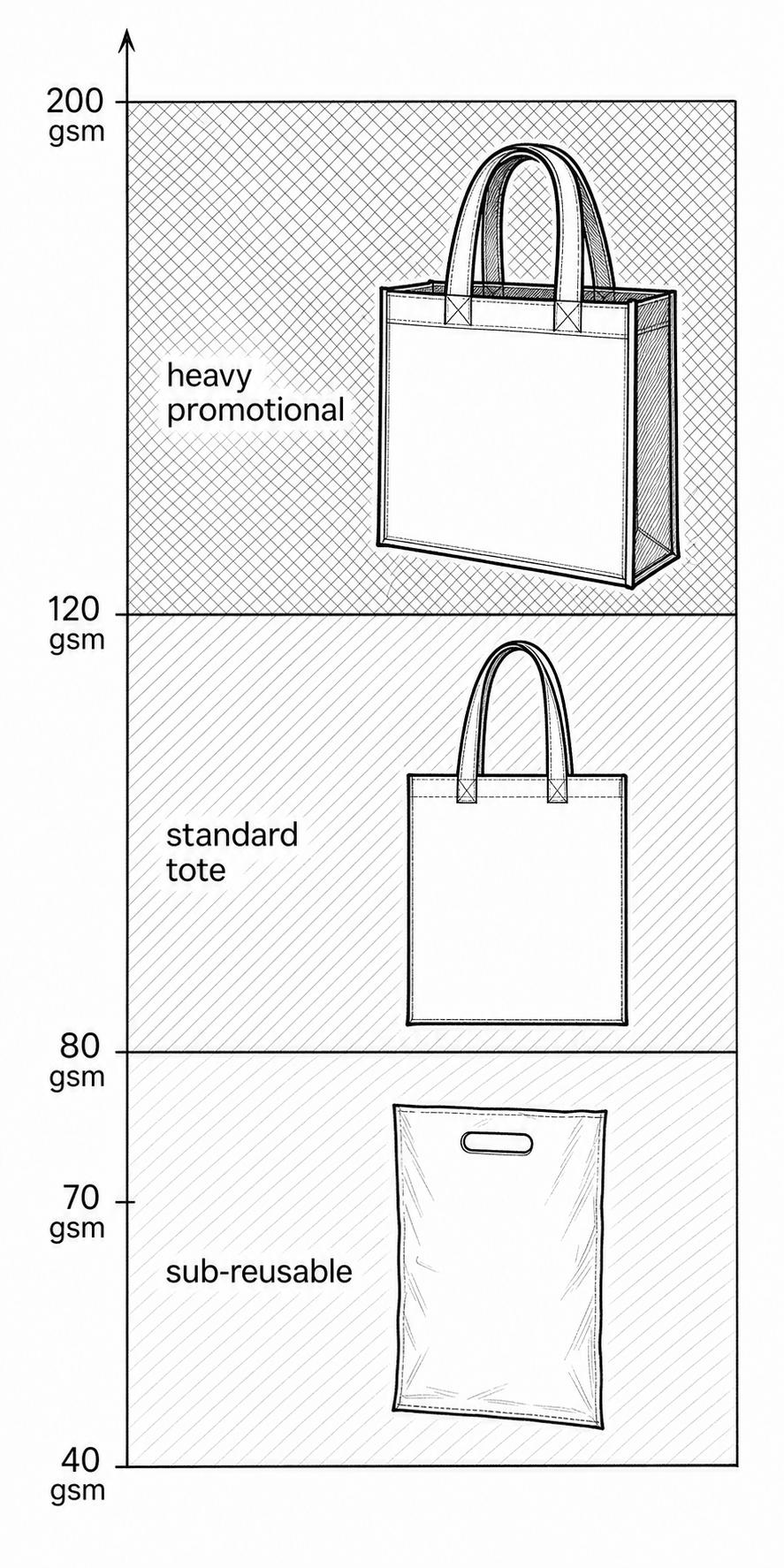
Spunbond PP basis weight bands and household use cases. Illustrative only.
TiO2, pigment, and the printed face
White and pastel spunbond commonly carries titanium dioxide (TiO2) as both opacifier and modest UV shield. The TiO2 scatters visible light (the bag looks white) and also intercepts some near-UV, which slightly slows photo-oxidation of the surface fibers. Colored totes use other pigments, sometimes carbon black (excellent UV shield) and sometimes organic colorants (poor UV shield, fade fast).
Printed promotional totes are the worst case. The print sits on the surface as a film of ink and binder, which absorbs UV differently from the unpigmented PP underneath. Over a few summers in a sunny car, the printed face often goes brittle and powdery before the unprinted back panel does. Look at a five-year-old promotional tote and you will see exactly this: faded logo on a still-flexible sheet, with the brittleness and the failed face being the same map.
Stiffness is not strength
Spunbond’s defining trick is that bond density makes a sheet stand open without raising tear resistance. The very feature that signals “reusable” in store, the way the bag holds its rectangular footprint on the checkout counter, is also the failure-initiation map. Stress concentrates at the bond points. A nick at a bond row propagates faster than a nick in a free-fiber zone.
Translation: the stand-open shelf-presence stiffness is not load-bearing structure. It is geometry.
Why spunbond proliferates
Cheap in bulk, printable, light, foldable, thick enough to signal reusable intent. Whether the lifecycle math works out compared to film or kraft depends on how many real trips the bag actually does, which is a function of household routing more than chemistry. The materials point is narrower: the fiber is PP, so UV, fatigue, and bond-pattern rules from above all apply.
Spunbond in the inventory
Two archetypes show up in my stash.
The Civic Spunbond. The boring institutional promo. Stamped with the year and the event, calender bonded at maybe 90 gsm, printed across one face. Mine all came in for free, often as the giveaway holder for the rest of the giveaways. The dot pattern is visible against a bright window. The first to brittle on the print face, the slowest to actually tear through. Status: active, used as light groceries carry, will get film-recycled when the print face powders.
The Stand-Open Stiff. A heavier (likely 130 to 180 gsm) calender-bonded tote, often a retail gift-with-purchase or a department-store seasonal release, sometimes with a stitched edge band and a cardboard insert in the base. Stiffness is the entire pitch. Mine arrived with a holiday gift two years ago and has been excellent at standing open in the closet to receive donations, while being mediocre at any task that involves drape. Status: active, role-converted from “tote” to “open bin.”
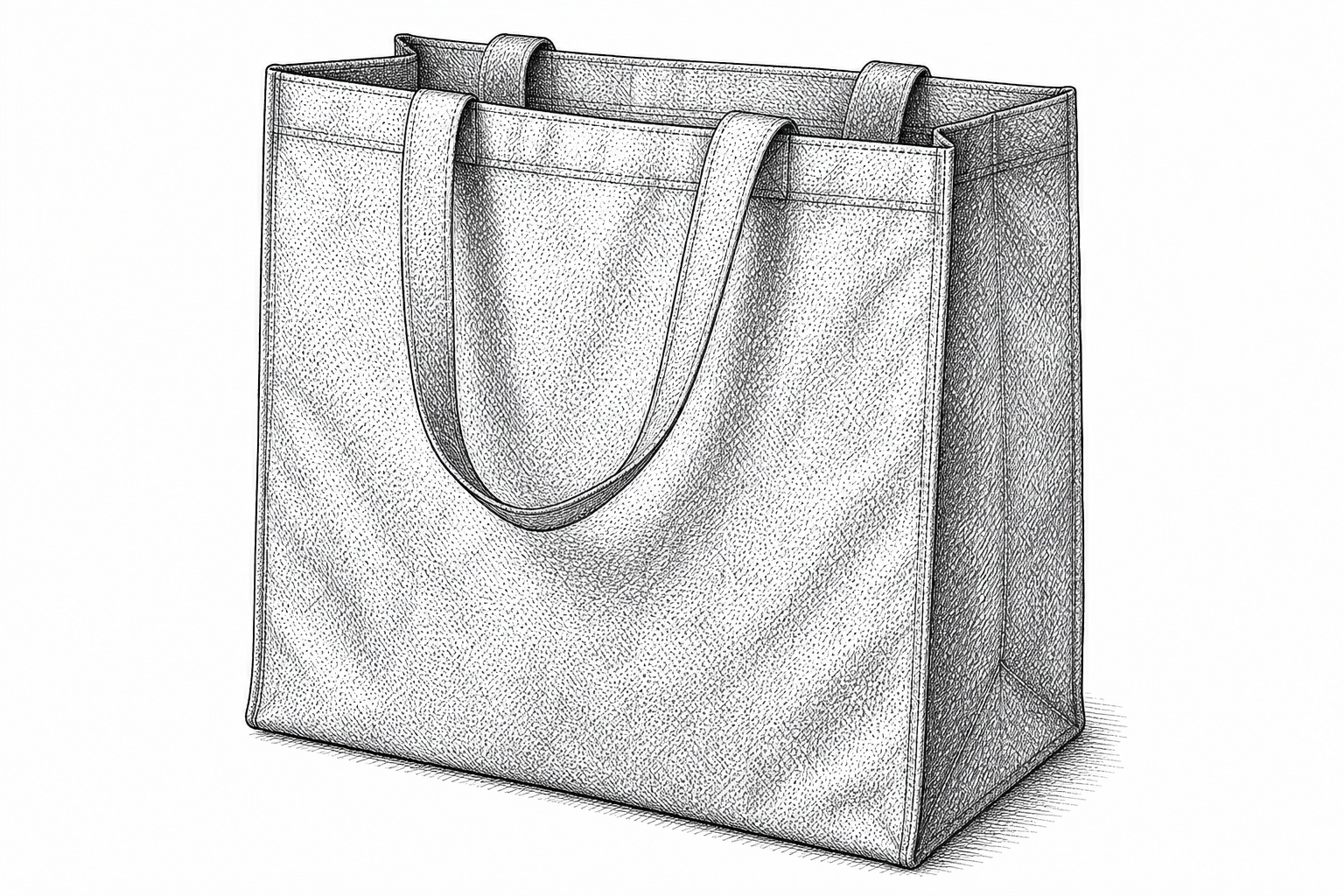
Fiber mat without weave grid. Illustrative only.