Polyethylene Film
Thin, stretchy, recyclable in theory; what decides it in practice.
- Volume
- 02
- Order
- № 02
- Read
- 4 min
- Published
Polyethylene (PE) is the default plastic of thin bags: grocery sacks, produce rolls, dry-cleaning film, kitchen and can liners, and jobsite contractor sacks. It is built from repeating –CH₂– units, the simplest stable carbon backbone in commodity plastics. The same polymer family covers the half-mil produce sack you tear off in the aisle and the six-mil black bag a roofer stuffs with torn shingles. Density, comonomer chemistry, and process discipline do all the work between those extremes.
Industrial PE comes in several densities. The ones that matter for bags:
- LDPE, low-density polyethylene. Branched chains that cannot pack tightly. Soft, flexible, tough in puncture for its thickness. The classic grocery-bag hand.
- LLDPE, linear low-density PE. Common in modern film blends; strength and sealability at lower thickness than LDPE alone.
- HDPE, high-density polyethylene. Straighter chains pack tightly. Stiffer, crinklier film. The thank-you sack that sounds like rustling foil is usually HDPE.
Why density matters: chain branching and packing change how film responds to stress. LDPE and LLDPE film tend toward stretch and yield; HDPE tends toward instant loud crackles and higher modulus. Same polymer, different hand.
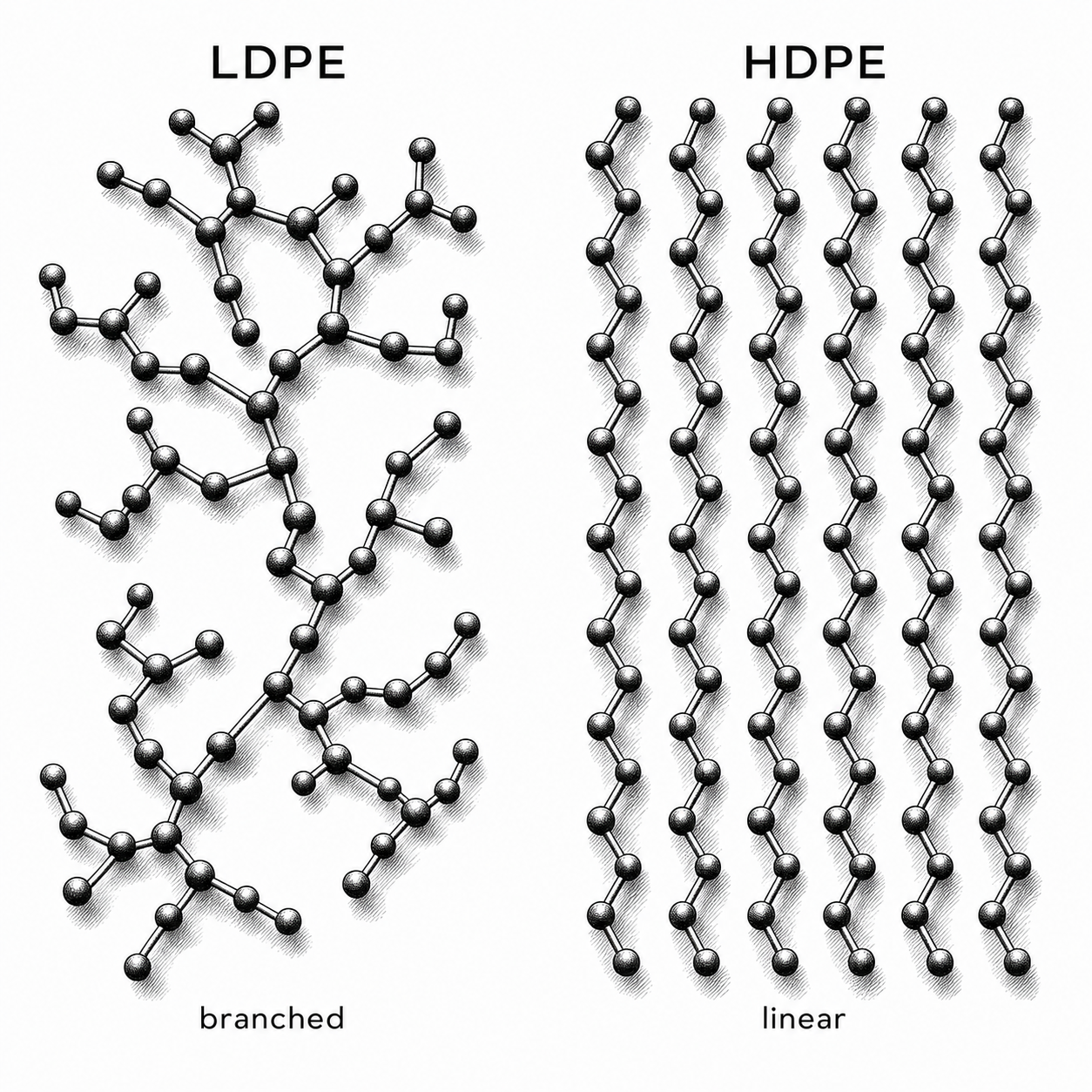
Chain branching and packing in LDPE vs HDPE. Illustrative only.
From pellets to blown film
Pellets are melted and extruded through a die. Many grocery films are blown film: a molten tube inflated like a bubble, cooled, flattened, then sealed into sacks. Thickness is measured in mils (thousandths of an inch) in the US, or microns elsewhere. Household bags vary by retailer generation and local legislation.
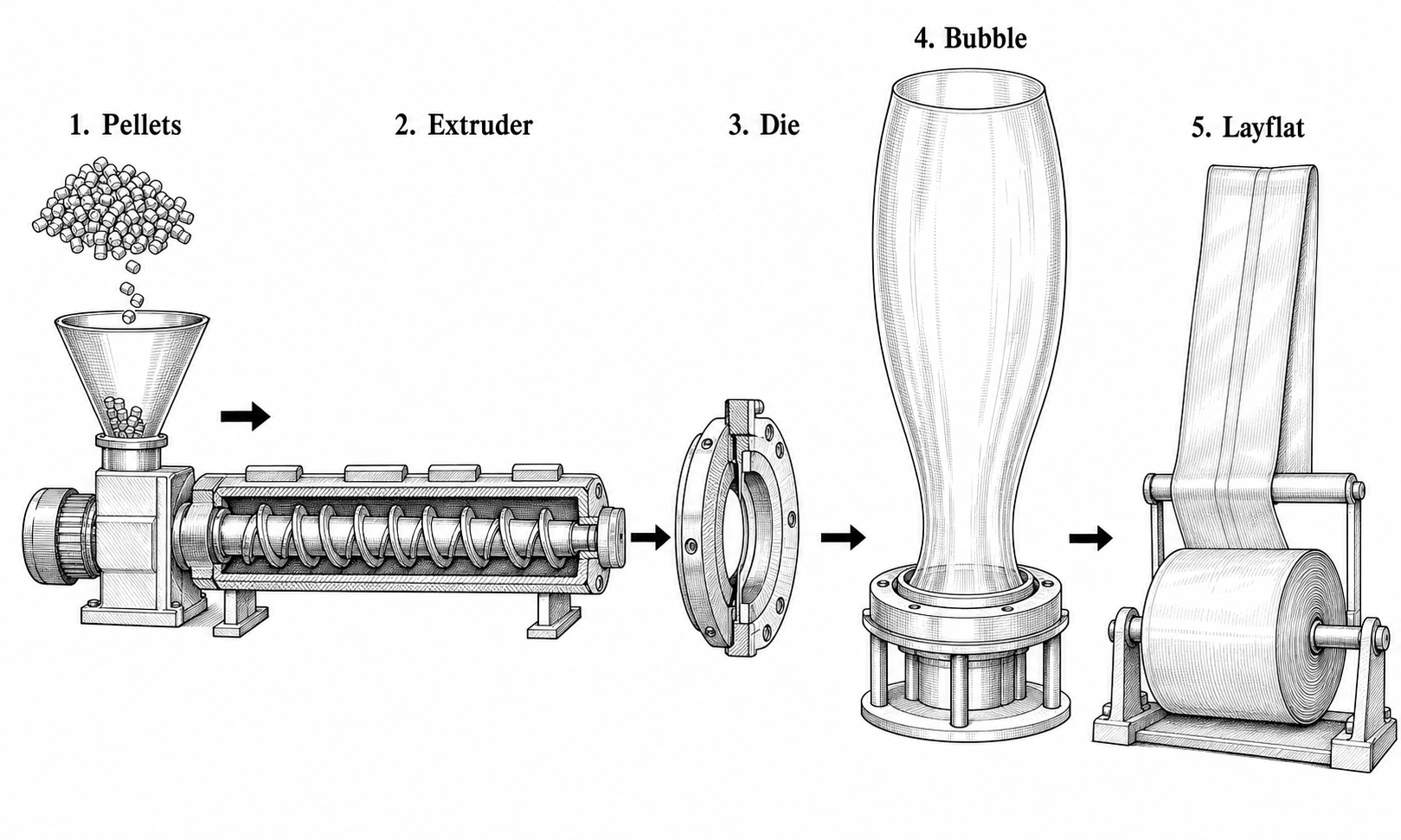
Pellets to bag: blown film extrusion process. Illustrative only.
Stress whitening and orientation
When PE film yields under strain, polymer chains rearrange and microvoids scatter light. The result is stress whitening: pale streaks along a stretched handle, a faded patch around the corner of a heavy can. That whiteness is diagnostic. The bag is telling you it has already spent some of its fatigue budget.
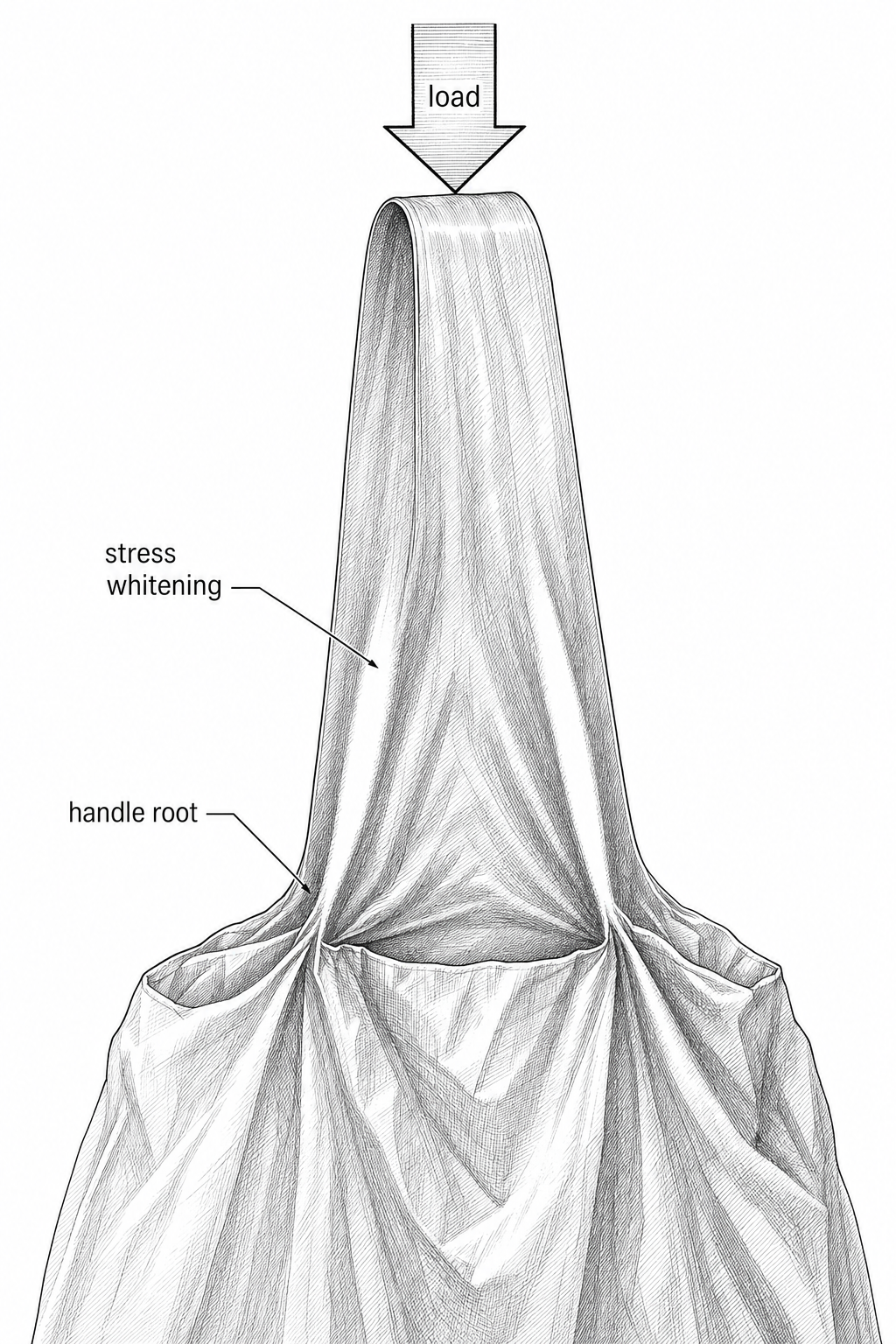
Stress whitening as a fatigue diagnostic on LDPE film. Illustrative only.
Gauge perception, or why louder feels stronger
Hand-feel is unreliable as a strength estimator, and HDPE is the reason. The thin thank-you sack feels substantial because it crackles and stands up under its own stiffness; the thicker LDPE grocery sack feels flimsy because it drapes and absorbs. In practice the HDPE sack is often the lower-gauge of the two. Stiffness comes from molecular packing, not from mass.
This matters because retailer thickness rules and bag-fee programs in much of the US and EU pushed retailers up the gauge ladder, sometimes by switching polymers and sometimes by going thicker on the same one. A heavier LDPE sack feels closer in dignity to a real reusable, even when its actual reuse count before failure is one or two more than the rustle sack it replaced. The hand says strong; the chemistry says fewer trips per gram.
The household read: trust gauge over crackle.
UV and heat
PE oxidizes under prolonged UV. Film stored outdoors goes chalky and splits along creases. Heat accelerates creep, especially in LDPE. Never trust a sun-baked trunk sack with glass bottles. The handle that held a watermelon last spring will not hold a kombucha next August.
Recycling stream honesty
Most curbside programs want HDPE bottles and LDPE film handled differently. Film usually belongs to store drop-off streams (the “plastic film recycling” bin near the entrance), not the curbside cart. Rules vary by municipality and this book will not pretend a universal bin. The materials lesson is narrower: PE is recyclable in principle, and collection economics decide whether your ZIP code participates.
Film in the inventory
There is never one film sack. There are thirty, with incompatible branding, balled into each other. Three archetypes do all the work.
The Stretch Sack. LDPE or LLDPE grocery carry. Drapes around contents. Yields visibly before failing. The honest one. Mine routinely come home with two-liter bottles or glass jars, and the survivor of last winter’s olive-oil run still works for kitchen-trash duty: stress whitening at both handle bases, no holes, structurally sound. The Stretch Sack is the only film in the drawer with a credible second life.
The Rustle Sack. HDPE thank-you film, the one that sounds like a snare drum on a grocery run. Stiff, lower drape, lower puncture tolerance for the same gauge as a Stretch Sack. Mine die fast. The last one tore at a corner three trips in, on a normal load, with no obvious provocation. Rustle Sacks travel best as the inner liner for small kitchen bins, where their stiffness is finally a feature.
The Half-Mil. Produce roll, the ultra-thin film torn off a roller in the produce aisle, often around half a mil thick (hence the name). LDPE or LLDPE blends, optimized for cost and tear-on-perforation. Single-trip on principle. Most of mine fail at the produce-roll perforation itself, which is the design intent: tear cleanly from the roll, then split tidily after one use.
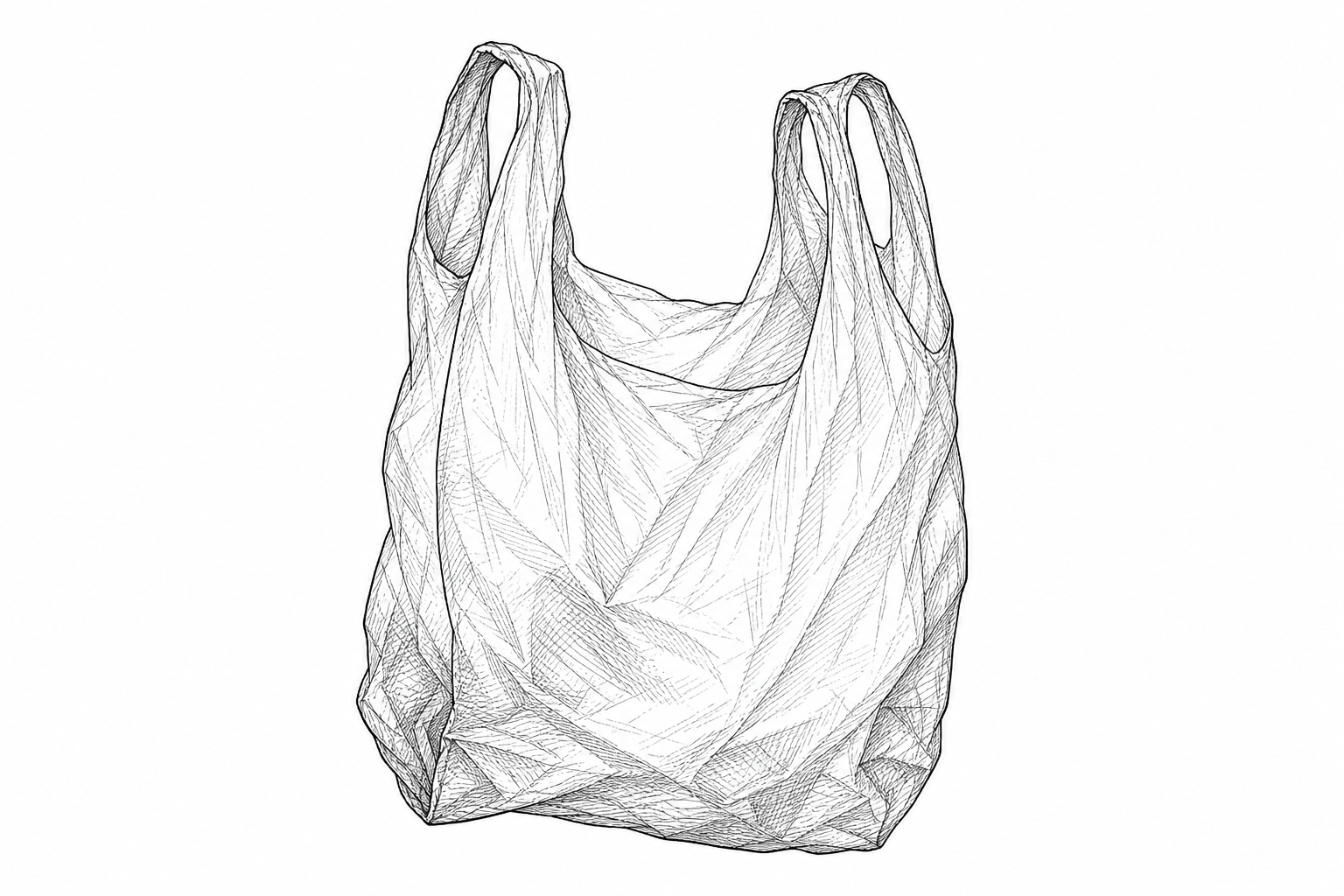
Film as thin structure. Illustrative only.