Polyethylene Film, Trash Tier
Liner gauge, seal geometry, and the compostable films that sit in the same aisle but are not PE.
- Volume
- 02
- Order
- № 03
- Read
- 12 min
- Published
Chapter 1 laid out the carry-tier polyethylene baseline: densities, blown film, stress whitening, and the carry-bag archetypes. This chapter routes the same chemistry through the trash tier: engineered liners, high-mil contractor sacks, and the compostable films that sit next to them in the aisle but are not polyethylene.
Can liners and flex garbage film
A grocery sack reused for trash is a different object than a sack engineered to be a trash sack. The dedicated can liner is a related but distinct PE product, and the modern liner has drifted well away from the LDPE grocery hand.
Modern can liners are predominantly LLDPE - linear low-density polyethylene, the same comonomer family used to stretch LDPE blends. LLDPE produces thinner, lighter liners that are stronger and more puncture-tolerant than the equivalent LDPE of a generation ago, which is why gauge alone is no longer a satisfactory strength claim on the box. Liner manufacturers grade LLDPE by comonomer: butene-LLDPE is the weakest film property tier; hexene-LLDPE yields high film strength with better tear resistance; octene-LLDPE is the upper grade. Cheaper liners ride on butene; the “heavy-duty” claim usually means hexene or octene under the hood. None of this is printed on the box.
A separate liner class uses HMW-HDPE - high molecular weight high-density PE, often coextruded with a small fraction (under 30%) of LLDPE for bubble stability on the line. HMW-HDPE is the resin behind the thin, crackly, almost cellophane-like institutional liner: the office-trash sack, the small bathroom liner, the bulk box at a warehouse club. It is excellent at carrying smooth, non-puncturing loads (paper, napkins, packaging) at low gauge. It tears easily once anything sharp gets to it. That is the trade.
Gauge conventions diverge between the two families. LLDPE and LDPE liners are sold in mils (thousandths of an inch); HMW-HDPE liners are sold in microns (25.4 microns per mil). A 0.9-mil “kitchen” bag, a 1.5-mil “tall kitchen heavy-duty” liner, and a 13-micron office-trash sack are three different gauge systems describing three different polymer specs. Manufacturer tolerance is typically ±10%, so the printed number is nominal.
Approximate LLDPE liner bands map to load capacity roughly as follows: 0.30 to 0.49 mil for small cans and around 10 to 20 lb static load; 0.50 to 0.74 mil for mid-size cans and 21 to 40 lb; 0.75 to 1.0 mil for larger cans and 41 to 60 lb; above 1.0 mil for sharp or heavy loads. HMW-HDPE bands run 6 to 9 microns for small cans and paper, 10 to 14 microns for mid-size cans and smooth heavy waste, 15 to 22 microns at the upper end. These are static-load numbers; real households drag, swing, and overstuff, and the dynamic load that actually breaks a bag is a smaller fraction of the static rating.
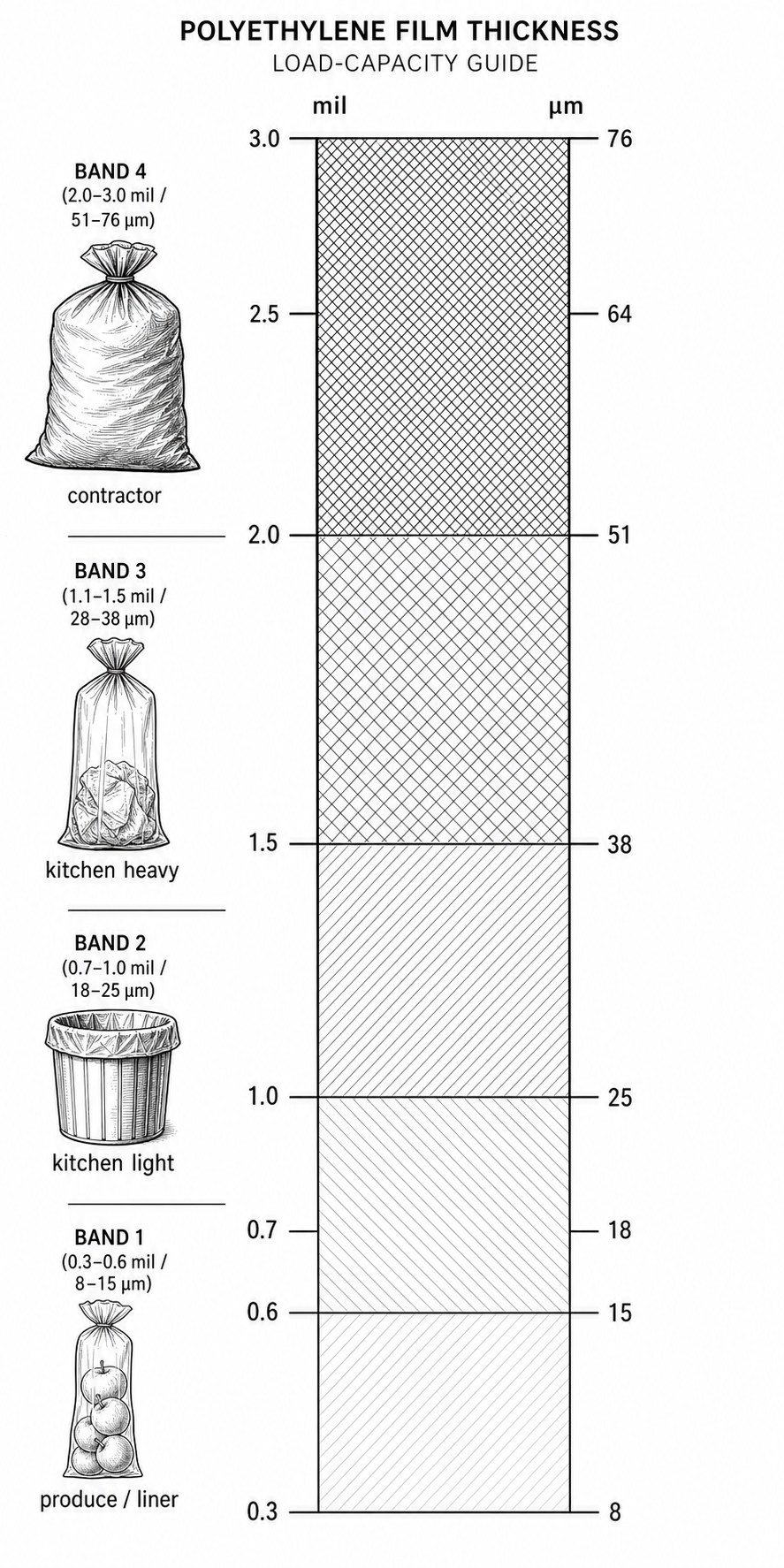
Mil for LLDPE/LDPE, micron for HMW-HDPE, side by side at the same load tiers. Illustrative only.
Seal geometry is a second-order variable that can dominate failure mode. Three seals recur:
- Star seal. No gussets. The bottom is folded into a six-point fan and heat-sealed in a star pattern, typically with a 120° fold angle. The result conforms to round containers, distributes weight around the bag, and removes the corner gaps where liquid can leak. Star seal is the modern default for round trash cans, and a well-designed star-seal liner at a given mil can outperform a thicker flat-seal liner in dart-impact testing - seal design carries more than gauge across that gap.
- Flat seal. The pillow-case bottom: one straight heat seal across the bottom edge. Cheap to make, simple to ship folded, and the only viable seal at very high mil where star folding is not physically possible. It is the seal on most contractor bags for that reason. The cost is leak risk at the corners and a bag that does not conform to a round can.
- Gusset (flat-bottom) seal. Both sides are tucked inward into folds; the bag opens into a rectangular footprint. Useful for square cans and roll-cart applications. The corner is sealed through four layers, while the middle is two: that thickness mismatch is a stress concentrator, and gusseted bags tend to fail first at the bottom corner gusset under dynamic load.
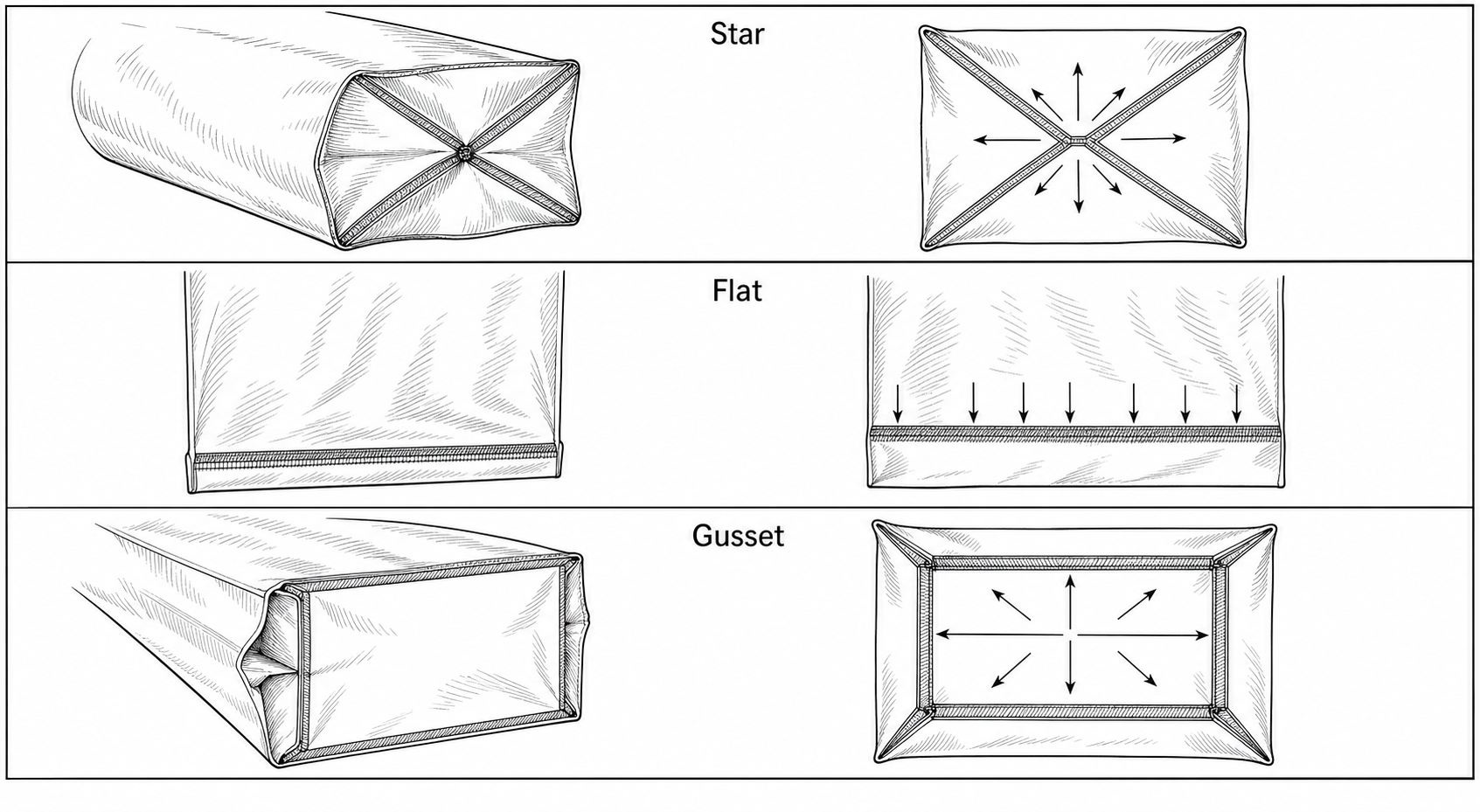
Star, flat, and gusset bottoms. Star is the modern liner default; flat dominates contractor-mil; gusset suits roll-cart geometry. Illustrative only.
The drawstring is its own miniature engineering problem. Traditional drawstrings were HDPE for tensile strength; modern designs use HDPE-LLDPE blend draw tapes with greater elongation before yield, and some are wave-shaped rather than linear, so the same tape spans a wider range of can diameters without snapping. The drawstring channel is also a load concentrator: when a full liner is lifted by the cinched draw tape, every gram of refuse routes through the narrow upper hem of the bag, so the channel hem is the first place to look for tear initiation on a heavy lift. Stress whitening across the hem before a haul is the same diagnostic it is anywhere else on a PE film.
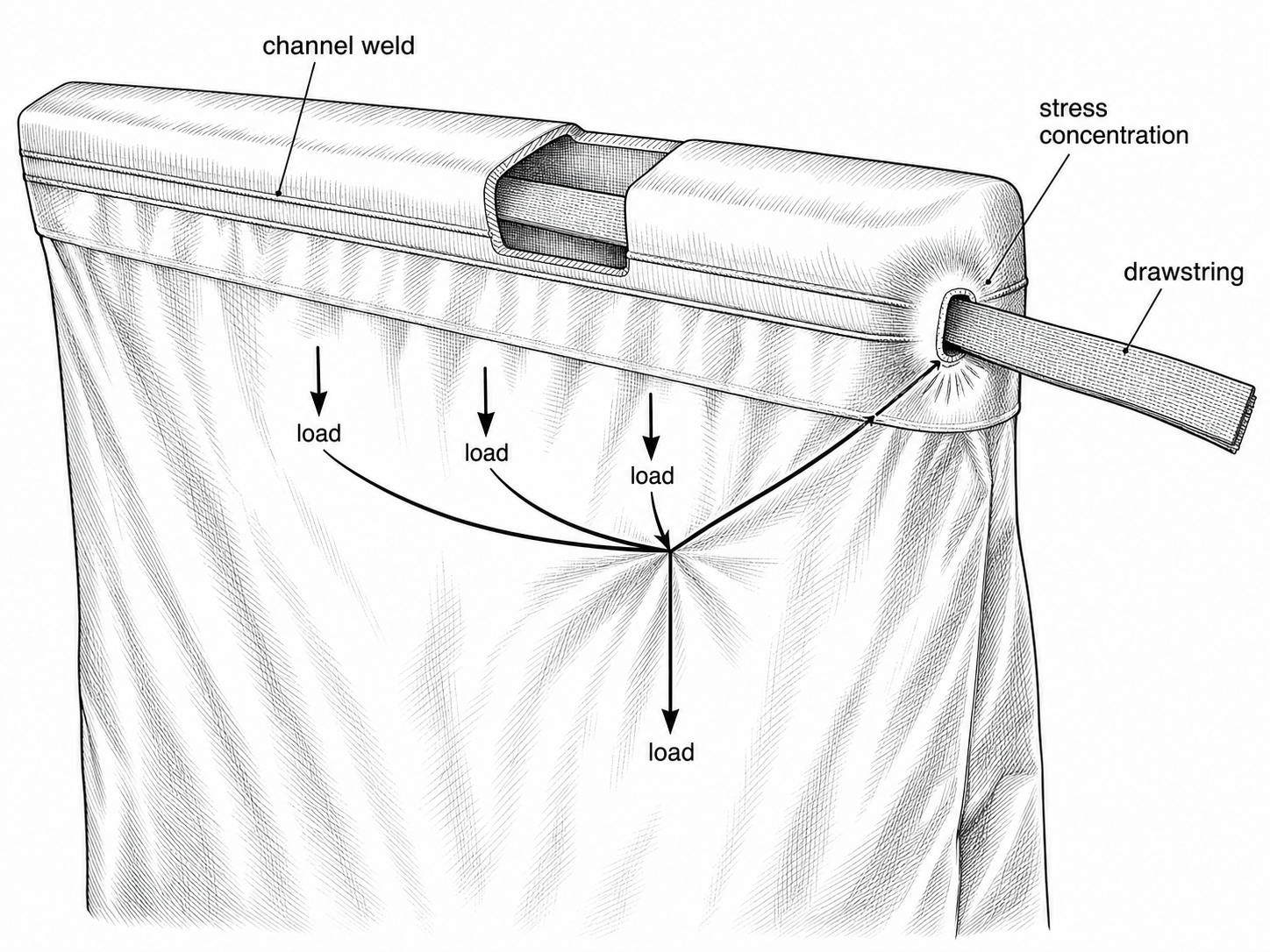
The drawstring channel as load concentrator: every gram routes through the upper hem on lift. Illustrative only.
Contractor film: high-mil PE
The contractor bag is the upper extreme of household-adjacent PE film. It is still polyethylene - usually LDPE or LLDPE - but the gauge band starts where can liners end. Extra heavy-duty contractor bags begin around 2.0 to 2.7 mil, suitable for broken glass, rough food waste, and sharper corners. Professional grades run 3.0 to 6.0 mil for construction and demolition debris: drywall scrap, nails, splinters of wood and metal, broken tile, roofing tear-off. A 3-mil bag is roughly three to four times the film thickness of a household tall-kitchen liner.
At those gauges the star seal stops being feasible - there is too much film to fold cleanly into a six-point fan - and contractor bags revert to flat seal or large gusset construction. That is one reason the bottom-corner gusset is the most common contractor-bag failure point under dynamic load. Drag a half-filled contractor bag across a deck by one corner and the stress concentrates exactly there.
The failure narrative on a contractor bag is puncture-then-propagate, not gradual yield. Thick LDPE has good puncture resistance for its gauge but lower tear-propagation resistance than its LLDPE cousin: once a nail or a wire end opens a notch in the film, the tear can unzip a long line. Stress whitening at the notch is the same diagnostic from earlier in this chapter, just at four times the thickness. The visible whitening is the bag finishing its yield budget along the propagating tear path.
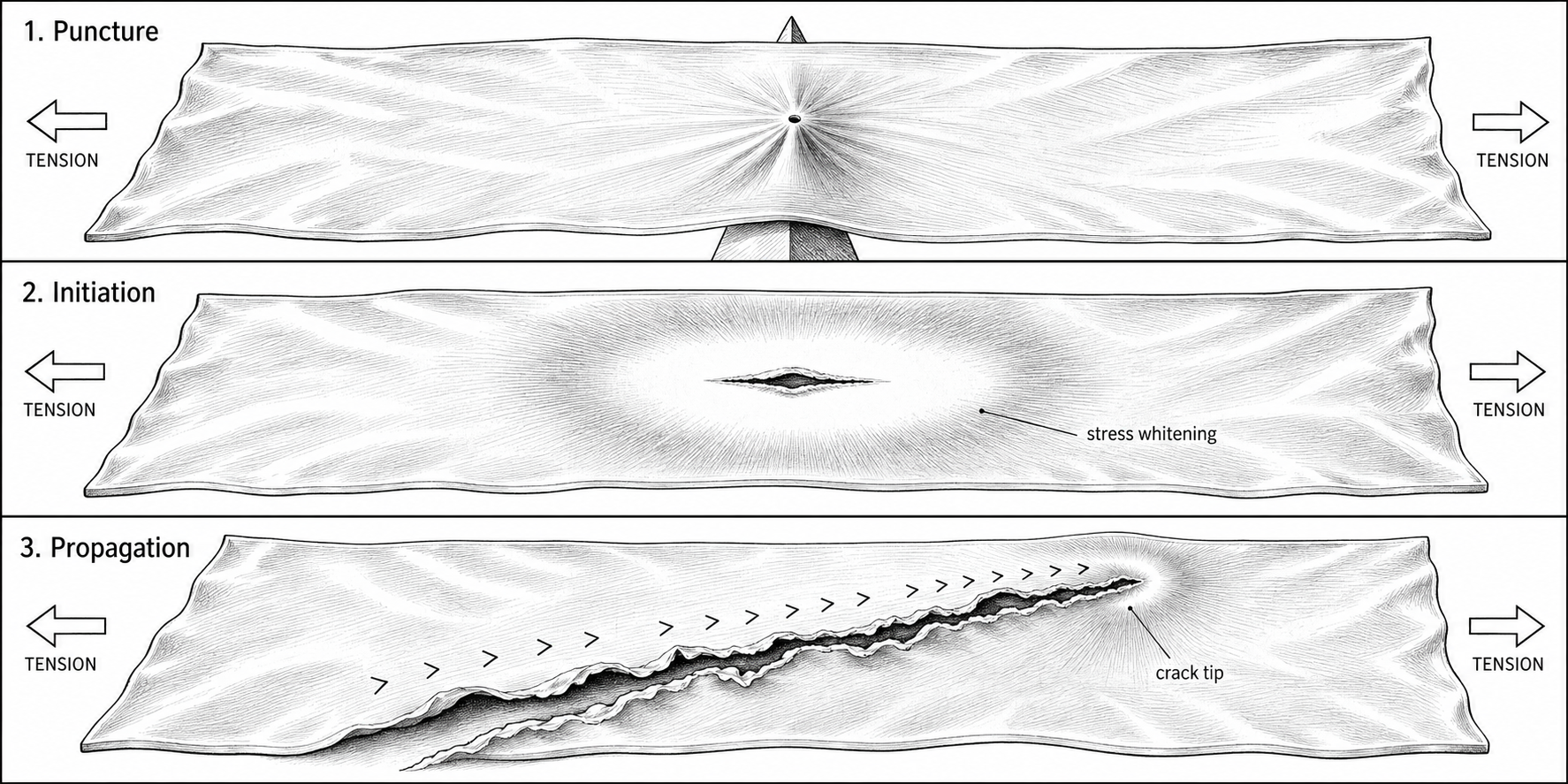
Puncture-then-propagate failure mode. Whitening tracks the tear path. Illustrative only.
Color is functional, not cosmetic. Most contractor bags are black, and black contractor bags are black because of carbon black pigment, not aesthetic preference. Carbon black absorbs UV and visible radiation across the spectrum and is the dominant UV stabilizer for PE film exposed to sunlight on a jobsite: it intercepts photons before they reach the polymer chains, slows photo-oxidation, and meaningfully extends outdoor service life relative to unpigmented PE. Loadings are typically in the low single digits by mass; too little gives insufficient UV coverage, and too much can crowd out antioxidant stabilizers and degrade other film properties, so the formulation is a balance, not a maximum. “Natural” (clear or hazy) and orange contractor bags exist for content-visibility and OSHA marking but do not get the same UV protection unless a separate stabilizer package is compounded in. A bag left in the sun behind a job trailer for the summer is doing chemistry the whole time.
Jobsite failure modes that recur, in roughly the order a foreman would name them: overfilling beyond the dry rating; sharp-edge puncture initiation mid-panel from nails, wire, or glass; bottom-corner gusset rupture under one-sided drag or lift; and hem tearout at the top when the bag is overfilled before the knot, so the knot rides over a stretched cuff. All four are the same chemistry as the kitchen-liner stories - yield, puncture, tear propagation, stress concentration at hems and seams - at higher mil and rougher cargo.
Compostable and biocompostable films
A bag labeled “compostable” is not made of polyethylene. The compostable trash and produce bag is a different polymer family, with different chemistry, different end-of-life pathway, and different failure modes than anything in the carry-tier polyethylene chapter. Reading a compostable bag through a PE lens is the most common confusion in the trash aisle, and it is the one this book wants to defuse.
The polymer set:
- PLA, polylactic acid. Bio-based (corn starch or sugarcane fermentation), relatively stiff (tensile strength 50 to 70 MPa), and brittle on its own - 2 to 10 percent elongation at break. Unsuitable as a neat film for flexible bags. Industrially compostable only: it needs sustained thermophilic conditions (around 55 to 60°C) to hydrolyze in a reasonable window. Home compost piles rarely get there.
- PBAT, polybutylene adipate terephthalate. Petroleum-derived, biodegradable. Soft and stretchy: tensile strength 10 to 20 MPa, elongation greater than 500 percent. PBAT is the flexibility component in almost every commercial compostable bag - the reason a PLA-PBAT blend feels like a bag at all instead of a brittle sheet.
- PBS, polybutylene succinate. Better heat tolerance than PLA, good film processability, fully biodegradable in industrial and some home composting conditions. Often used in blends with thermoplastic starch.
- PHA / PHB, polyhydroxyalkanoates. Naturally produced by bacterial fermentation. Biodegradable in marine, soil, and home composting environments - the only family in this list that biodegrades reliably outside an industrial facility. Brittle, narrow processing window, expensive. Currently a small share of commercial compostable bag film.
- TPS, thermoplastic starch. Starch plasticized with glycerol; cheap, highly water-sensitive, mechanically weak as a neat material. Used as a hydrophilic carrier in blends with PBAT, PBS, or PLA to accelerate water uptake and biodegradation.
A typical commercial compostable trash or produce bag is a PLA-PBAT blend or a TPS-PBAT blend: PLA or starch for stiffness and bio-content, PBAT for the flexibility and seal behavior that makes it a usable film. None of these polymers are polyethylene, and none of them should enter a PE film-recycling stream. A clear PLA bag visually resembles LDPE; the recycler’s bale does not care, and a few percent PLA contamination can damage the resulting recycled-PE product. Compostable films routed into store drop-off film bins are not recycling: they are contamination.
Industrial vs home composting is the most important practical distinction. Industrial (municipal) composting facilities maintain thermophilic temperatures around 55 to 60°C with controlled aeration, moisture, and turnover. PLA, most PBAT blends, and PBS biodegrade meaningfully under those conditions, typically within 90 to 180 days. Home composting runs at ambient mesophilic temperatures (roughly 20 to 30°C) with no forced aeration and consumer-grade management. Most PLA-containing items certified only for industrial composting will not visibly disintegrate in a backyard pile in any practical timeframe. PHA blends, some PBS blends, and TPS-rich films are the home-compostable cases, and they are still climate- and pile-management-dependent.
Certification vocabulary, in plain language:
- ASTM D6400 (United States, broadly aligned with ISO 17088) and EN 13432 (Europe) are the industrial compostability standards. Both require roughly 90 percent biodegradation to CO₂ within six months, disintegration of the test material in around 12 weeks (with residues on a 2 mm sieve below 10 percent of the original mass), ecotoxicity testing, and limits on regulated heavy metals. The two standards are broadly aligned for most products, though they are not strictly identical in scope. Neither covers home composting.
- BPI (Biodegradable Products Institute) is the dominant North American third-party certification mark to ASTM D6400. A BPI logo on the bag means an industrial composting facility, not a backyard.
- TÜV Austria OK compost INDUSTRIAL is the European third-party mark to EN 13432.
- TÜV Austria OK compost HOME, and the derived standards EN 17427 (Europe, carrier bags) and AS 5810 (Australia), are the home-compostability certifications. They test biodegradation at ambient temperatures, allow longer disintegration windows (12 months versus 12 weeks), and have stricter ecotoxicity expectations.
- “Biodegradable” without further qualification is not the same as “compostable.” Under FTC Green Guides, an unqualified “biodegradable” claim on a trash bag that ends up in a landfill is deceptive marketing: landfills are oxygen-limited environments where neither PE nor compostable polymers reliably degrade.
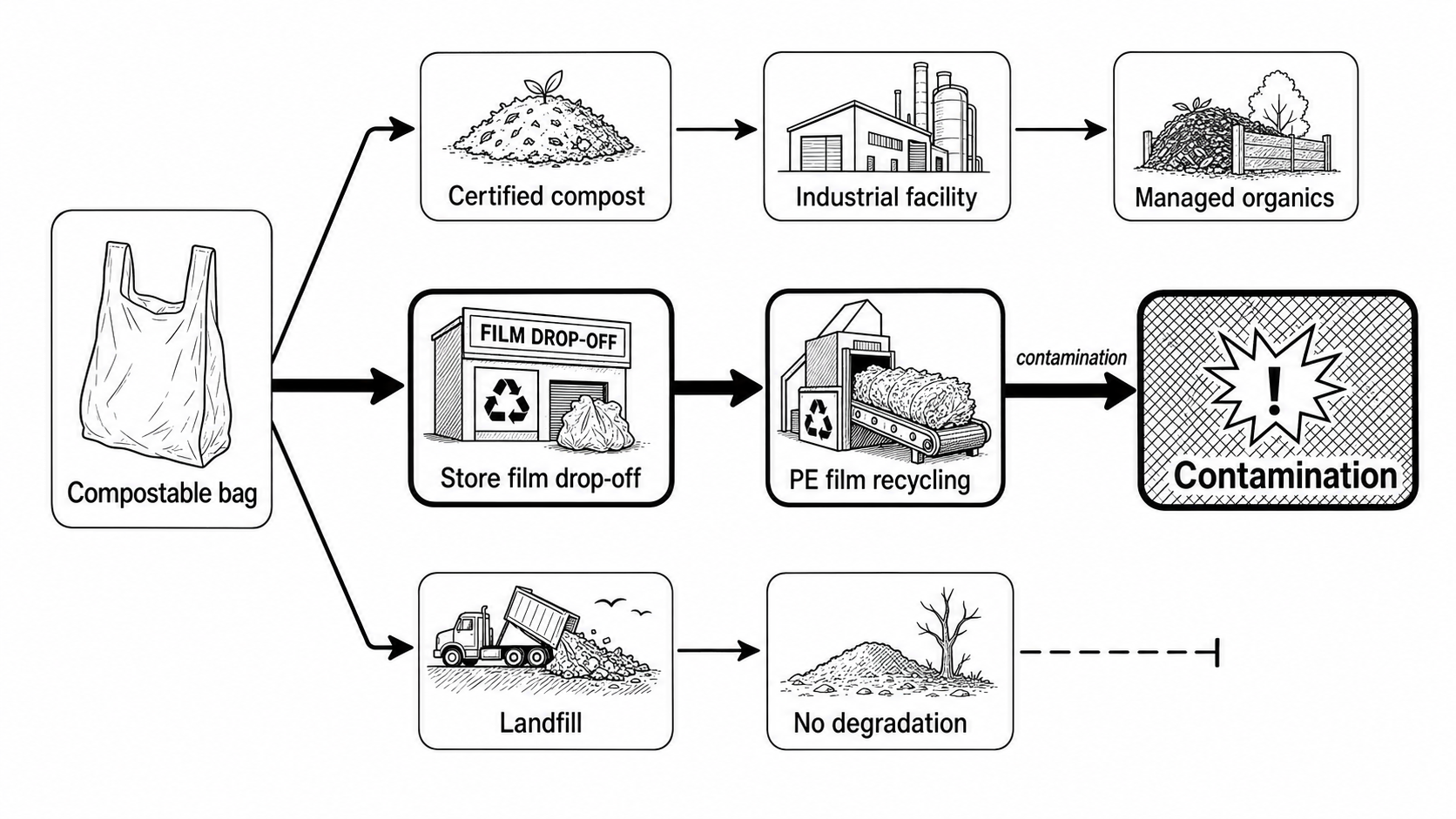
Where a compostable bag actually ends up. Industrial composter is the named target; the contamination route into PE film recycling is the failure mode. Illustrative only.
A compostable bag delivers its end-of-life benefit only if it reaches the correct facility. In landfill, a compostable bag behaves about as durably as a conventional PE bag and contributes the same anaerobic methane signature as other organic material trapped under cover. Well under a quarter of US composting facilities accept compostable packaging, and only single-digit percentages of municipal residential programs in the largest US cities route compostables to one of them. In jurisdictions without curbside organics that accept bioplastic bags, the most honest use is as a produce-and-food-scrap collection bag inside a home compost system that already runs hot, or as a tied-off transfer bag for a drop-off organics program that explicitly accepts certified compostables. Outside of those routes, the chemistry does not get to do its job.
What this book will not claim: that a compostable bag is a free upgrade over an LDPE sack in a household without organics infrastructure; that “biodegradable” on a label means anything more specific than “marketing wanted to be there”; that a home pile in February in a temperate climate will disintegrate a PLA-PBAT bag in a publishable timeframe. The chemistry is real. The infrastructure is the limiter.
Film in the inventory: trash tier
Three more PE-film objects belong in the inventory but are described plainly rather than nicknamed; they are commodity, single-role, and the household read on them is one paragraph each.
The dedicated can liner. LLDPE (hexene or octene grade in the better SKUs), 0.6 to 1.1 mil for a kitchen-tall liner, star-seal bottom, sometimes drawstring. Distinct purchase, not a reused grocery sack. Failure mode is hem tearout at the cinch or stress whitening across the draw channel after the bag has been swung too hard. Routinely sold under “heavy-duty” or “extra-heavy” SKUs that translate to a specific mil band and a specific seal geometry, not to a strength claim that survives cross-brand comparison. The household lesson is the same as the grocery-sack lesson: trust the gauge band and the seal type, not the adjective.
The contractor bag. LDPE or LLDPE at 2 to 6 mil, flat or gusseted bottom, black with carbon black for UV. Lives in the garage, the basement project corner, or the back of a hatch. Single-trip per fill but the role itself is durable: yard debris, demolition scrap, deep-clean purges. Failure mode is puncture-then-propagate from a nail or shard, or bottom-corner rupture under drag. A contractor bag overfilled is still a contractor bag; the failure is just earlier.
The compostable sack (separate object). PLA-PBAT or TPS-PBAT blend, not PE. Found in the produce aisle next to the half-mils, in some municipal organics programs, and as a marketed kitchen-caddy liner. The chemistry is real but routes through industrial composting unless the bag carries an explicit OK compost HOME or EN 17427 mark. Mishandled, it goes into the PE film recycling stream and contaminates it. Its presence in the drawer is best limited to actual organics-program use; otherwise the bag just sits there hoping for an infrastructure it does not have.