Paper and Kraft
Fiber, sizing, and the afterlife of brown bags.
- Volume
- 02
- Order
- № 06
- Read
- 3 min
- Published
Paper sacks are cellulosic: wood pulp fibers hydrogen-bond into a network. Kraft is a pulping process (German for strength) that uses sodium hydroxide and sodium sulfide to dissolve lignin while preserving the long cellulose fibers. The result is the characteristic brown, high-tear sack: longer fibers, more inter-fiber bonds, more tear resistance than the short-fiber pulp behind newsprint.
Tear propagation
Paper fails by tear, not yield. Once the fiber network is breached at a notch (a fold corner, the inside of a handle punch, a crease from being folded flat under heavier bags), energy concentrates and runs. Tear resistance is fiber length plus inter-fiber bonding plus the angle of the tear path. Kraft is good at all three until water shows up.
Wet paper loses hydrogen bonding almost instantly. Water molecules slip into the inter-fiber junctions, displace the hydrogen bonds that were holding the network together, and the sheet collapses to a fraction of its dry strength. Dry kraft is predictable. Rainy parking lots are where the romance dies.
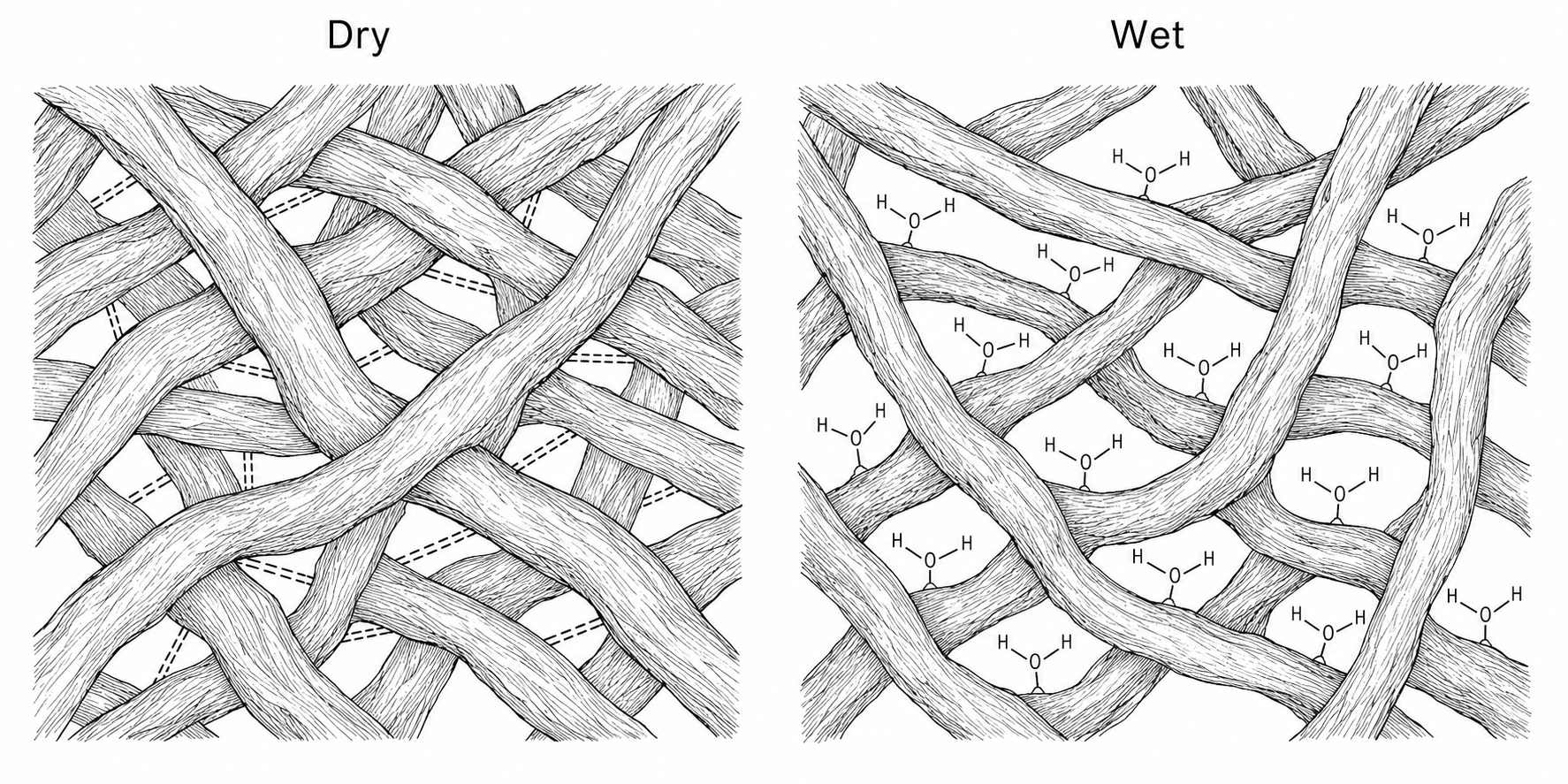
Water disrupting hydrogen bonds in the kraft fiber network. Illustrative only.
Wet-strength agents
Some kraft sacks survive light rain in ways that look impossible for plain paper. The trick is usually a wet-strength agent added at the wet end of the paper machine. The dominant chemistry is PAE resin (polyamide-epichlorohydrin), which forms covalent crosslinks between cellulose fibers that are not water-reversible. PAE-treated kraft retains roughly 10 to 30% of its dry tensile strength when wet, instead of the near-zero of untreated kraft.
You can sometimes feel it: PAE-treated kraft has a slightly stiffer hand and a less papery rustle than untreated. The line between true paper and paper-shaped composite runs through this additive. A grocery kraft that survived a five-minute walk in drizzle did not survive because of the fiber. It survived because of the resin.
Coatings
Some promotional kraft uses clay coatings, wax, or thin polymer films for print gloss or moisture resistance. Behavior shifts toward composite, not pure fiber, and the recycling stream gets pickier. Clay coatings are usually fine for curbside paper; wax-impregnated kraft (the old butcher-paper register) often is not; polymer-laminated kraft (the very glossy gift bag) is often not paper-stream at all.
Handle attachment geometry: where bags actually die
Kraft sacks die at the handle, never at the panel. Three handle patterns recur:
- Twisted-cord handles, glued or stapled to a reinforcement patch on the sack interior. The cord itself is strong; the failure point is the patch-to-sack adhesive bond, which peels away when wet or when overloaded with a swinging weight. The Sunday Kraft mode.
- Flat tape glued handles, common on retail gift bags. Slightly weaker than twisted cord under sustained load, similar peel-failure mode.
- Die-cut hand-hole (no separate handle, just a punched oval through the sack). The cheapest pattern. The fuse is the tear initiation at the corners of the die-cut, where stress concentrates against the grain of the paper. Die-cut hand-holes are nearly always the first failure point on a loaded sack, and the reason most “sturdy paper bag” experiences end at the threshold of the kitchen.
The household read: when picking up a heavy paper sack, watch the geometry under the handle. If the patch starts to lift, you have ten more seconds.
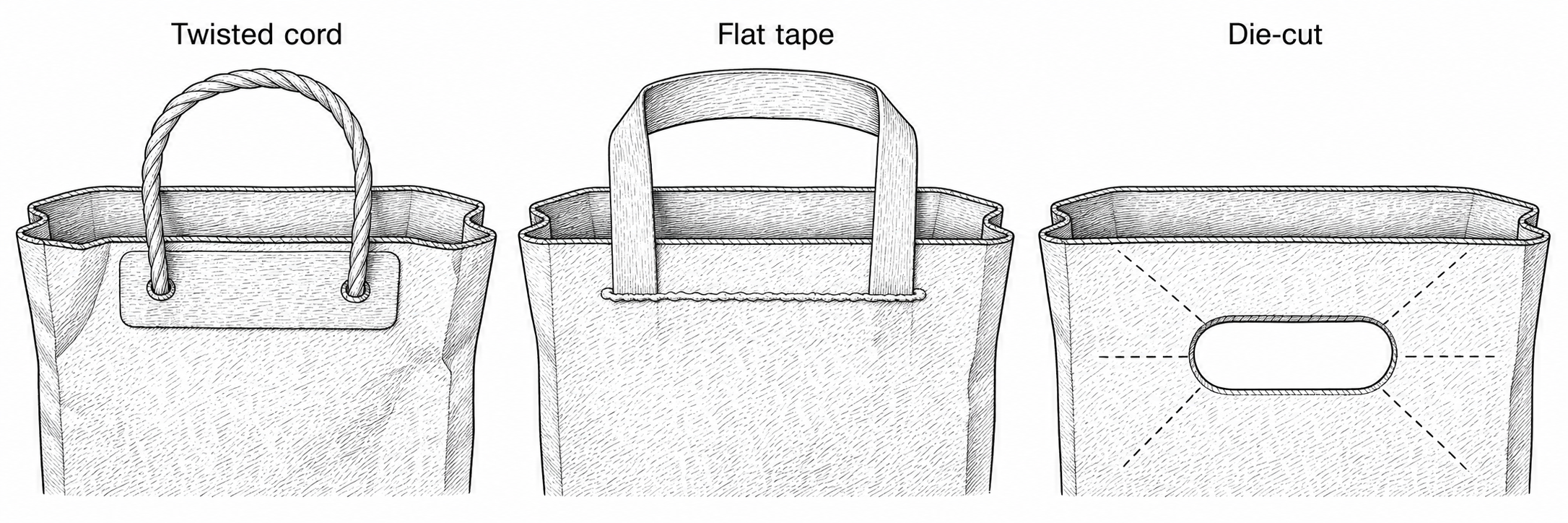
Three kraft handle patterns with failure point annotations. Illustrative only.
Kraft in the inventory
Two archetypes pass through my drawer.
The Sunday Kraft. Two-ply unbleached kraft from the farmers-market and the better grocery runs, twisted-cord handles glued to an interior reinforcement patch. PAE-treated, by feel. Mine survives single trips well, develops fold creases at the base after one or two reuses, and gets demoted to either kindling or under-sink scrap-bin liner around trip three. Status: high turnover, dignified retirement.
The Boutique Kraft. Glossy clay-coated retail gift bag, sometimes ribbon-handled, sometimes tape-handled, often with a die-cut top edge and a cardboard base insert. Optimized for one trip from store to recipient. Mine, when they come home, do exactly one duty as decorative scrap bins before the surface coating starts to rub off in patches. Status: single-use by design, kept briefly for gift-wrap relay.
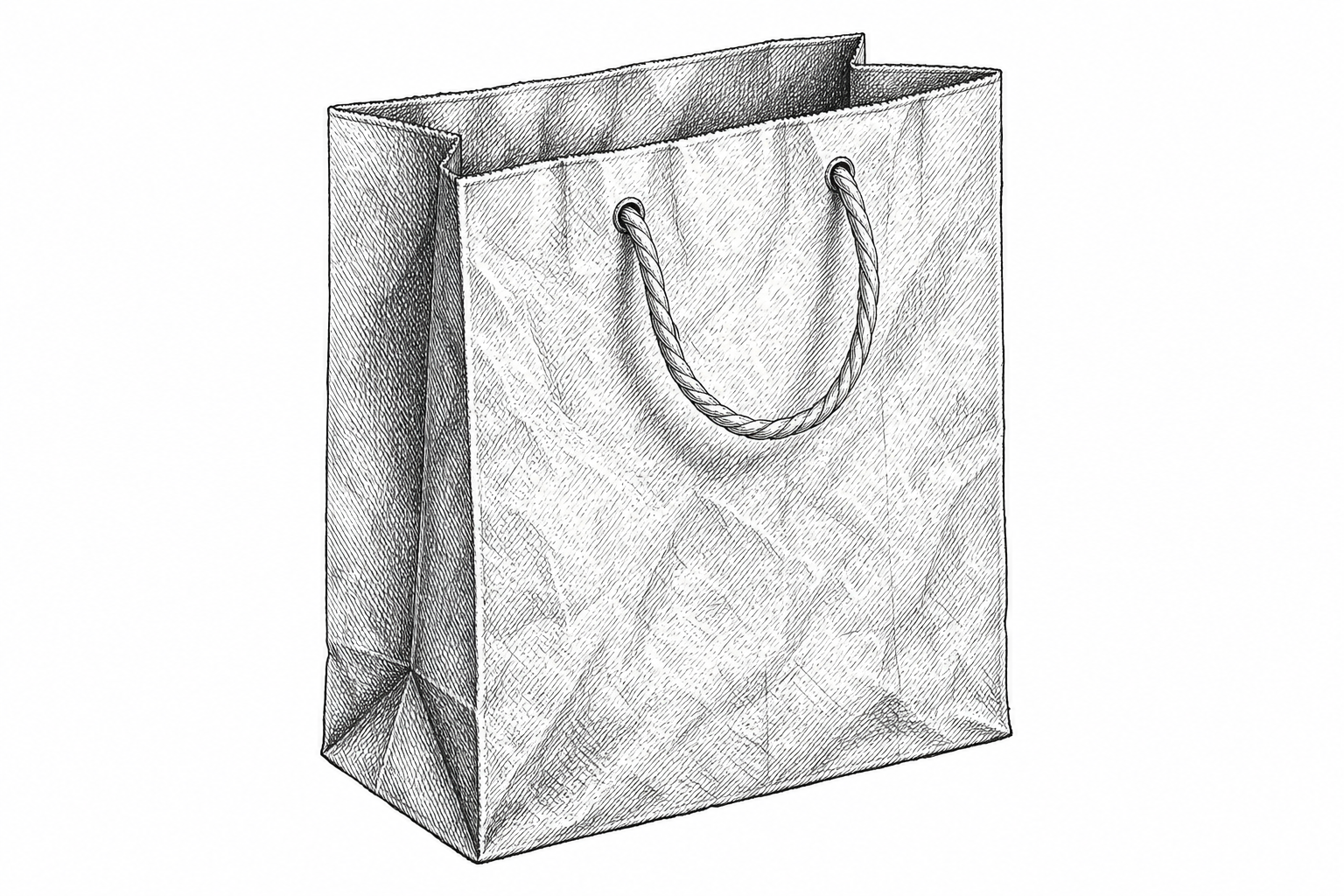
Tear geometry and fiber direction. Illustrative only.