The Dimensions
Five behavioral axes, and why asking what people did beats asking what they are.
- Volume
- 05
- Order
- № 02
- Read
- 6 min
- Published
Why Five Axes
The obvious comparison is Myers-Briggs: four dichotomies, sixteen types, a tidy matrix that feels comprehensive. The objection to that framing is not merely aesthetic. Pittenger’s peer-reviewed review of the MBTI literature concluded that available evidence provides insufficient support for the instrument’s tenets and utility claims. A 2023 open-access study found that the relationship between MBTI type and leadership-practices outcomes was weak. The critique is not that personality taxonomy is illegitimate - it is that fixed type systems built on thin empirical foundations tend to generate compelling narrative at the expense of predictive accuracy. If the goal is to describe carry behavior reliably, the taxonomy needs to be built on behavioral evidence, not on which categories feel right to the person designing the quiz.
Five axes emerged not from theory but from the community. The carry discourse, if you read it long enough, clusters around five recurring tensions: how much to bring, how much to know about what you’re bringing, how settled the system is, how many bags are in the system at any given time, and how clearly each bag’s role is defined. These five tensions are not independent - they correlate in interesting ways, and some positions on one axis predict positions on others - but they are distinguishable. A person can sit at the maximizer end of Load Philosophy while sitting at the Spec-Fluent end of Material Awareness, and can do so while occupying a Locked-in position on System Stability. The axes measure different things. Five covers the key variance in carry behavior without over-segmenting into the kind of hair-splitting that produces fourteen clusters of which eight are populated by fewer than three respondents.
Four axes would miss something important. Three axes would collapse distinctions the community clearly cares about. Six would begin to measure the same variance twice. Five is a hypothesis about the structure of carry behavior. The poll will test it.
Polling Methodology: Behavior Before Identity
The instrument is designed hypothesis-first. That means: define what you are measuring before you ask a question, then ask the question that measures the behavior rather than the identity.
The distinction matters because socially admired carry identities - minimalist, prepared, disciplined, “done searching” - are particularly vulnerable to social-desirability bias. Pew Research Center identifies this as the tendency to provide inaccurate answers in order to be accepted or liked, and notes that survey mode, question wording, and response options can all affect honesty. In a community where minimalism and system-discipline carry social cachet, an identity-framed question (“Do you consider yourself a minimalist?”) will overcount minimalists, because claiming minimalism is the admired response. A behavior-framed question (“How many items did you carry in your bag last Tuesday?”) produces a noisier but more honest distribution.
DeBell et al.’s work on voter-turnout overreporting provides a useful calibration. They found that wording informing respondents about possible validation reduced self-reported turnout by 5.7 percentage points in one study and by 4 points in two nonprobability samples - illustrating that even behavioral self-reports can overstate socially desirable behavior. The carry community polls planned for this volume will use anonymous web collection, neutral language, balanced response options, and “not applicable” answers. Even so, every frequency claim that depends on those results carries [PLACEHOLDER: poll N / wave date] until the data exists.
A further methodological caution: cluster algorithms will produce clusters from any dataset, regardless of whether the data contain meaningful structure. Dolnicar’s guidance on cluster analysis warns that uncritical partitioning produces results that look definitive regardless of sample quality. The archetypes in Chapters 2–6 are therefore framed as candidate behavioral clusters - hypotheses about where the community’s axis positions tend to concentrate - not as discovered natural types. The plan is to use Wave 1 for instrument pretesting and axis candidate validation, Wave 2 for clustering, and Wave 3 or split-sample resampling for stability checks. For a five-axis model, Dolnicar, Grün, Leisch, and Schmidt recommend at minimum 70 responses per segmentation variable - meaning a conservative target of at least 350 usable responses before claiming stable five-axis clusters [PLACEHOLDER: poll N / wave date].
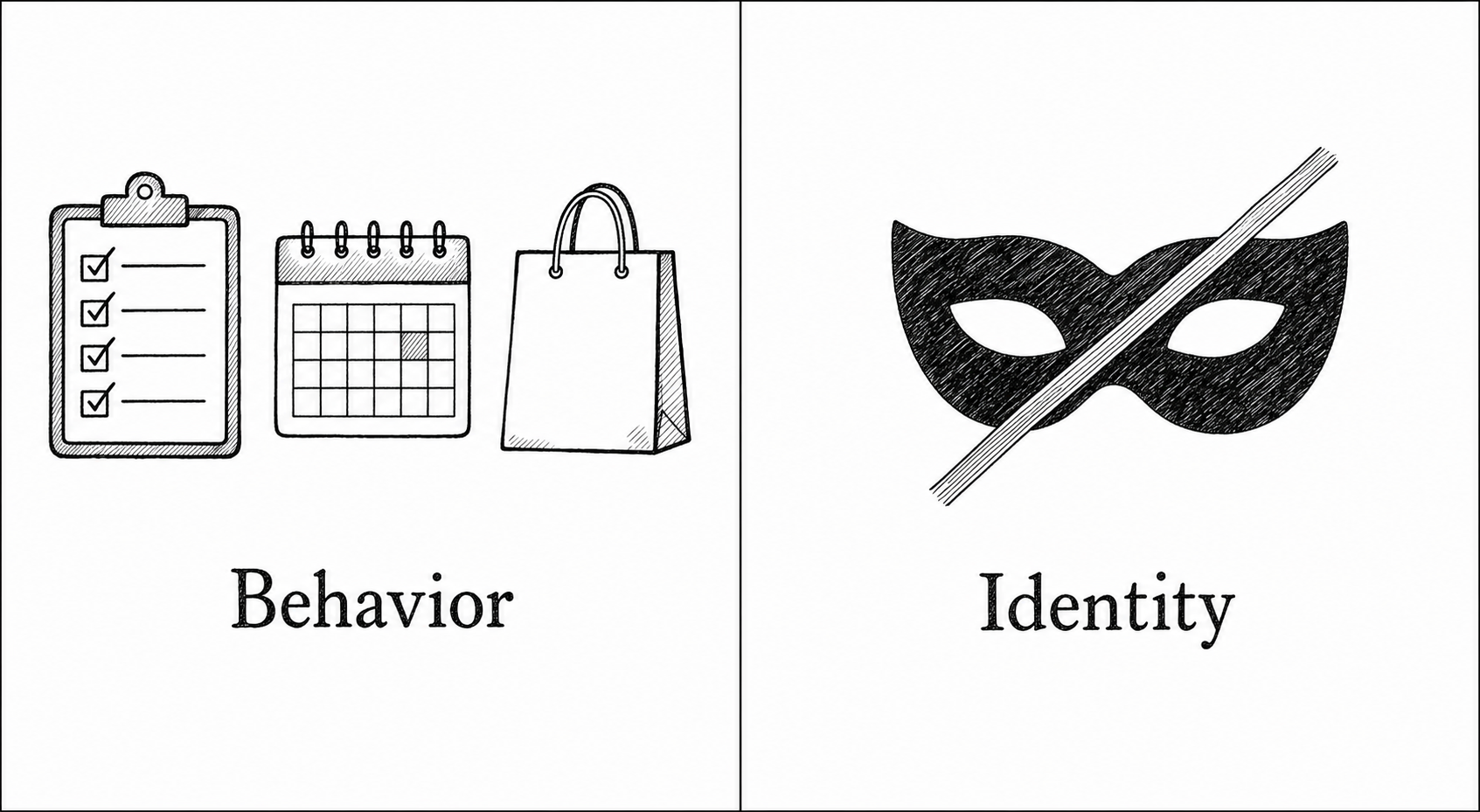 Behavior, not identity. Illustrative only.
Each Axis Defined
Load philosophy: Minimizer ↔ Preparedness maximizer. At the Minimizer end sits the person who flew to Europe for a week with a single 18L bag - not because they had to, but because they chose to, and because the constraint itself was the point. The carry-on gate check is a personal failure, not an inconvenience. At the Preparedness end sits the person who packed a dedicated rain jacket pouch, a dedicated tech organizer, a dedicated first aid kit, and a pouch for the pouch - not because anything bad has happened, but because the system is built around the recognition that things could. Neither position is irrational. The axis measures carry philosophy, not judgment.
Material awareness: Chemistry-blind ↔ Spec-fluent. At the Spec-Fluent end sits the person who reads the laminate stack article, notices when a manufacturer switches face-fabric constructions, and distinguishes AquaGuard® water-resistant from waterproof as a point of practical honor. At the Chemistry-blind end sits the person who calls it “the good nylon one” - and who is not wrong, exactly, because the bag works fine and the name is sufficient for their purposes. The axis does not reward Spec-Fluency; it merely locates it. You can be a Minimizer who knows every denier in their one bag, or a Preparedness maximizer who has never looked at a spec sheet. Material awareness and load philosophy are independent.
System stability: Perpetual-search ↔ Locked-in. At the Locked-in end sits the person who has carried the same three bags for four years and has no plans to change - not out of inertia, but because the system works and the question of whether something better exists is not especially interesting to them. At the Perpetual-search end sits the person whose rotation has changed significantly in the past twelve months and who experiences this not as failure but as the natural state of an ongoing calibration. The axis measures how settled the system is, not whether the person is capable of commitment.
Acquisition pattern: Accumulator ↔ One-in-one-out. At the Accumulator end sits the person whose bag shelf holds twelve bags in active-ish rotation, none of which are being sold because they might come back into use. At the One-in-one-out end sits the person who sold or retired a bag before buying this one and expects to do the same next time. This axis is correlated with System Stability but is not identical to it: a Locked-in carrier can still be an Accumulator if they locked in to a large system.
Use-case discipline: Overlap-tolerant ↔ Zero-overlap strict. At the Zero-overlap end sits the person whose gym bag does not become their weekend bag under any circumstances - those are different roles, they require different configurations, and conflating them means neither role is served well. At the Overlap-tolerant end sits the person for whom a bag is a bag and the role is determined by what you put in it on a given day. The axis measures system design philosophy. Both ends of this axis are valid carry strategies.
How Placement Works
Axis placement is population-relative and contextual. The Spec-Fluent designation means something compared to the general bag-buying public and something different compared to a textile engineer or a gear journalist. The quiz in the appendix is calibrated against community respondents - the population being described - not against experts or novices. A mid-range score on Material Awareness means “toward the middle of the carry-community distribution,” which is already a fairly knowledgeable position compared to the general public.
Placement Drifts
The quiz is designed to be retaken annually. Carry behavior changes with life stage, employment, travel frequency, and how recently a person discovered a new community thread or made a purchase that shifted their perspective. The person who was a committed Minimizer during a travel-heavy period may drift toward Preparedness during a period of commuting with variable gear needs. The person who was a Perpetual Searcher for three years may achieve a Locked-in system when they find a bag that resolves the open variables. Axis placement is a snapshot, not a character verdict.