Self-Assessment Quiz + Archetype Map
Twenty questions about what you did recently, not about what kind of bagger you are.
- Volume
- 05
- Order
- № 10
- Read
- 8 min
- Tags
- appendix · inventory
- Published
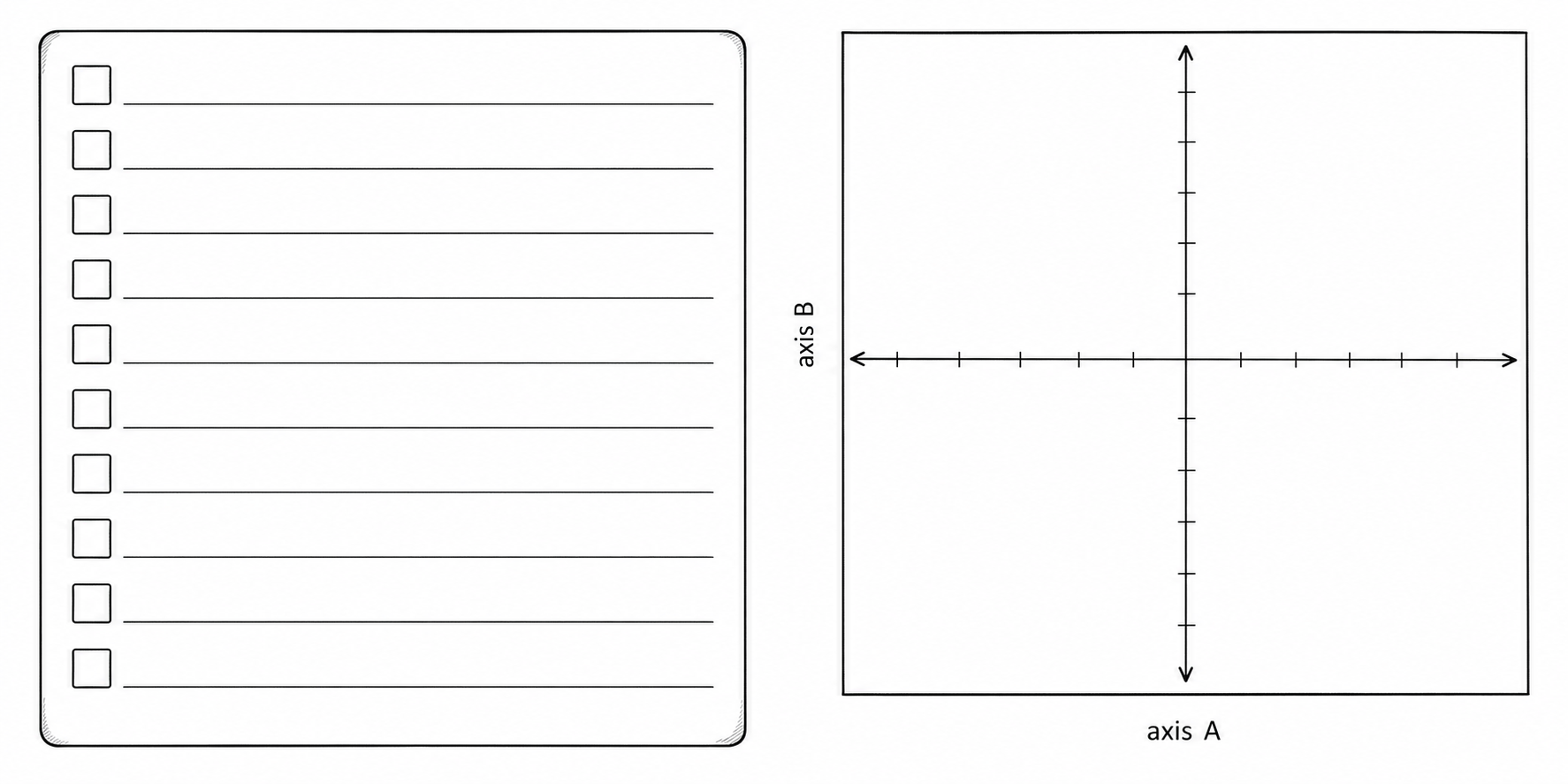 Placement drifts - retake yearly. Illustrative only.
About This Quiz
Twenty questions across five axes. Each question probes a recent, specific behavior - not a self-image, not a general tendency, but something you did or did not do in a defined time window. The answers are not evaluated as better or worse. They locate a position on each axis, population-relative, based on responses from community polling [PLACEHOLDER: poll N / wave date].
The community-sourced archetype map - a scatter plot showing where actual respondents from the carry communities land across the five axes - will be added here after Wave 1 polling is complete [PLACEHOLDER: community-sourced archetype map - to be added after poll wave 1].
The quiz is designed to be retaken annually. Carry behavior changes with life stage, travel frequency, and time in the community. A placement from two years ago is not necessarily wrong; it may simply be out of date.
Instructions: Answer each question based on the last 30 days, or the most recent comparable period if the last 30 days were atypical. If a question does not apply to your current situation, select “not applicable.” Read each question once, answer intuitively, and proceed. Over-deliberating on behavioral questions introduces the same self-flattery bias the instrument is designed to avoid.
Axis I: Load Philosophy (Minimizer ↔ Preparedness Maximizer)
Q1. In the last 30 days, on a typical day out (not travel), how would you describe what you carried?
- (a) The minimum I could identify: keys, wallet, phone, one small bag
- (b) A moderate carry: the essentials plus a few items for foreseeable needs
- (c) A considered loadout: I carry items for a range of scenarios I’ve thought through
- (d) A thorough carry: I have items for unlikely-but-possible situations and I’m comfortable with the weight
Q2. On your last trip of more than two nights, how many bags did you check or gate-check?
- (a) None - everything went carry-on in one bag
- (b) None - everything went carry-on across two bags
- (c) One checked bag; carry-on for essentials
- (d) Not applicable - I haven’t traveled recently
Q3. How would you describe your attitude toward “just in case” items?
- (a) I actively remove them from my kit
- (b) I carry one or two and feel mildly guilty about them
- (c) I carry them when the scenario justifies it
- (d) Several of my regular carries are “just in case” items that have earned their place
Q4. What is the approximate loaded weight of the bag you carried most last week?
- (a) Under 1kg
- (b) 1–2kg
- (c) 2–4kg
- (d) Over 4kg / I don’t know and haven’t checked
Axis II: Material Awareness (Chemistry-Blind ↔ Spec-Fluent)
Q5. What is the primary face fabric of the bag you used most in the last week?
- (a) I know the specific fabric, denier, and construction
- (b) I know the general material (e.g., nylon, polyester) but not the spec
- (c) I know what it feels like; I couldn’t name the material
- (d) I genuinely don’t know and haven’t thought about it
Q6. Before your most recent bag purchase, which specifications did you check? (Select all that apply and note roughly how many you checked)
- Denier / fabric weight
- Laminate or coating type
- Zipper brand and model
- Hardware brand or rating
- None of the above
Q7. The term “AquaGuard®” refers to which of the following?
- (a) A waterproof zipper - sealed against water ingress
- (b) A water-resistant zipper - polyurethane coated, not sealed
- (c) A brand name for a specific bag waterproofing treatment
- (d) I don’t know
Q8. When you encounter a bag in a store or online, what is typically the first thing you look at or for?
- (a) Material spec or construction detail
- (b) Volume and dimensions
- (c) Layout and pocket structure
- (d) Aesthetic and colorway
Axis III: System Stability (Perpetual-Search ↔ Locked-In)
Q9. How many bags in your current rotation changed their primary role in the last 12 months?
- (a) None - my system has been stable
- (b) One
- (c) Two or three
- (d) More than three, or I’m not sure - the rotation has been in flux
Q10. Complete this sentence: “The bag I use most often for daily carry is ____.”
- (a) The same bag I was using 2+ years ago
- (b) A bag I’ve had for 6–24 months and plan to keep
- (c) A bag I’ve had for less than 6 months; I’m still assessing it
- (d) Not settled - I’ve switched daily-driver bags more than twice in the last year
Q11. In the last 12 months, have you posted - or seriously considered posting - something equivalent to “I think I’ve found my final bag”?
- (a) No, and the concept of a “final bag” doesn’t really apply to me
- (b) No, but I understand the impulse
- (c) I’ve thought it without posting it
- (d) Yes - and I stand by it / or I’ve since revised the position
Q12. When you imagine your carry system in two years, what feels most accurate?
- (a) Roughly the same bags I have now
- (b) One or two changes - replacing what wears out or a specific gap filled
- (c) Significant evolution - I’m actively looking for a replacement or addition
- (d) I can’t predict; the system changes when I find something better
Axis IV: Acquisition Pattern (Accumulator ↔ One-In-One-Out)
Q13. How many bags do you currently own? (Count all bags you would consider active, stored-but-possible, or in transit)
- (a) 1–3
- (b) 4–7
- (c) 8–12
- (d) More than 12
Q14. When you last acquired a new bag, did you retire or sell one first?
- (a) Yes - I sold or donated a bag before or simultaneously with the purchase
- (b) No, but I retired one shortly after
- (c) No - the new bag filled a gap; nothing was retired
- (d) No - I’m comfortable owning more bags than I sell
Q15. Do you have a box, shelf section, or storage area of bags described as “retired but possibly returnable”?
- (a) No - when I retire a bag I sell or donate it
- (b) Yes, one or two
- (c) Yes, three to five
- (d) Yes, and “possibly returnable” is doing a lot of work in that description
Q16. In the last 6 months, how many bags have you bought, sold, or traded through BST (buy/sell/trade) communities or equivalent channels?
- (a) None - I don’t use BST communities
- (b) One transaction
- (c) Two or three transactions
- (d) Four or more transactions; BST is a regular part of how I manage the rotation
Axis V: Use-Case Discipline (Overlap-Tolerant ↔ Zero-Overlap Strict)
Q17. In the last month, has any bag in your rotation served two or more distinct named roles (e.g., gym bag that also served as a weekend bag)?
- (a) No - each bag has one role and I kept to it
- (b) Yes, once - it was a stretch and I noticed it
- (c) Yes, a few times - I’m flexible about roles when context requires
- (d) Roles are guidelines; I use whatever bag works for the day
Q18. If a bag you currently own “does two jobs,” how do you feel about that?
- (a) I’d prefer it didn’t - I’d rather get a dedicated bag for one of those roles
- (b) It’s acceptable as long as both roles are served adequately
- (c) It’s a feature - versatility is a design goal
- (d) The concept of a bag having a single defined role doesn’t really apply to how I think about my system
Q19. Do you have a written or mental map of which bag serves which role in your system?
- (a) Yes, explicit - I could describe it precisely
- (b) Yes, informal - I know it without having written it
- (c) Roughly - there are some overlap zones I haven’t resolved
- (d) No - I pick what’s closest to the right size
Q20. When you retire a bag, what is the most common reason?
- (a) It was doing two jobs and neither well
- (b) It wore out or developed a defect
- (c) I found a better option for its primary role
- (d) I was curious about something new / the upgrade cycle moved on
Scoring and archetype map: [PLACEHOLDER: community-sourced archetype map - to be added after poll wave 1]. Axis placement scores will be provided on a per-axis basis, referenced against Wave 1 respondent distribution. An approximate archetype label (nearest cluster centroid) will be offered alongside the axis co-ordinates - the co-ordinates are more informative. The label is a convenience, not a category you belong to.
Series Note on Community Sourcing
Poll design is the methodological center of this project, and the design principle is straightforward: ask about behavior, not identity. The self-flattery problem in community surveys is well documented - Pew Research Center identifies social desirability bias as one of the central threats to survey accuracy, and carry communities are unusually vulnerable to it because the admired identities (minimalist, prepared, disciplined, “done searching”) carry strong social valence. A question that asks “are you a minimalist?” hands the respondent an admired identity and invites them to claim it. A question that asks “how many items were in your bag last Tuesday?” does not.
The behavioral design of the quiz in this appendix reflects that principle throughout. Each question names a recent, bounded behavior - a time window, a count, a specific action taken or not taken - rather than a self-assessment of type or character. The five axes are the structural output of this approach: they describe what people do with bags, not what kind of person each bagger is. The expectation is that behavioral probes will produce cleaner clusters when the Wave 1 polling is run, and that the clusters will correspond recognizable to the behavioral types described in Chapters 2–6. The taxonomy is the hypothesis. The poll is the test. Wave 1 data collection is planned [PLACEHOLDER: poll N / wave date].
The quiz itself is designed to be retaken annually. This is not a formality. Carry behavior drifts with life stage, job change, travel pattern, and how recently a person discovered r/ManyBaggers, r/onebag, or r/ThePerfectBag. The person who was a committed Minimizer at one life stage may find the Preparedness cluster a better description of their current behavior. The Final-Bag-Again poster may have, since their last retake, genuinely locked in. The axes are stable; the placements move.