Top-Loaders
Barrel geometry, roll-top mechanics, and the volume you give back with every fold of the collar.
- Volume
- 04
- Order
- № 03
- Read
- 5 min
- Published
A top-loader is any bag whose primary access is through the top. The load stacks vertically; what went in first is at the bottom; what went in last is at the crown. This is a constraint as much as a feature: top-loaders enforce sequential packing discipline by geometry alone.
Barrel geometry
The classic top-loader is cylindrical or quasi-cylindrical in cross-section - that cross-section does not change significantly from base to shoulder. Volume fills the tube; the opening is the tube’s mouth. “Barrel” is an analogy for this geometry, not a formal industry term: it describes the rounded, continuous-section packing volume in a way that distinguishes it from a flat-walled suitcase or a tapered hiking pack. Many top-loaders are not actually circular in cross-section - they are rectangular with rounded corners or slightly tapered - but the barrel analogy holds for access logic: contents pack into a volume whose only opening is at one end.
The roll-top adapts this same basic body. The tube is the same; only the closure changes. Where a fixed-collar top-loader has a permanent rim at the crown, the roll-top has excess wall material that folds down and seals over the opening.
Roll-top mechanics
A roll-top closure works by extending the bag’s side walls above the load, rolling them over, and securing the roll against itself. The mechanism is borrowed from dry-bag construction: ULA Equipment describes their roll-top as closing like a dry bag and rolling down to create a barrier to water penetration. The principle is the same - each fold cinches the opening tighter and moves the opening seal downward.
Each complete fold of the collar removes some accessible volume; the exact amount depends on wall height, wall circumference, and how tightly the roll is cinched. ULA lists an 8.19 liter extension collar on their Circuit pack, which gives a concrete feel for what a full extension represents - but that number is product-specific and should not be generalized as a universal rolls-to-liters conversion. ASTM F2153 distinguishes between “unextended” and “extended” capacity precisely because roll-top volume is not a single number.
The sealed roll requires uniform wall height around the full opening circumference. If one side of the collar is taller than the other - because a hip belt attachment point or a seam anchor raises one edge - the roll will sit crooked; a crooked roll does not seal as cleanly. Asymmetric wall height is a known design compromise on bags that blend roll-top closure with structural side features.
Cinch variants
The alternative to the roll-top is a fixed collar with a cinch closure. Three common mechanisms: drawstring (a cord threaded through a channel at the collar, pulled tight and toggled), buckle cinch (a plastic buckle draws the collar closed), and compression strap overlay (straps cinched externally after the collar is loosely closed). The drawstring is fast and imprecise; the bag closes without attention but the opening can shift asymmetrically. The buckle cinch is slower and repeatable; the same opening geometry every time. Compression strap overlay does not seal the top - it stabilizes the load after the collar closes.
What top-loaders do well
Top-loaders offer a continuous volume gradient: pack less, roll or cinch more; pack more, let out the collar. This flexibility makes them natural travel companions when load volume changes across trips - Zpacks describes rolling down the collar and cinching the sides to compress volume on shorter trips.
Single-compartment discipline follows from the geometry. A barrel top-loader is one space; the load is one system. There is no front-versus-back confusion, no misrouted cable, no phantom pocket. The bag is the tube.
Weatherproofing is the roll-top’s primary functional advantage. A rolled and buckled collar prevents water entry at the seam line. A drawstring cinch does not seal the same way - water can track down the cord channel.
The same geometry that seals and flexes also slows retrieval and empties organization into one tube. Travel and EDC bags increasingly hedge: roll-top main for weather seal and volume gradient, with zippered front or side pockets - or a full side zip into the main - for daily grab access. The hybrid does not erase either opening’s costs; it assigns each job to the closure that can do it. The Perfect Bag’s case for roll-tops lands on the same hedge from the enthusiast side of the aisle.
A note on the roll line, for laminate shells
The roll-top is geometry; the laminate is chemistry; they meet at the hinge. On laminated shells - X-Pac, Ultra, ECOPAK, DCF Hybrid - the roll line is the single most aggressive crease zone in the bag’s geometry, because the fold lands at the same circumferential band every cinch cycle. Adhesive-bonded laminates fatigue under cyclic flex at a single hinge line faster than they fatigue under abrasion, UV, or load. The community delamination photographs that cluster at roll-top hinge points are not anomalies; they are the geometric consequence of repeating one fold at one position for every closure of the bag.
This is a Vol. IV note about a Vol. III problem, and the practical implication lives in shape vocabulary: a roll-top closure with a wide tolerance band (one that does not insist on the exact same fold line each cycle) accumulates fatigue more slowly than one with a tight, alignment-marked roll. Some pack makers rotate or vary the roll position deliberately for this reason. The geometry decides where the adhesive will tire first.
Failure modes
Cord fray begins at the grommet or cord lock where the drawstring bends most sharply; that corner experiences repeated abrasion from cinch-and-release cycles. Buckle fracture occurs at the cinch collar when the buckle is pried open with one hand rather than released with two - the cam mechanism is not rated for that load angle. That buckle failure is usually a hardware swap, not a bag death sentence - field-replaceable plastic buckles are standard. A split main zipper or broken slider on a panel-loader often ends useful life unless the tape can be replaced, which most owners cannot do. The roll-top’s simpler seal hardware is more repairable because it has fewer moving parts in the weather path. Lid-pocket overpacking is the subtler failure: a detachable top lid loaded beyond its designed weight shifts the bag’s center of gravity upward and backward, straining the attachment webbing and, on roll-tops, distorting the roll line so the collar no longer seals flat.
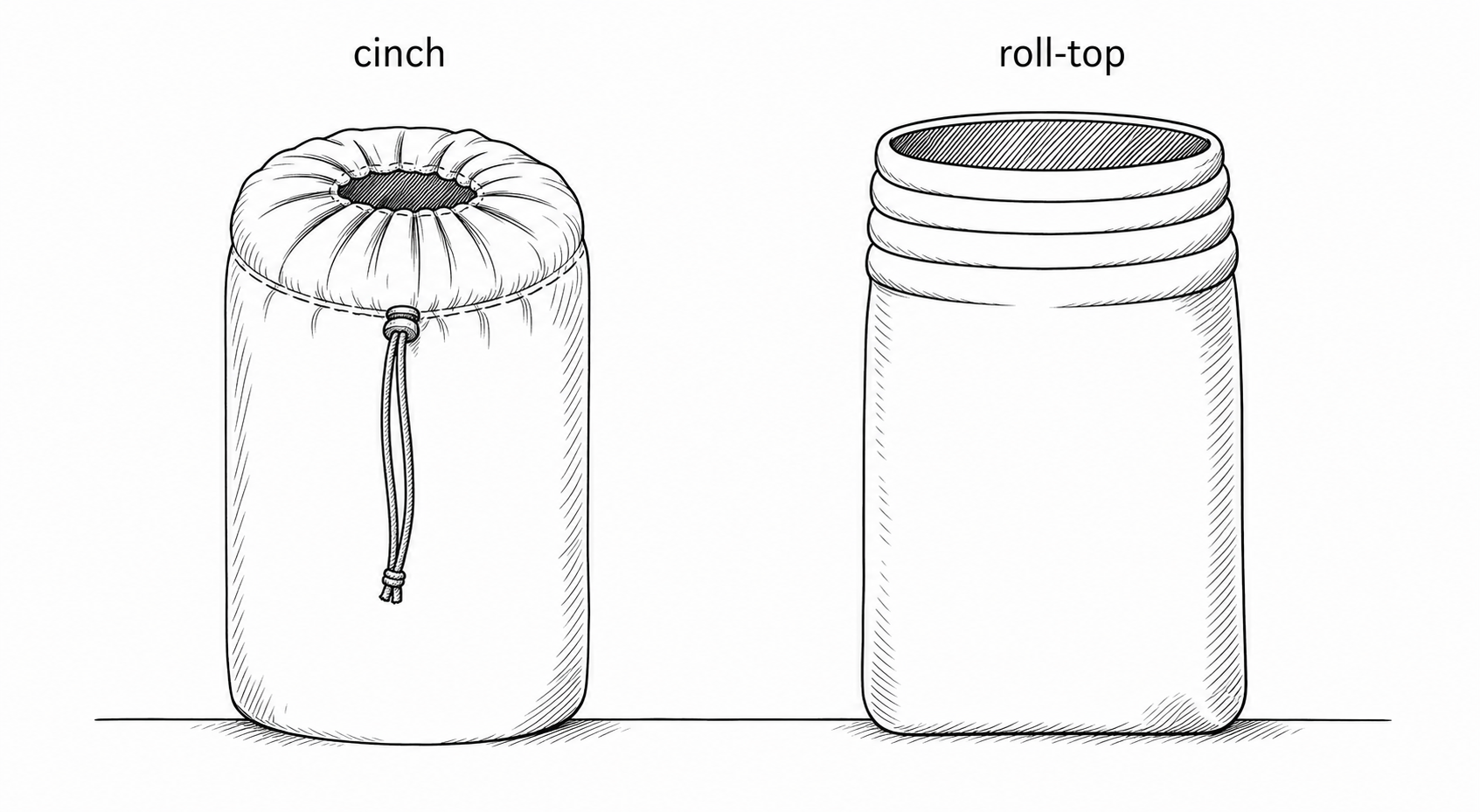 How you lose volume after you pack. Illustrative only.