Side-Entry & Sling Geometry
Torso axis, hip axis, and what single-shoulder carry costs in comfortable load ceiling.
- Volume
- 04
- Order
- № 05
- Read
- 5 min
- Published
A side-entry bag is accessed from a panel or opening that faces perpendicular to the direction of travel. Instead of opening from the front (panel-loader) or the top (top-loader), the bag opens from the side - typically through a zippered panel or flap facing outward from the body. The design intent is retrieval without removing the bag. With a hip or torso rotation, the opening swings into reach.
Access angle
Side-entry means the opening faces roughly 90 degrees from the direction of forward motion. In practical terms: the bag rides on the back or hip, the opening faces to the side, and a twist of the torso brings the opening to the front. The quality of this motion depends on strap configuration and opening size. A small slit pocket offers fast single-item grab; a full side panel zip offers near-clamshell access without the bag leaving the body.
Torso axis
The torso axis describes a diagonal strap running from one shoulder to the opposite hip - the classic cross-body geometry. The bag rests at front-of-chest or side-of-chest depending on strap length. Load center sits on the sternum; the bag is held between shoulder anchor and hip anchor. Pack Hacker defines sling bags as worn across the chest or back with a cross-shoulder strap; the torso-axis descriptor is a geometric shorthand for this diagonal.
The bag can be rotated from back-carry to front-carry by sliding along the strap, which is the quick-access motion the design is built around.
Hip axis
A hip-axis bag rides on a horizontal strap around the waist; the bag sits at the hip or small of the back. Bring the bag to the front by rotating it along the strap. Hip carry distributes load differently than torso carry: the strap bears weight at the pelvis rather than the shoulder. Suited to lighter loads and shorter durations; a heavy hip-axis bag migrates forward under gravity and creates uneven pressure at the small of the back during extended wear.
Pack Hacker notes that most current-generation sling straps are not comfortable worn on the hips - they are designed for the torso-diagonal geometry. A bag that claims both hip and torso carry should be evaluated in both configurations; the strap geometry rarely optimizes for both simultaneously.
Single-shoulder load path
A single-shoulder bag concentrates all carried weight on one shoulder. This is the structural reality of any torso-axis sling or crossbody design. The shoulder, neck, and upper back on the load side carry the full weight; the opposite side carries nothing. Over time, the load side fatigues; the bag migrates forward or drops toward the weak side; the user begins to counter-rotate to compensate.
A 2022 biomechanical study found that unbalanced carrying styles - shoulder bags, handbags - caused greater muscle force and lumbar loading than backpacks of the same weight. This is not a reason to avoid sling bags; it is a reason to understand the geometry. The load ceiling for comfortable sling carry is lower than for two-shoulder carry, and the duration ceiling drops faster as weight increases. Pack Hacker notes that larger or heavier sling bags can become uncomfortable or cause back discomfort. Counterweight pocket placement - a small rear pocket positioned to hold dense items on the trailing side - partially mitigates this by distributing mass more symmetrically, but it does not eliminate the asymmetric load path.
Sling vs. crossbody distinctions
The terms “sling” and “crossbody” overlap. Pack Hacker acknowledges that some companies use “crossbody bag” for what it considers sling bags, and notes explicitly that its definitions are not absolute. A working distinction for this book: sling = single strap, diagonal from one shoulder to opposite hip, back-to-front rotation is the intended retrieval motion; crossbody = strap over one shoulder, bag hangs at the side, no rotation is implied. Neither term is ISO-formalized. In practice, manufacturers use both terms for similar geometries; the strap path and rotation logic are more diagnostic than the label.
A note on the rotation crease, for laminate shells
The defining motion of a sling - rotating back-to-front along the strap axis - presses the bag against the user’s torso and then against the strap’s pull direction in alternation, many times per day for an active carrier. On a laminated shell, this rotation generates two recurring crease patterns: a vertical fold line where the bag meets the strap anchor under sustained pull, and a diagonal fold across the bag’s face where the rotation pivot lands. Both lines accumulate cyclic flex stress on the same adhesive bond, day after day.
A sling carried by a Spec-Fluent owner in Ultra or X-Pac for daily quick-access use will typically show its first delamination indicator (haze, then blister lift) along one or both of these geometric lines rather than across the panel as a whole. The asymmetry of single-shoulder carry compounds the effect: the loaded side of the bag flexes more than the unloaded side, and one face accumulates fold-fatigue damage while the opposite face does not. Geometry routes the failure to a specific zone.
The practical implication is the same as on the roll-top: the laminate’s fold-fatigue endurance is not infinite, and the bag’s shape decides where the count runs out first.
Failure modes
Strap twist occurs at anchor points - where the diagonal strap attaches to the bag body, the strap tends to rotate under load. Twist accumulates across carry sessions; a twisted strap narrows its effective width and bites harder into the shoulder. Stress concentration at the D-ring is the structural counterpart: the D-ring or anchor tab at the bag’s corner carries the entire peel force of the loaded bag against gravity; this is typically the first hardware point to fail on an overloaded sling. Foam pad migration happens in single-shoulder carry when the shoulder padding shifts down the strap toward the bag body across repeated use - the padding is no longer where the shoulder contacts the strap.
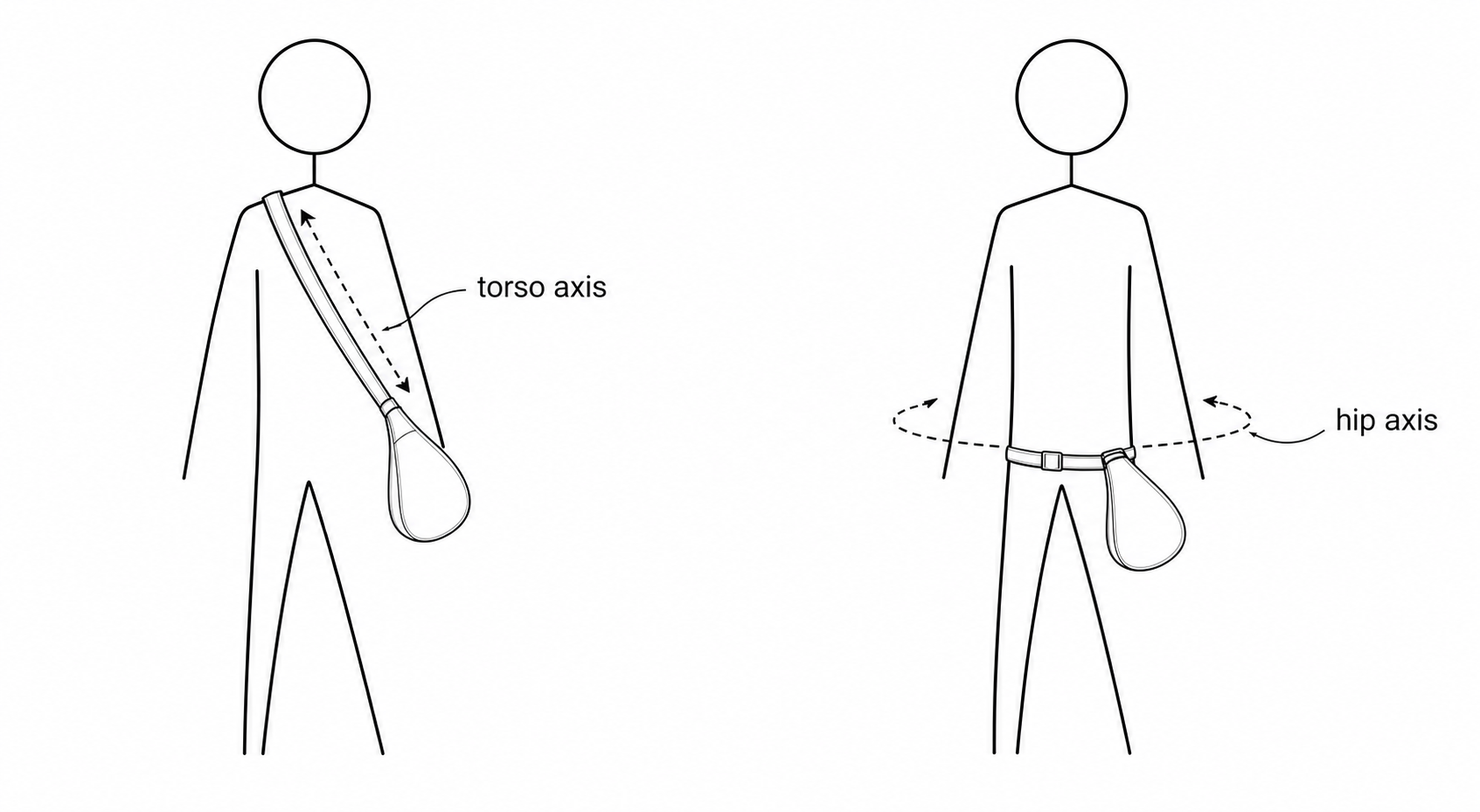 Torso axis vs hip axis - access follows gravity habits. Illustrative only.