The Shape System
The opening system is the least substitutable spec, and no material choice patches it.
- Volume
- 04
- Order
- № 09
- Read
- 3 min
- Published
The preceding seven chapters each describe one dimension of bag geometry. This chapter argues that the dimensions are not independent - they constrain each other, and together they constrain the use case. The synthesis: form follows load, and load type determines which opening system is non-negotiable.
The opening system is the least-substitutable variable in the shape set. A bag’s fabric can be changed by the manufacturer without redesigning the bag. Hardware can be upgraded. Internal pockets can be added or removed in a new SKU. But changing a top-loader to a clamshell requires rebuilding the bag from the zipper path outward - it is a different product, not a variant. This means the opening system should be the first question, not an afterthought.
The diagnostic matrix
Four use-case categories and the opening system each implies:
Commute load - laptop, notebook, charger, a change of clothes; retrieved and returned to the same organized configuration each day; accessed on a desk or café table. The clamshell or slab panel-loader is the natural form. The load needs a flat packing plane, daily presentation in the same sequence, and a laptop that appears without digging. A top-loader can work for commute use if the load is shallow and the sequence is predictable, but the clamshell’s flat presentation removes the sequencing constraint entirely.
Travel load - volume changes trip to trip; sometimes 20 liters, sometimes 35; includes both clothing (soft, compressible) and hard items (laptop, camera, charger); checked in some cases. The top-loader or roll-top is the natural form. The continuous volume gradient is the feature: the same bag compresses for a carry-on and expands for a check. A clamshell is a fixed-volume form; it cannot compress below its frame. Roll-top travel bags pair best with a collapsed or tapered profile; the structure accommodates the variable fill.
Sport and trail - weight matters; hands-free is required; load shifts during activity; access during movement is occasional, not frequent. The top-loader with a hip transfer (hip belt transferring load from shoulders to pelvis) is the standard form. The tapered profile serves shoulder clearance. A clamshell on a trail pack would require stopping, setting down, and opening the bag flat - the access geometry does not match the movement context.
Quick-access carry - urban daily; the bag is accessed many times per hour; items are retrieved and returned without stopping movement; security is secondary to speed. The sling with torso-axis rotation, or the magnetic-flap grab bag, is the natural form. The sling allows front-access without bag removal; the magnetic flap allows single-gesture retrieval. A top-loader for a quick-access scenario is the platform scene from the prologue.
The matrix is a diagnostic, not a prescription
The matrix above maps load types to opening systems. It is not a rule. A top-loader commuter pack is a viable daily driver if the load discipline is maintained and the user is willing to sequence the pack each night. A clamshell travel pack works if the travel volume is consistent. The matrix identifies mismatches - configurations where the opening system fights the use case - not configurations that are prohibited.
The underlying principle: if the bag’s opening system is in conflict with the use case, no material choice resolves it. Ballistic nylon does not fix a roll-top that was wrong for the trip. YKK zippers do not fix a clamshell that cannot compress for carry-on. Shape is the variable that cannot be patched.
The corollary: when a bag feels wrong and the individual components seem fine - the zipper is solid, the strap is comfortable, the fabric is holding - check the opening system. The frustration is likely geometric.
The matrix maps pure forms. A growing class of bags refuses the either-or: roll-top main plus zippered quick-access pockets, or side entry into the main, is a deliberate multi-opening system. Weather seal and volume gradient stay on the roll; zipper speed stays where retrieval frequency demands it. That does not make the opening system substitutable - it means each opening still has to match its job.
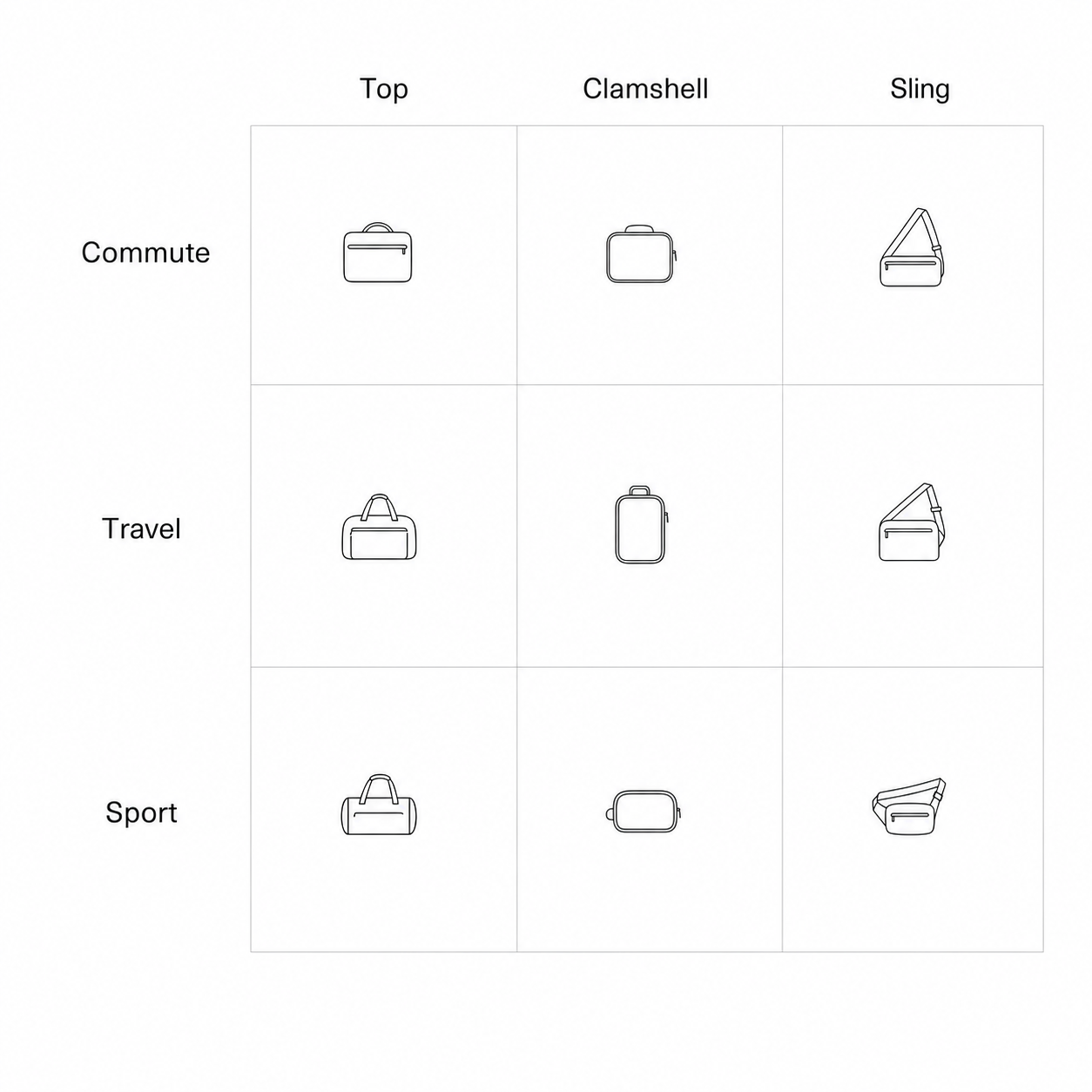 One opening discipline per job. Illustrative only.
Little Bag Buddy, Vol. IV: Shapes & Forms is written in the same spirit as this series: shape vocabulary over silhouette intuition. Nothing here is sponsored or affiliate-linked.
Reminder: every image in this guide is illustrative only. AI-generated. Not a substitute for manufacturer specs, primary literature, or hands-on examination.