Profile Taxonomy
Slab, structured, tapered, collapsed, and boxy - five working descriptors for a bag's shadow.
- Volume
- 04
- Order
- № 02
- Read
- 4 min
- Published
Every bag has a silhouette. Pull the fabric taut, set the bag upright, photograph it from the side - that shadow is the profile. It determines where the center of gravity sits, how the bag contacts the body, how efficiently it fills a locker or overhead bin, and (loosely) what kind of opening system makes functional sense with it.
The five profile descriptors used throughout this book are slab, structured, tapered, collapsed, and boxy. A word of precision before defining them: these are working geometric terms, not ISO or ASTM standardized silhouette categories. ASTM F2153 standardizes backpack capacity measurement - the methodology for arriving at a liter figure - but it does not define a silhouette taxonomy. The terms here are geometric descriptors consistent with how bags get described in practice; define them once, use them consistently.
Slab
The slab is panel-dominant and thin relative to its face. Width and height are large; depth is small - often 4–6 inches on a bag with a 12-inch face. The profile is a flat rectangle. Natural commuter and messenger form: it rides against the back without projecting far, fits under desks and train seats, and packs documents and laptops in a single flat plane.
What the slab affords: low projection from the body; clean access to a flat packing surface; easy to lean against walls or slide under an airline seat. What it costs: limited depth means limited volume per square inch of back panel; a slab bag cannot take a bulky load without distortion. Typical users: laptop sleeves, messenger bags, thin daypacks.
Structured
The structured profile is three-dimensional at rest - it holds its shape when empty. Padded side panels, a frame sheet, or rigid base inserts keep the trapezoid form. Profile from the side: a box with presence. The bag does not collapse when set down; it stands.
What the structured profile affords: predictable packing geometry (the same items fit in the same way every time); protection for hard contents; bag stands independently on surfaces. What it costs: weight and bulk even when empty; the structure does not compress for travel. Typical users: camera bags, structured totes, some travel backpacks with integrated frame sheets.
Tapered
The tapered profile is narrower at one end than the other - usually narrower at the top, following hiking-pack convention. Shoulder clearance is the reason: a narrower top clears the neck and head during movement; a wider base creates volume at the hip. Tapered bags often pair with a top-loader or roll-top opening, since the taper would distort a three-sided clamshell zipper.
What the tapered profile affords: natural movement clearance; weight sits lower and stays close to the back; aerodynamic feel on trail. What it costs: odd packing geometry - full-sized rectangular items (laptops, tablets) may not fit cleanly if the taper is aggressive; packing cubes may leave corner waste at the shoulder. Typical users: daypacks, trail packs, some commuter packs marketed with ergonomic framing.
Collapsed
The collapsed profile has no fixed shape - it follows its contents. Duffels, stuff-sacks, and tote bags in their natural state are collapsed until loaded. Empty, they fold flat or stuff into a pocket. Loaded, they take the shape of whatever is inside.
What the collapsed profile affords: packability (the bag itself stores small); maximum volume efficiency for soft loads; no structural overhead. What it costs: no packing geometry - a collapsed bag offers no predictable access plane; whatever went in last is on top; compression or retrieval can be chaotic. The collapsed form favors loads that don’t need organized presentation: gym kit, laundry, overflow gear, airline-check inserts. Typical users: duffels, stuff-sacks, packable daypack sleeves.
Box / Boxy
The boxy profile is depth ≈ width; the bag presents as a near-cube from the side. Rigid or semi-rigid construction keeps corners square. The geometry is cube-compatible: a boxy interior allows packing cubes to sit cleanly without corner waste or sidewall bulge.
What the boxy profile affords: efficient packing geometry for rectangular items; stands on its own; predictable dead volume is minimal because all corners are right angles. What it costs: projects far from the body; feels heavy for its volume; may not compress for smaller loads. Typical users: hard-shell camera cases, rigid briefcase-style bags, some structured travel packs designed specifically for packing-cube systems.
A note on load distribution that applies across all five: heavier items ride best close to the back and centered toward the middle of the torso. Profile shape constrains this. A slab bag keeps load naturally close to the spine. A collapsed bag offers no enforcement. The profile is not the load-balancing system - it is the envelope the load-balancing system operates inside.
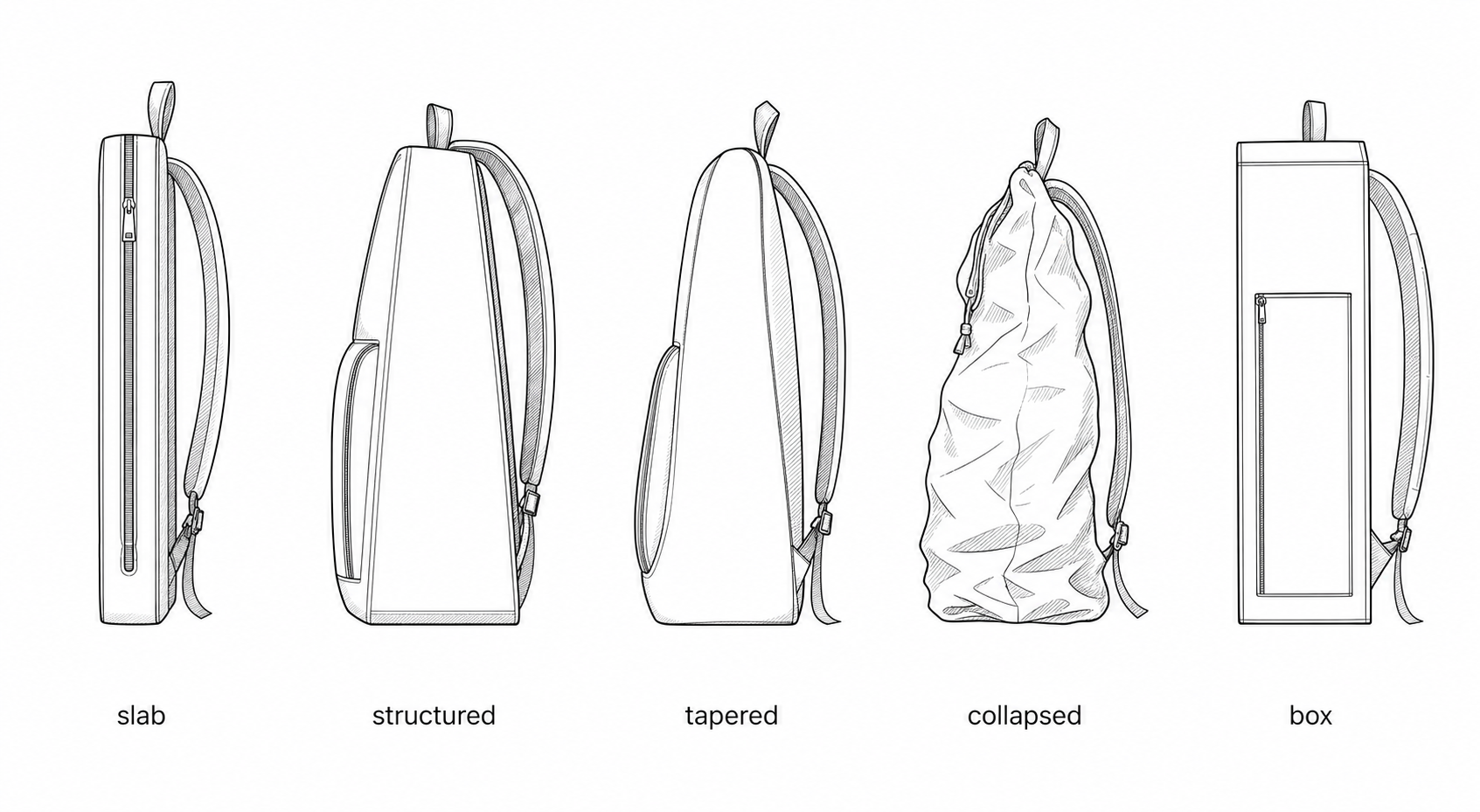 Silhouette is the first spec. Illustrative only.