Magnetic & Quick-Access
Flap coverage, magnet placement, and the security traded away for a one-finger grab.
- Volume
- 04
- Order
- № 06
- Read
- 4 min
- Published
Quick-access design is a trade-off specification. The goal is retrievable without the sequence - open bag, find item, close bag - becoming a multi-step process. Magnetic closures, grab pockets, and slash pockets each attack this problem geometrically. None of them solve it without cost.
Flap geometry
A flap is a fabric panel that folds over the bag’s opening and secures at the front face. Coverage and lift-speed trade off directly. A short flap - covering only the top few inches of the opening - lifts fast; one finger can clear it. Weather protection is minimal. A long flap - covering most or all of the opening face - provides better sealing against rain and obscures the contents more thoroughly. It takes both hands to manage cleanly and slows access under pressure.
Magnetic snaps are commonly used at the top of a bag or purse and to secure a fold-over flap to the front face. The snap placement determines where the hand goes: a lip magnet (at the flap’s trailing edge) requires the grab to go to the edge; an inset magnet (sewn behind the fabric face rather than at the lip) requires pressing against the bag face to disengage. Lip placement is faster for practiced users; inset placement wears less visibly.
Magnet placement
Magnetic snaps in bag construction typically use paired components - a male and female element - sewn with washer reinforcement on both sides of the mounting fabric. Placement guidance from sewing sources favors fewer layers between the fabric face and the magnet: foam, batting, or thick fleece between the magnet and the mating surface reduces closure hold force. The fabric face itself is an acceptable layer; padded linings reduce snap engagement strength.
On neodymium snap magnets used in bag closures: the magnetic field at the snap face is strong at contact but attenuates quickly with distance. A few millimeters of fabric and a few centimeters of air separate the magnet from anything stored inside the bag.
Interference caveats: Magnet interference with electronics, payment cards, and medical devices is context-specific and distance-dependent - not categorical. Magnetic stripes on payment cards can be affected by prolonged close exposure to magnets, but EMV chip cards are not vulnerable to demagnetization; do not say “magnets ruin credit cards” without distinguishing stripe format, exposure duration, and distance. On camera interference: Apple notes that magnets near iPhone rear cameras can interfere with optical image stabilization and closed-loop autofocus sensors; this applies to accessories placed in close proximity to the camera module. On medical devices: the FDA recommends keeping consumer electronics that may create magnetic interference at least six inches from implanted medical devices; Apple’s guidance for many implanted-device contexts similarly recommends at least 15 cm / 6 inches of separation. These are guidance figures for consumer electronics - not tested figures for bag closure magnets specifically. The safest posture is to describe magnet field strength as context-dependent, flag the relevant guidance, and not make categorical claims in either direction.
Grab zone design
The grab zone is the band of the bag face that can be accessed without fully opening. Three implementations: grab pocket (a shallow pouch behind an unclosed or elasticized opening - hand goes in, retrieves without looking), slash pocket (a horizontal or angled slit through the face fabric - fast but shallow), and open-top pouch (no closure; fast access, no security). Width determines whether a full hand fits; depth determines whether the intended item seats cleanly. A grab pocket sized for a passport does not grab a water bottle; a grab pocket sized for a water bottle swallows everything else.
Quick-access trade-offs
Speed and security are inversely correlated in this design space. A magnetic flap is not a theft deterrent; it can be cleared with one finger from behind. A zippered flap adds a second physical layer; a zipper-plus-magnet combination is the most common higher-security quick-access design - the magnet closes the flap habitually; the zipper is the actual barrier. Bags marketed as “anti-theft” typically add a third layer (lockable zipper, hidden secondary zipper, or slash-resistant strap webbing) at cost to access speed.
Failure modes
Magnet delamination from fabric occurs when the snap washer pulls through the fabric over repeated snap cycles, particularly when the snap is used to close an overfull bag against fabric tension. Flap snap fatigue happens at the compression snap when the male and female elements are repeatedly forced together slightly off-axis - the snap surface wears and hold force drops. Grab-zone edge wear is visible at the lips of slash pockets and open-top pouches within a year of regular use; the cut edge frays and the elastomer (if used) loses memory.
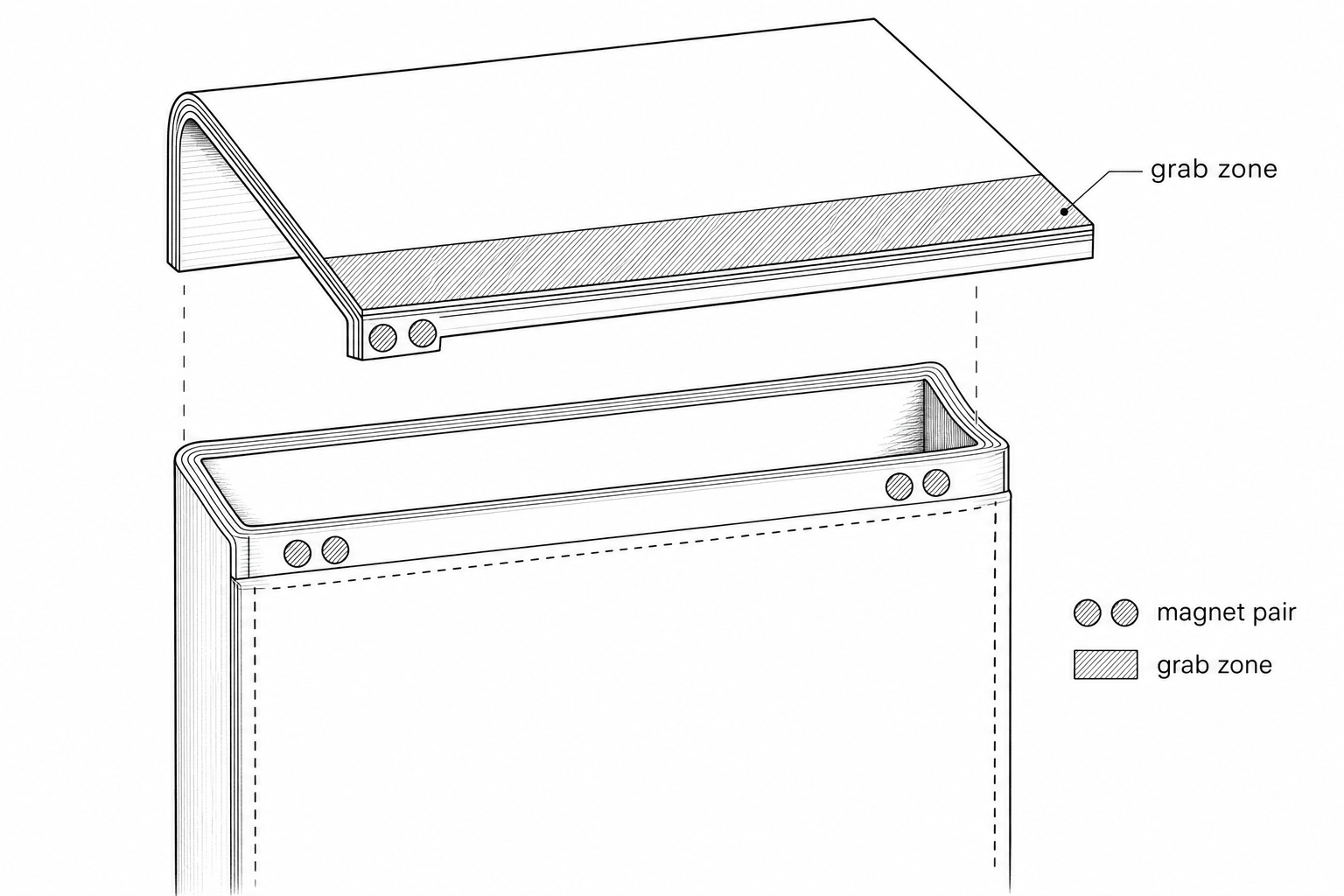 Magnets hide at the lip. Illustrative only.