Internal Organization Geometry
Floating sleeves, deadspace, and why access sequence matters more than pocket count.
- Volume
- 04
- Order
- № 07
- Read
- 5 min
- Published
The interior of a bag is not neutral space. Its shape - how it is subdivided, what geometry it presents to the load - determines whether packing is a system or a search operation every time the bag opens.
Floating sleeve
The floating sleeve is a laptop or tablet compartment suspended away from the bag’s back panel and base. “Floating” means the sleeve’s lower edge does not touch the bag’s floor; there is an air gap, or a structural suspension element, between the sleeve bottom and the bag base. The functional reason is drop protection: when the bag is set down hard, the base decelerates against the floor; a sleeve that bottoms out in the bag transmits that deceleration directly to the device. A sleeve that floats - hanging from straps, sewn to the bag’s interior walls at some height above the base - absorbs the distance between the suspension point and the floor in the bag’s own structure rather than in the device.
Sleeve depth relative to panel depth is the diagnostic spec. If the sleeve is shorter than the main compartment depth, it floats in the intended sense. If the sleeve runs the full interior depth of the bag, it touches the floor; the “floating” label, if applied, is cosmetic rather than functional.
Deadspace
Deadspace is the volume that exists inside a bag but cannot easily hold packed items - typically a wedge or triangular zone behind a floating sleeve, between a shaped back panel and the main compartment wall, or at the corners of a tapered profile where the taper meets the floor. The name sounds pejorative; it is not. Deadspace is accessible volume for cables, chargers, documents, and flat items that benefit from being separated from the main compartment. A floating sleeve by definition creates deadspace behind it. That deadspace is useful real estate if the bag’s design acknowledges it with a pass-through or a deliberate opening.
Deadspace becomes a problem only when the bag’s design pretends it doesn’t exist - when there’s no access path, no deliberate use-case, and the volume simply absorbs small items that then can’t be found. The difference between functional deadspace and lost deadspace is an opening and a use case.
Packing cube compatibility
Packing cube compatibility is not a standardized specification. Packing cube sizes are not universal - one brand’s “small” is another brand’s “medium,” and the dimensions vary meaningfully across manufacturers. “Cube-friendly” design in a bag typically means: flat floor with minimal taper at the base, upright walls with consistent depth across the width of the compartment, and interior dimensions that accept a standard-sized rectangle without significant compression or side-wall bulge.
A tapered bag will bind a rigid cube at the shoulder; the cube’s top will hit the narrowing walls before the cube is fully seated. A collapsed bag will conform around a cube but will not support it - the cube will sag or tip. A boxy bag offers the cleanest geometry for cube-based packing. Rectangular bags in general pair better with cube systems; the efficiency of the pairing depends on how well the cube’s dimensions match the compartment’s dimensions. Multiple smaller cubes often fill a mixed-shape bag more efficiently than one large cube, because smaller cubes can be arranged to fill corner geometry that a large cube leaves waste.
Compression panels and straps
Compression straps - internal or external, cinching across the face of the main compartment - reduce effective volume while stabilizing the packed mass. A half-full bag without compression allows contents to shift; a shifted load changes the bag’s center of gravity mid-carry. Compression holds the load condensed and near the back panel.
The distinction between compression straps and compression panels is worth holding: compression straps are webbing elements that cinch across the load; a compression panel would be a structured face that moves inward against the load, which is less common as an explicit design feature in non-luggage bags. Manufacturers more consistently describe compression straps, compression zippers (a secondary zip that cinches the bag’s girth), and external compression systems. When evaluating compression claims, check whether the feature is a strap cinch (common, effective at load stabilization) or a marketing term for ordinary straps that happen to have a buckle.
A note on compression creases, for laminate shells
Compression is repeated creasing on the same line by design. A compression strap cinched across the face of a laminated panel forces a fold along the strap’s path every time it is engaged; release it and the panel partially flattens, engage it again and the fold returns to roughly the same position. Over months of daily compression cycles, the bond layer beneath the strap’s footprint accumulates fatigue damage in a narrow band that matches the strap geometry.
This is not an argument against compression - load stabilization is a real benefit and worth the trade. It is an argument for understanding what the geometry is doing. A compression-zipper bag (the kind whose girth is cinched by a secondary zipper) routes the same logic through a different line - the secondary zipper’s path - and concentrates fatigue there. A bag with three external compression straps creates three potential fold-fatigue lines on the face.
The mitigation, where it exists, is to vary the load condition: a bag compressed every day at the same fill level traces the same fold; a bag compressed at varying fill levels distributes the fold positions across a wider band. Compression strap design also matters: wider webbing distributes its bend across a larger zone, narrow webbing concentrates the crease.
Organization taxonomy
Pocket quantity is not the spec; access sequence is. A bag with twelve pockets and six zippers is not better organized than a bag with three if the twelve-pocket bag requires opening five wrong pockets before finding the item. The diagnostic question is: in the sequence of things retrieved most often, is each item one gesture away? Key clip, pen loops, card slots, and cable pass-throughs each solve a specific access-sequence problem. A key clip makes the key findable without digging; a cable pass-through lets a charging cable route from an internal battery to an external device without opening the bag. These are geometry solutions. Pockets exist to give a specific item a predictable location - the moment the pocket count exceeds the number of items with predictable locations, the surplus pockets become the search space.
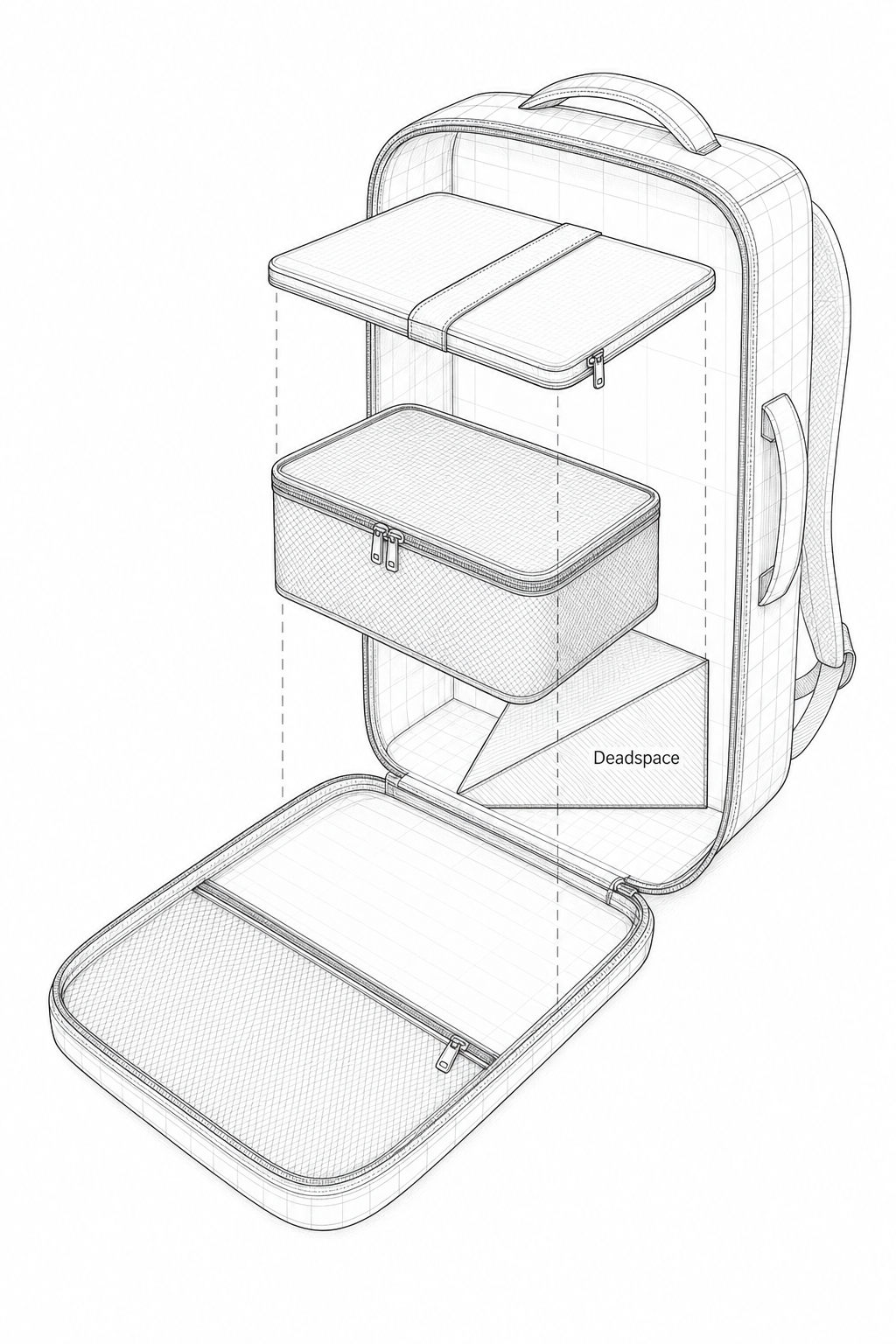 Dead space is still volume. Illustrative only.