Clamshells & Panel-Loaders
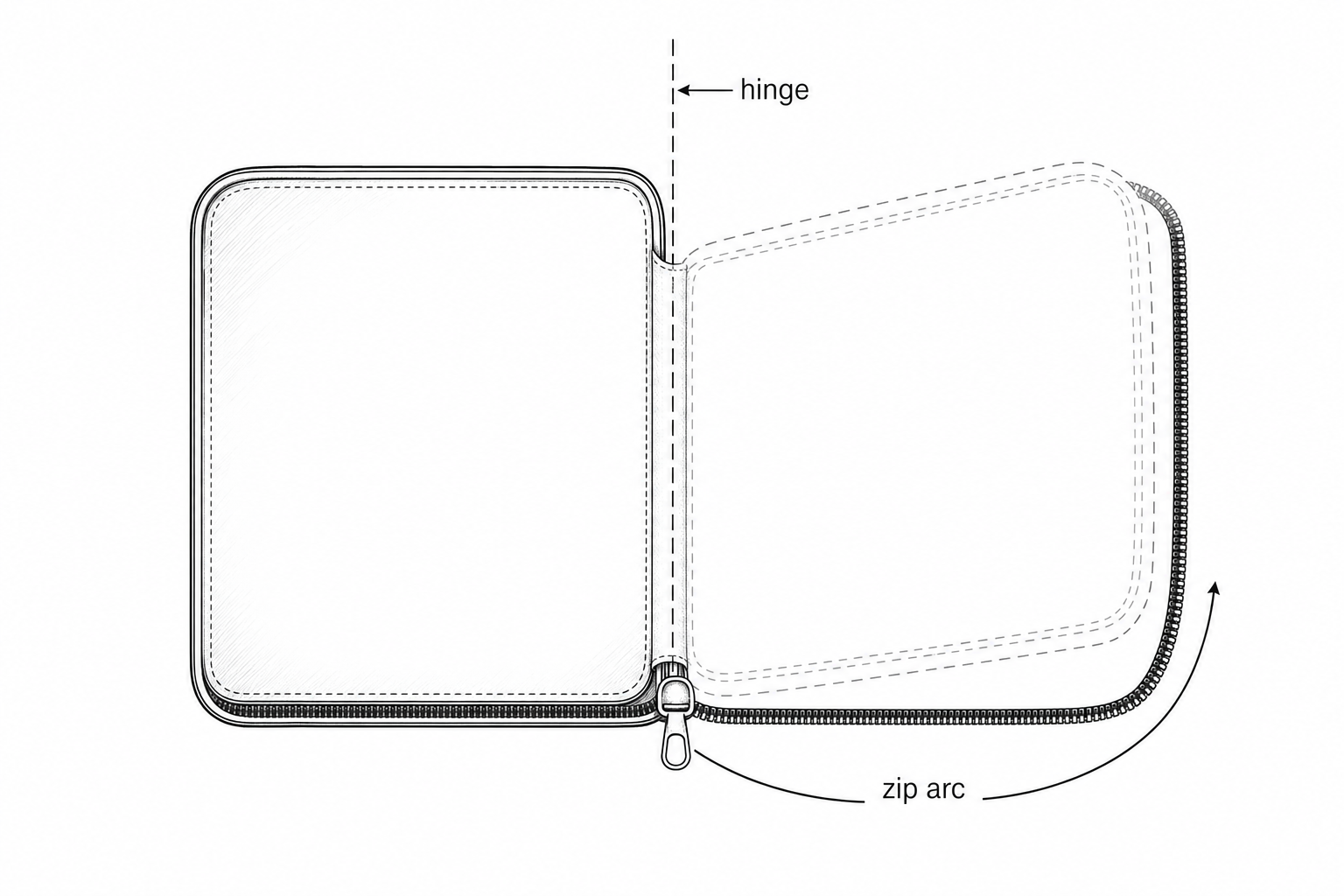
Hinge axis, zipper arc, and the flat packing plane a three-sided zip buys.
- Volume
- 04
- Order
- № 04
- Read
- 4 min
- Published
A panel-loader is any bag whose primary access is through a panel that swings open rather than through the top. The front (or back, or a full face) opens like a suitcase or book, exposing the packing space in a single plane. A clamshell is a panel-loader whose main zipper spans three of four sides - along the bottom and up two sides - so the bag can lay flat and fully open. The distinction between “panel-loader” and “clamshell” is a matter of zipper extent: a partial front-panel zip is a panel-loader; a three-sided zip that lets the pack lay flat is a clamshell.
Hinge axis
The hinge axis is where the bag pivots. On a spine-hinged bag - the laptop bag convention - the back panel stays fixed and the front panel swings away on a hinge running vertically along one side edge. This is the book-opening motion. On a base-hinged bag - less common; suitcase-convention - the bag opens from the bottom edge, both halves rotating upward. In practice, neither “spine-hinged” nor “base-hinged” is formal bag-industry vocabulary; what manufacturers describe is the zipper path and the opening direction. These hinge terms are useful geometric shorthand for where the pivot lives.
The zipper arc is the functional hinge proxy. The slider travels along a path that defines the opening angle and the opening extent. Where the zipper terminates, the bag stops opening. Where it curves, the curve radius determines whether the slider can complete the arc without binding.
Zipper arc geometry
A U-shaped zipper path describes the clamshell standard: the slider travels from one top corner, down one side, along the bottom, up the other side, and terminates near the second top corner. A J-shaped path opens only partially - down one side and along the bottom - limiting access to roughly two-thirds of the panel. A three-sided rectangle is the clamshell form with squared corners rather than curves.
Slider stress concentrates at corners. A tight corner radius requires the zipper tape to bend sharply; the tape is a fabric-and-coil system that tolerates some bending but fatigues at extreme angles. Slider travel distance is also a function of path length - a full three-sided U-path requires more slider travel per open/close cycle than a partial J, which partly explains why partial-panel bags are faster to operate under time pressure.
Bifold vs. trifold
In a bifold opening, the front panel drops entirely away from the bag - one hinge axis, full exposure, the packing plane is horizontal and visible. In a trifold opening, the panel folds back in two sections rather than one; the bag can stand upright while open because neither half falls past vertical. A trifold is narrower in footprint when open - useful in tight spaces (under an airline seat, on a café table) - but exposes less of the packing plane at once.
Bifold preserves standing access: the bag stays upright, the panel hangs in front, the interior is presented vertically and fully accessible. Trifold is the more compact, less fully exposing option.
Laptop compartment conventions
Laptop compartments in clamshell bags follow two geometries: the fixed back panel and the floating sleeve. In the fixed-panel design, the laptop slot is sewn to the back wall of the bag at a fixed depth; the sleeve is the back wall itself, padded on both faces. In the floating sleeve design, the laptop compartment hangs suspended away from the back panel, often on straps or a suspended frame. The “floating” dimension matters: a sleeve suspended so that the laptop’s base does not contact the bag’s floor on drop impact is protecting the laptop from the floor shock. A sleeve that reaches the floor defeats its own protection logic. Sleeve depth relative to the panel depth is the spec worth checking: if the sleeve is shorter than the panel, it floats; if it extends all the way to the base, it does not.
Failure modes
Zipper tape separation occurs most often at the corner radius, where the tape has been bent and rebent across thousands of open-close cycles. A zipper that “skips” or delaminates at the corner is showing cumulative fatigue at the highest-stress point in its travel path. Corner abrasion happens where the panel’s lower corners contact floors and surfaces - the corner of an opened clamshell is a contact point that no padding reaches. Hinge-side webbing stress accumulates on the side of the bag opposite the slider travel direction - a single anchor point on one top corner handles the peel force every time the panel is yanked open.
 The hinge axis is the spine. Illustrative only.