Attachment & Modularity
PALS grids, lash tabs, and daisy chains - three bets on how often you reconfigure.
- Volume
- 04
- Order
- № 08
- Read
- 4 min
- Published
External attachment systems let a bag gain or lose volume without a zipper. The trade-off is always weight and bulk on the exterior versus flexibility in total load configuration. The dominant systems - PALS grid, lash tabs, daisy chains, bungee nets - each make a different bet about how often the attachment will be used and how much weight it needs to carry.
PALS/MOLLE grid
PALS stands for Pouch Attachment Ladder System. It is the webbing grid: horizontal rows of 1-inch-wide nylon webbing stitched to the bag face at repeating intervals. The nominal DoD-derived specification, reflected in commercial manufacturer guidance, gives 1-inch webbing width, 1-inch vertical spacing between rows, and 1.5-inch stitch spacing along each row. The lineage of this attachment geometry traces to U.S. Army-assigned patent US5724707A (“Interlock Attaching Strap System”), which describes interwoven nylon straps for removable pouches - the functional principle that became PALS.
MOLLE - Modular Lightweight Load-carrying Equipment - is the broader military load-carrying system that uses PALS webbing for attachment. MOLLE is the system; PALS is the grid. A bag has PALS webbing; a bag is described as MOLLE-compatible. “MOLLE webbing” is common commercial language but is technically imprecise. Commercial bags adapt the grid geometry loosely; actual row spacing and stitch intervals vary by manufacturer and are not guaranteed to match the DoD-derived specification on any specific commercial product. Verify spacing against the specific manufacturer if PALS-compatibility with military-specification pouches is required.
How PALS attachment works
A PALS-compatible pouch attaches by weaving a secondary strap through the primary grid rows. The secondary strap is also 1-inch nylon webbing; it weaves over-under through successive primary rows, threading horizontally across the face. The 1.5-inch stitch spacing accommodates the 1-inch secondary webbing with enough slack to thread cleanly. Once threaded and secured (typically with a snap or Fastex closure at the terminal end), the weave locks the pouch against pull-out in all directions. A well-executed PALS attachment is not dislodged by normal carry forces; it requires deliberate unthreading to remove.
The modularity is real but not instantaneous. Attaching or removing a PALS pouch takes 30–60 seconds per pouch under normal conditions. This is not a quick-release system; it is a configurable-before-departure system.
Lash tabs (hypalon squares)
A lash tab is a single-point anchor: a small square or rectangle of hypalon (a neoprene-based synthetic rubber) or similar material, stitched to the bag face with an X-slit or H-slit cut through the center. A strap or carabiner passes through the slit and attaches. Lash tabs are rated for light accessories - a rain cover, a carabiner with a water bottle, a small pouch - not for load-bearing attachments. The slit geometry limits the width of what can thread through; the stitching footprint limits the pull-out force the tab can resist.
Common on ultralight packs where a full PALS grid adds unacceptable weight. A single lash tab adds a few grams; a full PALS panel on a 1-liter daypack is a structural overconstruction. The lash tab trades capacity for weight: one attachment point, light enough to include on a 100-gram frameless pack.
Daisy chains
Daisy chains are columns of looped webbing, stitched at intervals to create multiple attachment heights along a vertical or diagonal axis. Zpacks uses daisy chains on current packs for clipping on items. The loop-and-clip geometry allows a carabiner to attach at any loop height; the attachment is a point load on a single loop stitch. Daisy chains are lighter than PALS grids and offer more vertical positioning flexibility, but they are less rigid laterally: an item attached via carabiner to a daisy chain will swing under gravity; an item woven into a PALS grid will not.
External pockets as volume extenders
Bungee-cord nets, side-pocket expansion systems, and compression overpanels extend the bag’s usable volume without adding a zipper. A bungee net on the face of a top-loader can hold a helmet, a rain jacket, or a packable layer - bulky, light, not worth a dedicated compartment. Side pockets that expand via hidden gussets can go from flat to a water-bottle-sized pouch by opening a zipper along the side seam. The geometry that makes external attachment practical is clearance: the external load must not extend past the bag’s silhouette in a way that catches on door frames or aisles, and its center of gravity must not shift the carry balance unacceptably far from the back.
Failure modes
PALS webbing delamination at the stitched row is the primary structural failure: the stitching holding each webbing strip to the bag face fatigues under load, particularly at the ends of each strip where peel forces concentrate. Lash tab tearing at the slit occurs when an oversized or overloaded item is forced through the slit rather than a correctly sized attachment; the hypalon tears from the slit toward the edge. Bungee elastomer fatigue is time-based more than cycle-based: the elastic core of a bungee cord loses memory over years of UV exposure and temperature cycling; the cord becomes a cord without tension, which no longer secures anything.
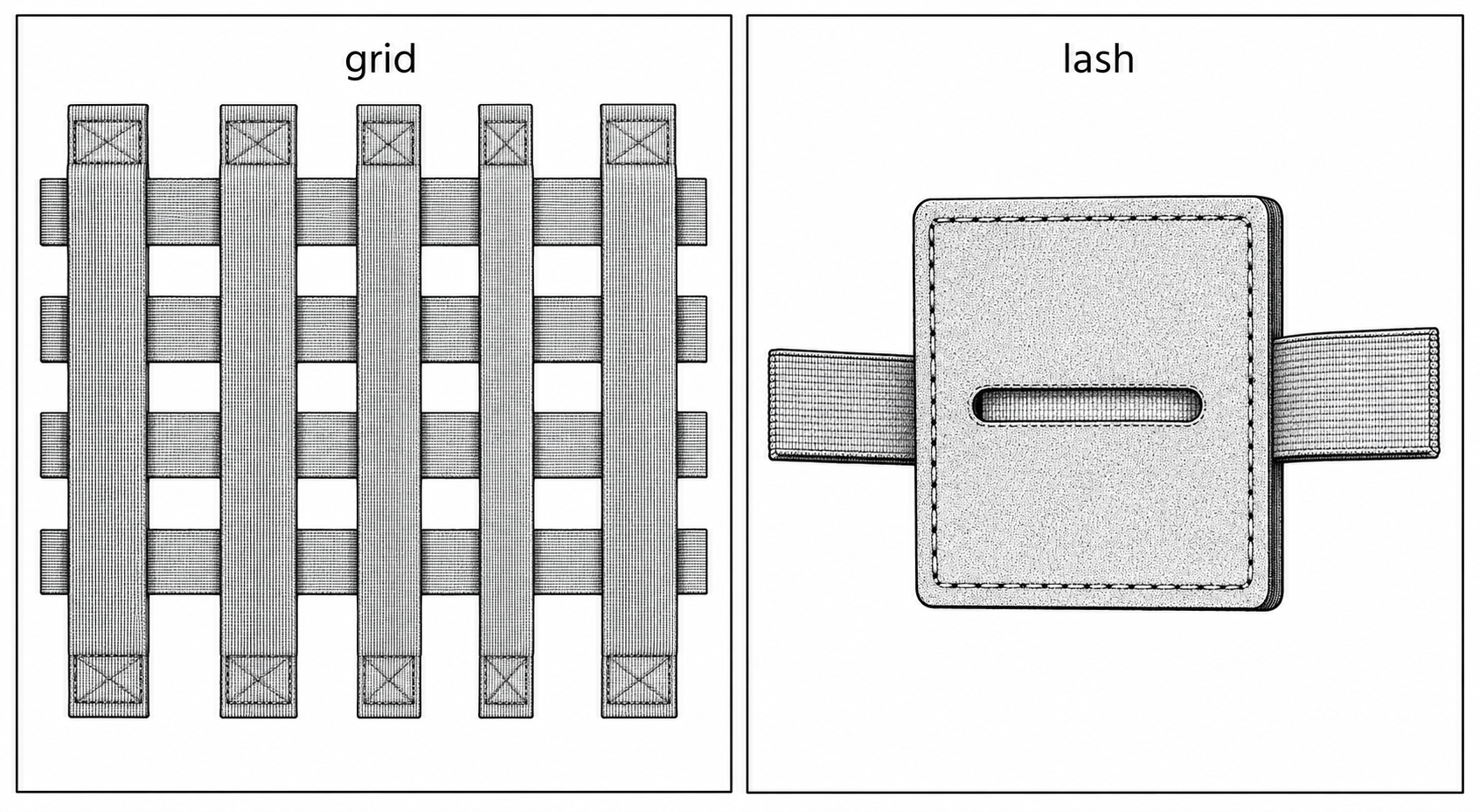 Repeat lattice vs point attachment. Illustrative only.