Zippers
Chain, slider, and tape are three separate systems; "YKK zipper" names none of them.
- Volume
- 03
- Order
- № 02
- Read
- 6 min
- Published
Every bag has at least one. Most have several. The zipper is the component people touch more than any other single part of a bag - open, close, open, close - and yet it is almost universally described on a spec sheet as a single noun. “YKK zipper.” That tells you almost nothing about what you actually have. Understanding the anatomy, and the vocabulary behind it, changes how you read those specs and how you diagnose problems when they arrive.
Anatomy
A zipper consists of at least three separable systems: the chain, the slider, and the tape. Treating them as one part is how failures get misdiagnosed.
The chain is the interlocking element, and it comes in three principal construction types. A coil chain uses a continuous spiral filament - most commonly nylon or polyester - woven or sewn into the tape edge. When a coil zipper closes, the two spirals interlock at their helical contact points. Coil zippers flex well across curves, which is why they dominate bag applications where the zip line is not perfectly straight. Their failure mode is deformation of that filament: once the spiral geometry is disturbed, the interlocking interface deteriorates.
A molded tooth chain - sometimes called a metal or plastic tooth chain - uses individual elements stamped or injection-molded onto the tape at regular intervals. Teeth are stiffer per element than coil, project higher off the tape face, and have a more positive engagement geometry. The trade-off is that they follow curved stitch lines less gracefully and are heavier.
VISLON® is YKK’s term for their injection-molded polyacetal tooth construction - a specific product family within the molded-tooth category. The teeth are formed directly onto the tape through injection molding rather than attached as separate pieces. This is a brand term, not a generic category name; other manufacturers have their own injection-molded plastic-tooth lines.
The slider is its own assembly: a slider body, a pull tab (also called a puller), and a locking mechanism if the zipper is auto-locking. YKK’s glossary codes these as separate parts for good reason - the slider body determines the engagement geometry, the pull tab determines the grip surface and fail point, and the lock determines whether the slider stays in position under vibration or load. Collapsing these into “the slider” misses where failures originate.
The tape is the woven carrier that everything mounts to. Standard tapes are woven polyester. YKK’s NATULON® product line uses tape woven from recycled PET - post-consumer recycled polyester - and the tape material is a product-line fact, not a universal YKK fact. Not all YKK tapes are recycled PET. NATULON® may show color variation because of the recycled input material; dye-to-match precision is reduced.
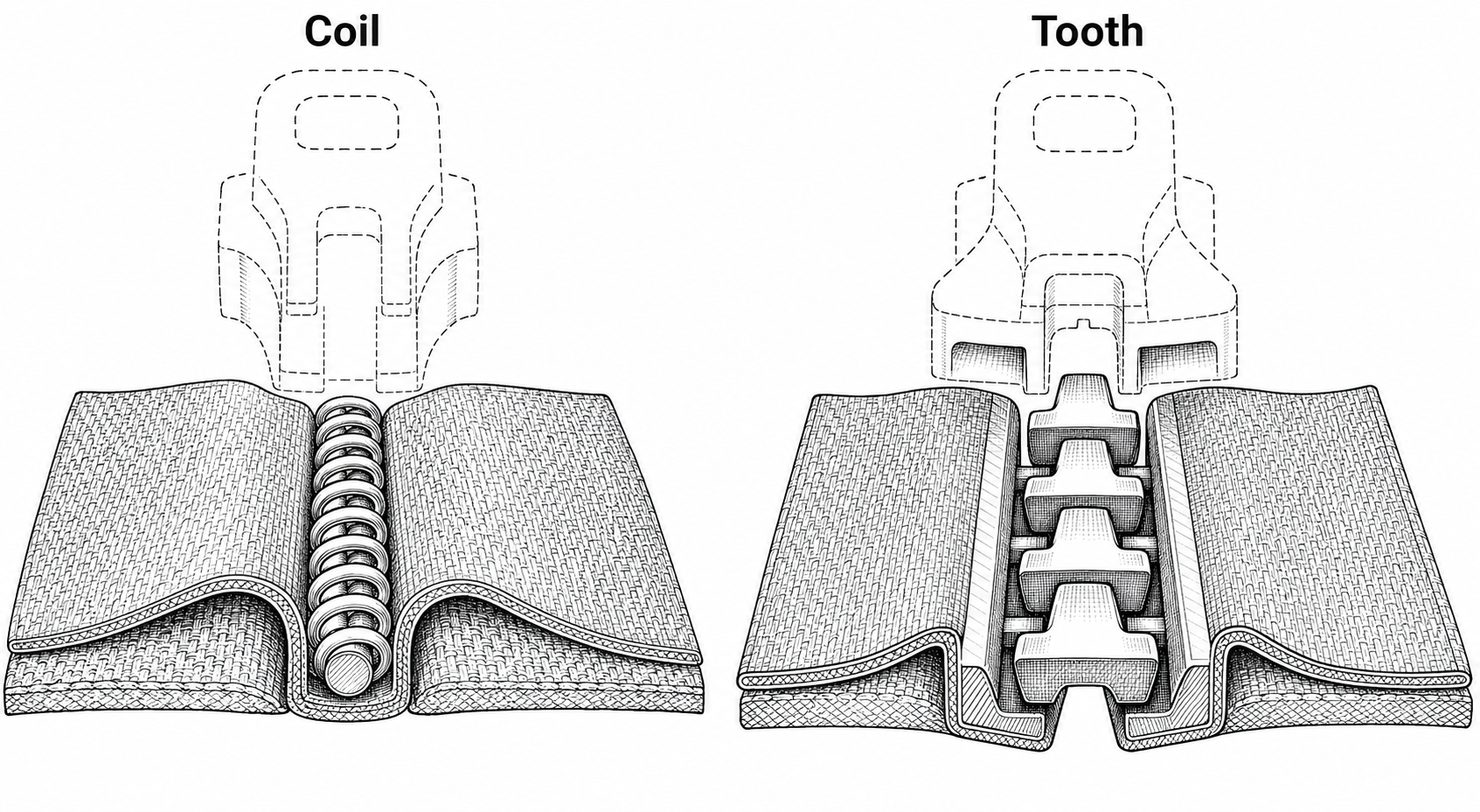 Coil lives inside the tape; teeth march on sturdier legs. Illustrative only.
Gauge
The number in “YKK #5” or “YKK #8” refers to the zipper’s element size - a measurement related to the width of the closed chain in millimeters. A #3 chain has smaller elements than a #5; a #10 has larger elements than an #8. YKK’s glossary lists gauge codes including 3, 5, 6, 8, 9, 10, and 45 (which represents 4.5 mm). The number is a size reference, not a direct load rating. Two #5 zippers from different chain types - coil versus VISLON®, for example - are not interchangeable in terms of mechanical behavior just because they share a gauge number. Any conversion from gauge to specific strength must be verified at the SKU level [verify against manufacturer].
Reading gauge in the field: the chain width of a closed zipper, measured at its widest point, gives a rough indication. A #3 chain is slim and light; typical on interior or secondary pockets. A #5 is the workhorse of bag main compartments. A #8 or #10 appears on luggage, duffel openings, or anywhere the designer wanted a more positive engagement feel and was willing to accept the weight.
Waterproofing
This is where marketing language and physical reality diverge most sharply, and the distinction matters.
YKK’s VISLON® AquaGuard® page states explicitly: the zipper is water resistant, not waterproof or watertight. That language is from YKK themselves. The mechanism is a DWR (durable water repellent) treatment on the tape and elements, combined in some configurations with a PU film laminate over the tape back. The AquaGuard® NATULON® variant uses a PFC-free DWR treatment and PU film lamination according to YKK’s product copy [verify against manufacturer for operation-force specifications].
What water-resistant actually means in practice: the zipper resists light rain and splash. Sustained immersion, submersion, or high-pressure spray will eventually pass water through. When a bag is described as “waterproof” with an AquaGuard® zipper, the “waterproof” claim belongs to the system - sealed seams, coated shell, flap coverage - not to the zipper element alone.
Reverse-coil zippers address a different problem: they put the coil face on the inside of the tape, so the mating surfaces are away from the weather. This reduces direct water ingress at the chain face. It does not seal the zipper; it changes the geometry of the gap. DWR-taped reverse-coil zippers combine both approaches.
“Barrier sealing” - the approach used in drysuits and truly waterproof zipper assemblies - involves a different mechanism entirely: mating profiles that physically compress against each other to create a fluid seal. This is a distinct product category. ASTM D2061 covers strength tests for zipper and zipper parts; separate standards (AATCC TM35, AATCC TM127, ISO 811) address water penetration and hydrostatic pressure resistance of textile assemblies. No single test determines zipper suitability for a specific end use.
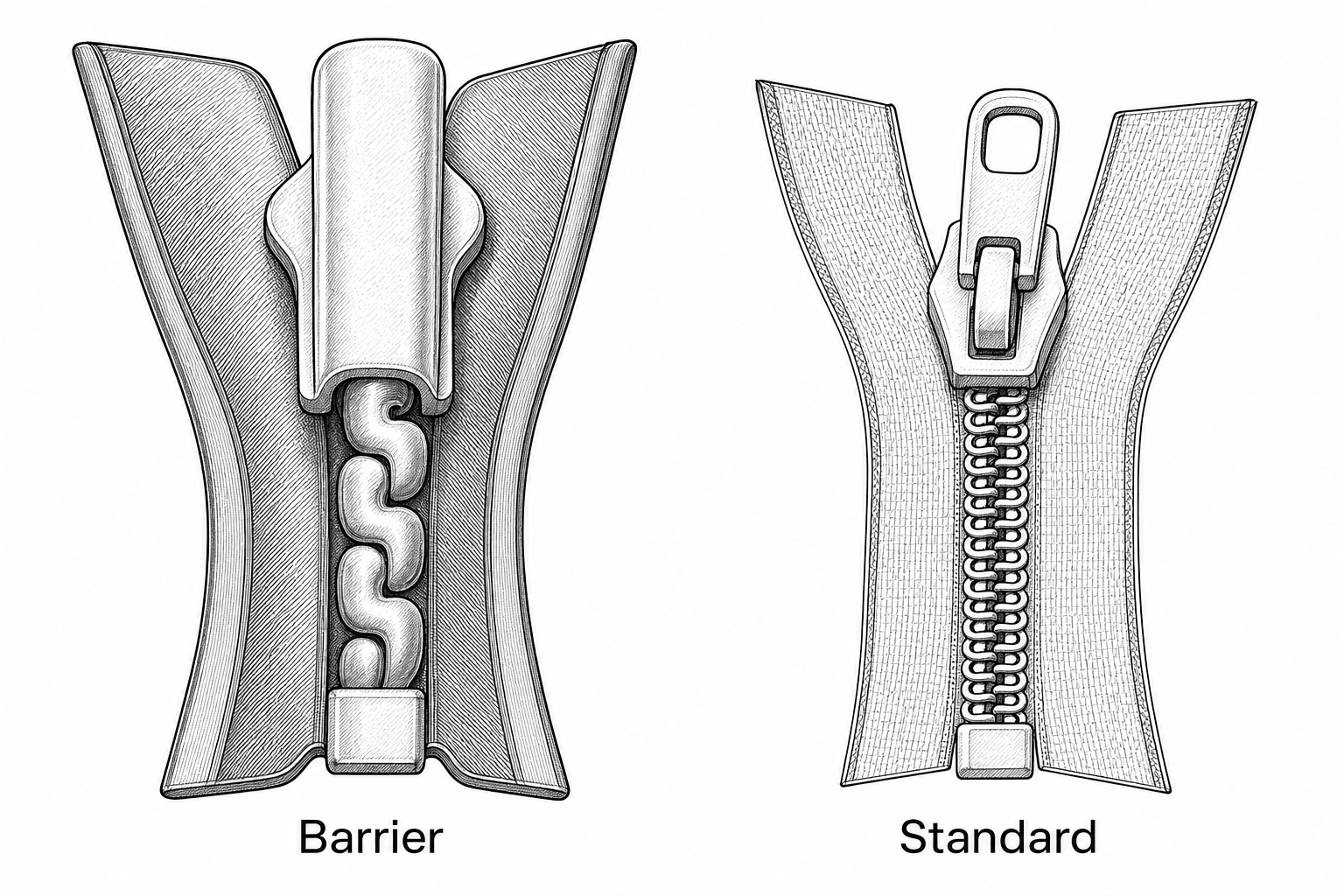 Barrier geometry vs everyday coil. Illustrative only.
Pull Materials
The pull tab - the part your fingers actually grip - is coded separately from the slider body in YKK’s system. Common materials: zinc alloy (cast, heavier, durable, subject to plating wear), aluminum (lighter, softer, anodized or painted surface), cord (eliminates the metal pivot failure point, adds flexibility), and custom shapes (brand-differentiated, often injection-molded).
What fails: plating wears through at contact points, revealing base metal; pivot pins fatigue and eventually allow the tab to separate from the slider body; cord frays at the crimped or stitched attachment point, often before the cord material itself fails. A pull tab that feels slightly loose has usually reached the pivot-wear phase. Replace the slider before it separates entirely.
Failure Modes
ASTM D2061 names the test categories for zipper and zipper parts. They map to observable failures:
Coil distortion - the filament deforms, interlocking geometry fails. What it looks like: slider moves but chain does not close; or closes behind the slider but springs open. Cause: lateral load, over-stuffing the compartment, sharp fold through the chain.
Slider pull-off - the slider separates from the chain. ASTM calls this “slider pull pull-off” and “angular pull-off.” What it looks like: slider reaches the end stop and the chain pops out of the slider body under tension. Cause: worn slider geometry, chain element damage at the end stop.
Stop failure - the end stop (top or bottom) detaches or deforms, allowing the slider to run off the chain end. What it looks like: slider falls off. Cause: improper installation, fatigue at the crimp.
Tape separation - the tape delaminates from the chain or from the bag panel at the sewn joint. What it looks like: the chain floats free of the tape edge; the whole zipper assembly peels away from the panel seam. ASTM tests include twist, torsion, and compression categories that correspond to the load paths that cause tape failure.
ASTM D2061 notes explicitly that no one test determines suitability for a specific end use, and that more than one test may be needed for complete evaluation.