Thread
Bonded nylon or polyester, the Tex scale, and why break strength is not seam strength.
- Volume
- 03
- Order
- № 07
- Read
- 4 min
- Published
Thread is the last component most bag buyers consider, and the first one to show field wear on an exterior bag. Understanding the Tex system and the two dominant fiber families for industrial bag thread takes less than ten minutes. It saves considerably more confusion than that.
Bonded Nylon vs. Bonded Polyester
Industrial bag sewing thread is almost always bonded - meaning the multifilament yarn bundle is coated with a resin (typically a heat-set nylon or polyurethane) that binds the individual filaments together. This prevents filament separation during high-speed sewing, reduces friction through the needle eye, and gives the thread consistent handling behavior on an industrial machine.
The two fiber families:
Bonded nylon thread has good tensile strength, good elongation (useful for applications where the sewn seam flexes in use), and reasonable abrasion resistance at the stitch surface. Its weakness is UV sensitivity. Nylon degrades under prolonged sunlight exposure; the polymer backbone absorbs UV radiation and undergoes photolytic chain scission, reducing tensile strength over time. The Thread Exchange notes that polyester thread has superior sunlight and UV resistance, and superior mildew resistance, compared with nylon.
Bonded polyester thread has similar strength to bonded nylon, somewhat lower elongation, and significantly better UV and mildew resistance. For outdoor bags, stitching on exposed seam lines, or any application with prolonged sun exposure, polyester is the more durable choice. For interior seams and applications where UV exposure is limited, the fiber choice matters less.
Neither is universally “stronger” than the other in absolute terms; seam performance depends on fiber, stitch density, fabric, needle, seam type, and application.
Tex Rating System
The Tex system is a direct measure of thread weight: Tex = mass in grams per 1000 meters of thread. A Tex 30 thread weighs 30 grams per 1000 meters; a Tex 90 weighs 90 grams per the same length. Higher Tex number = heavier, thicker thread = larger needle required = more material per stitch = more thread visible at the seam surface.
Tex 30–90 covers the practical range for bag and gear sewing. Tex 30–45 is appropriate for lighter fabrics, fine seams, and interior stitching where thread visibility is not desired. Tex 70 is a common workhorse weight for pack cloth and webbing attachment. Tex 90 is for heavier applications - saddle bags, tactical gear, repeated high-load stitch zones.
Thread size also determines needle sizing. Vendor charts pair thread sizes with needle ranges:
- Tex 45: approximately 90/14 to 100/16 needle [verify against Superior Threads bonded needle guide and The Thread Exchange needle chart]
- Tex 70: approximately 100/16 to 110/18 needle [verify against manufacturer]
- Tex 90: approximately 110/18 to 125/20 needle [verify against manufacturer]
These are vendor recommendations; the right needle also depends on the specific fabric stack, needle system, and machine. The Thread Exchange notes that Tex 70 (Size 69 in government sizing) is typically the thickest thread most home sewing machines can handle [verify against specific machine model and capability].
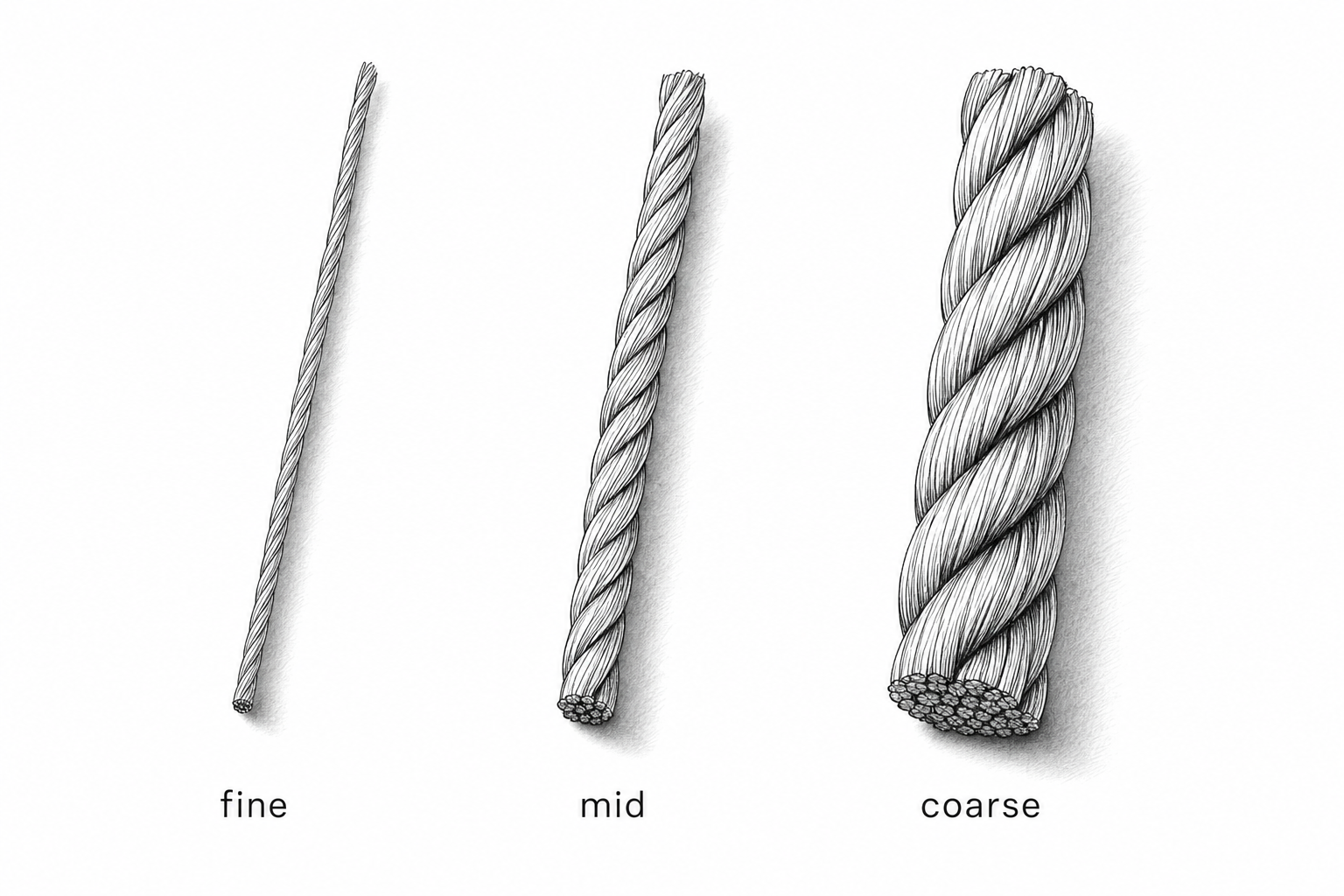 Thicker thread eats larger needle holes. Illustrative only.
UV Degradation
Bonded nylon thread on exposed exterior seam lines ages visibly under UV. The observable sequence: the surface resin coat dulls and loses sheen first; the thread then becomes slightly fuzzy as the resin loses its binding; eventually the thread develops a powdery or chalky appearance at the most exposed surfaces (typically the tops of seam ridges, where the thread loops are fully exposed to sunlight).
This chalking is a field indicator of UV degradation. It does not mean the seam has failed; it means the thread’s UV exposure history is visible and the tensile capacity of that thread has likely decreased relative to its original state. The precise degradation rate requires measured test data and defined exposure conditions - no general number is publishable [verify against manufacturer/test].
What to look for in the field: exterior seam lines on the sun-facing face of a bag (typically the back panel on a backpack, the top panel on a shoulder bag). Run a fingernail lightly along the stitching. Bonded thread in good condition has a waxy or smooth surface. Degraded bonded thread has a matte or powdery surface and may shed fine white particles. If the thread in a high-load seam - a handle attachment, a strap base, a zipper tape stitch - shows chalking, inspect the seam for separation under gentle peel load before trusting the attachment.
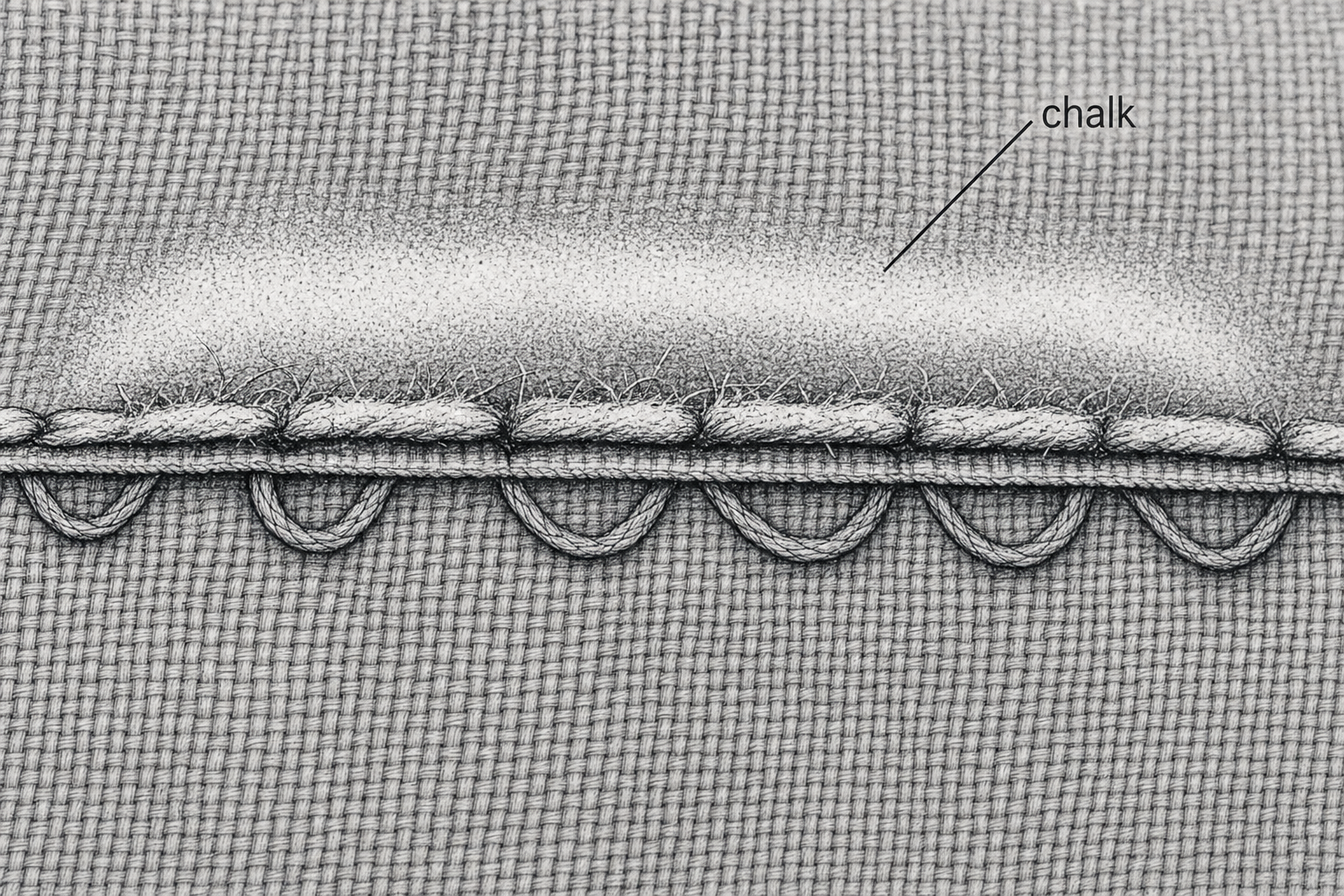 Sunlight finishes what abrasion started. Illustrative only.
Seam Strength Caveat
A common error is to read a thread’s single-end break strength from a manufacturer chart and treat it as a seam strength. It is not.
A&E (American & Efird), one of the major industrial thread manufacturers, states explicitly in their thread size comparison chart that single-end break strength values are for comparative purposes and should not be used as minimum seam requirements. Finished seam performance depends on thread tensile strength, but also on fabric tear strength, stitch density (stitches per inch), stitch type, seam allowance width, thread elongation, needle size and condition, and the load angle relative to the seam direction. ASTM D1683 covers woven textile seam strength under tensile loads; actual seam performance requires fabric-and-thread combination testing, not thread specification alone [verify against primary standard before publishing procedural claims].