Straps
Webbing fiber, foam density, and the bar tack that ends up carrying the whole shoulder load.
- Volume
- 03
- Order
- № 03
- Read
- 6 min
- Published
A shoulder strap transfers body-weight load from the bag to the human. That is its primary mechanical function. Everything else - padding, adjustment, material feel, moisture management - is in service of that transfer, or in service of making the transfer tolerable for eight hours. Understanding the component stack from webbing fiber through attachment stitch gives you the vocabulary to evaluate straps honestly.
Webbing Materials
Nylon webbing is the workhorse. MIL-W-4088 (currently in revision as MIL-W-4088K) is the U.S. military specification for nylon webbing; it defines types and classes with different widths, thicknesses, weights, and tensile values. Bally Ribbon Mills lists examples including types rated at 500 lb, 600 lb, 800 lb, 1,800 lb, 2,500 lb, 4,000 lb, and 6,000 lb - but these are type-specific values, not general statements about nylon webbing. Nylon absorbs some moisture and elongates slightly under sustained load; elongation is mostly elastic at bag-use loads, not a degradation concern in ordinary use [verify against manufacturer/spec].
Polypropylene webbing is lighter and less expensive than nylon. It does not absorb moisture, which makes it dimensionally stable when wet. Its weaknesses: it is more UV-sensitive than nylon, elongates less before failure (which makes it stiffer but less forgiving under shock load), and has lower melting point. Many budget bag shoulder straps use polypropylene; it is functional but wears differently.
UHMWPE/Dyneema webbing occupies a different tier. Ultra-high-molecular-weight polyethylene has an exceptional strength-to-weight ratio and is UV stable, abrasion resistant, and chemically resistant to most substances (oxidizing acids are an exception). Sturges Manufacturing describes their UHMWPE webbing as lighter and thinner than traditional-fiber webbing at comparable breaking strengths; specific breaking-strength values in their catalog are part-number specific and should not be generalized [verify against manufacturer]. UHMWPE webbing has low elongation - it is stiff for its cross-section - and does not absorb water. It appears on ultralight packs and technical climbing-adjacent gear where pack weight and moisture management are primary design constraints.
Width and Stiffness
Width is the most visible specification on a strap, and it carries direct physical consequences.
Common widths in bag construction: 15 mm for secondary adjustment straps and sternum straps; 25 mm for light shoulder straps and luggage handles; 38 mm for primary shoulder straps on loaded packs. The numbers correspond to hardware sizing - a 25 mm triglide accepts 25 mm webbing.
Wider webbing distributes load over a larger surface area; narrower webbing concentrates it. At equivalent load, a 15 mm strap delivers more pressure per unit area than a 38 mm strap. This matters at the shoulder contact point: narrow straps cut into soft tissue faster at load. It also matters at the buckle or adjustment hardware: the webbing-to-hardware interface at 38 mm is geometrically more tolerant of load angles than the same hardware at 15 mm.
Bend stiffness increases with width for a given material and thickness. A 38 mm nylon webbing resists draping and conforms less easily to body contour than a 25 mm webbing of the same fiber. Padded strap systems manage this by adding foam compliance on top of a stiff webbing spine.
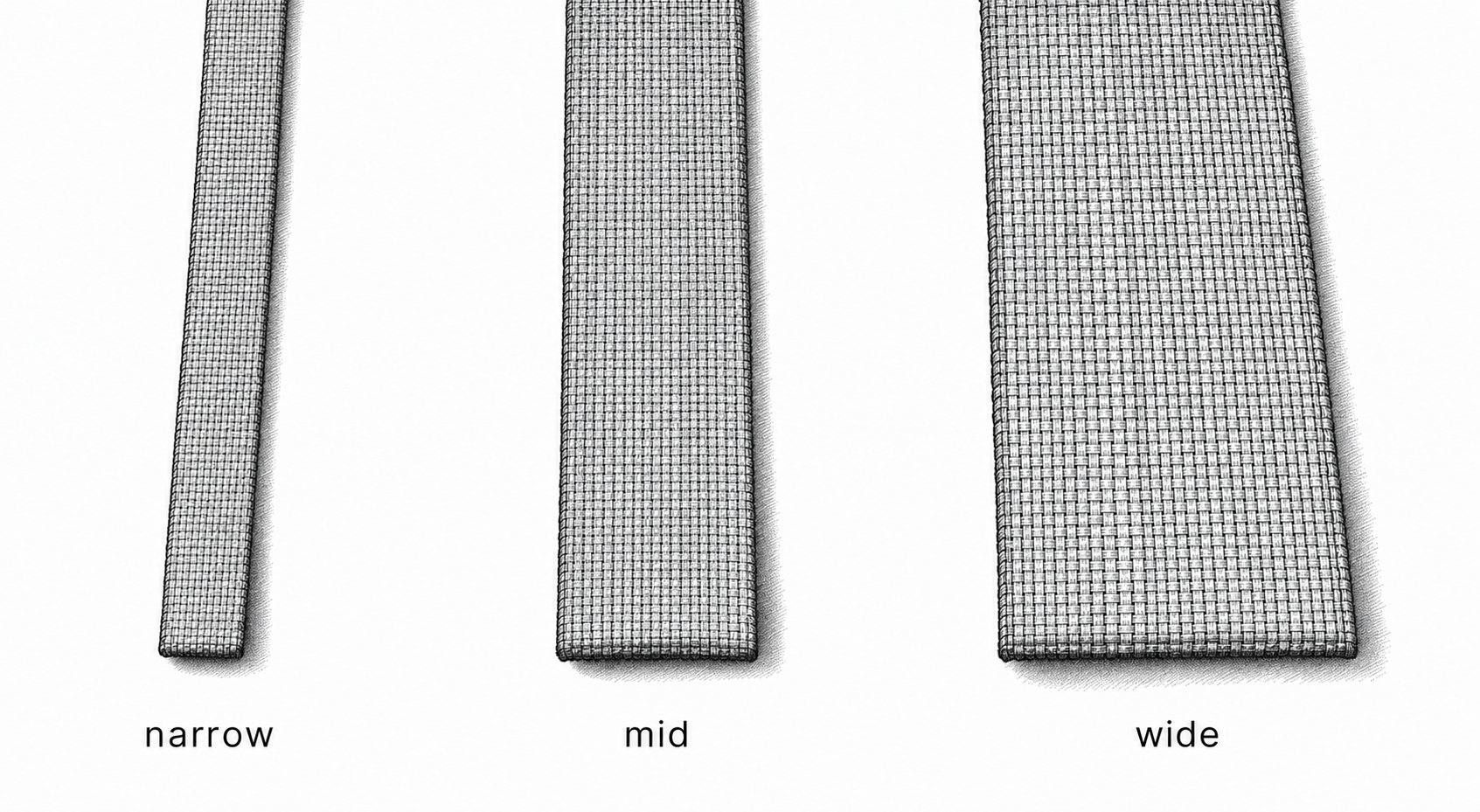 Width changes bend stiffness and bite pressure. Illustrative only.
Padding
Padding in a shoulder strap is almost always a layered system: a face material (often a knit or woven surface), a foam core, and a back surface (often spacer mesh or a softer fabric for breathability). The foam choice determines most of the mechanical behavior.
Closed-cell EVA (ethylene-vinyl acetate) is the most common strap foam. It is denser than open-cell foams, more water-resistant (closed cells do not absorb moisture), and has predictable compression behavior at moderate loads. The failure mode for EVA in a strap is compression set: after sufficient cycles of load and unload, the foam does not fully recover its original thickness. A shoulder strap that has gone soft and flat has typically reached this point. EVA density, thickness, and lamination are SKU-dependent properties; “EVA padding” alone does not guarantee any particular performance [verify against manufacturer].
Open-cell foams are softer and more porous. They compress more readily under load, which can feel more comfortable initially but means they absorb sweat and take longer to dry. Open-cell padding in a strap back is a moisture management choice with a maintenance trade-off.
Spacer mesh undersides are a different approach: instead of foam against skin, a 3D knit spacer mesh creates an air channel between the strap back and the body. This improves ventilation at the cost of some load distribution - spacer mesh has less inherent compliance than a foam layer. Many technical packs use foam on the compression axis and spacer mesh on the ventilation face, combining both in a single cross-section.
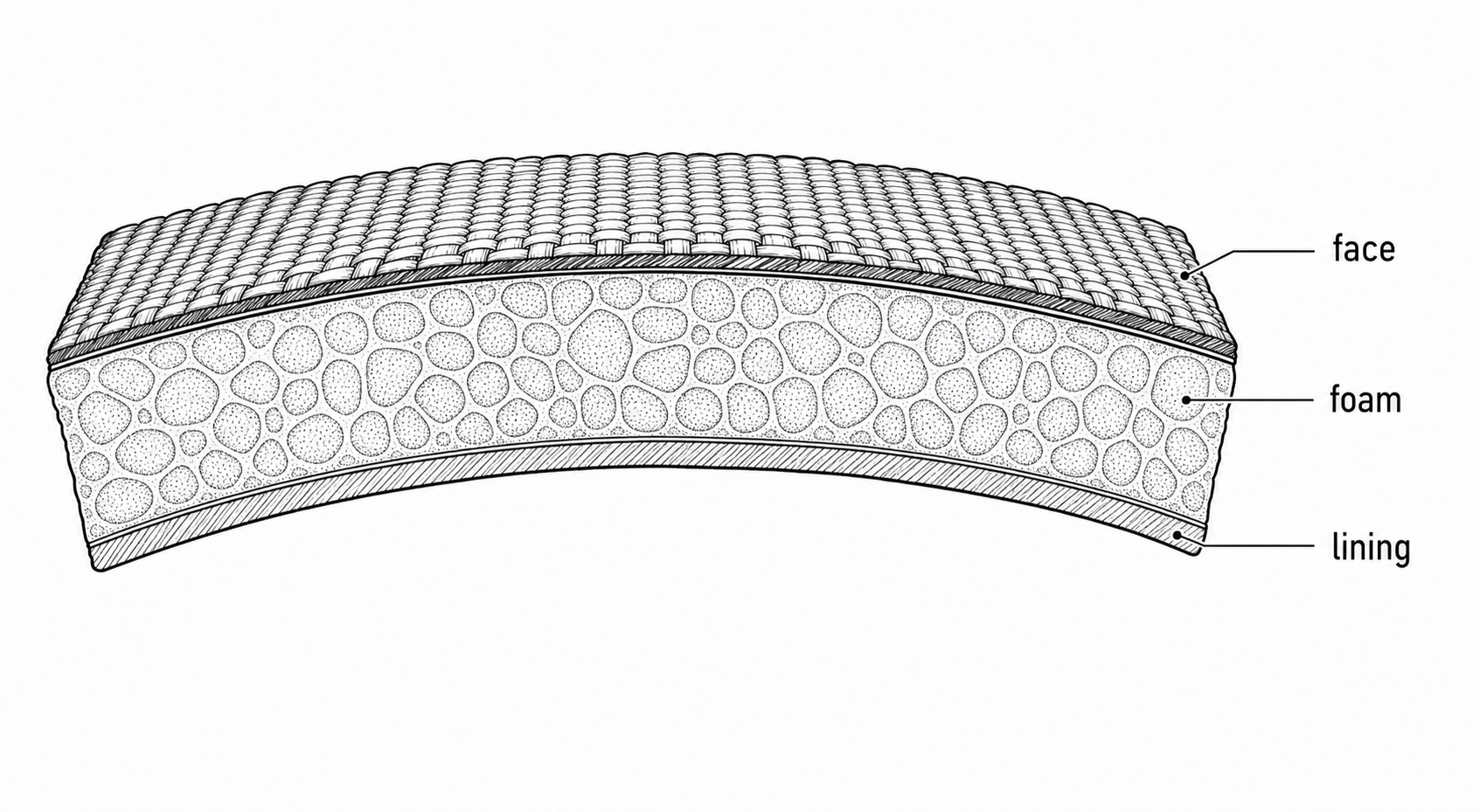 Foam stack between faces - bend radius and sweat rate. Illustrative only.
Adjustment Hardware
Triglides - three-bar slides - allow continuous strap length adjustment. The webbing passes over the outer bar, back under the middle bar, and over the outer bar again, creating a friction grip that holds position under load. The three-bar geometry is what distinguishes a triglide from a two-bar slide; the extra bar creates the friction lock without a mechanical gate. Slippage under heavy load is a function of webbing surface texture, bar diameter, and the angle of the webbing path through the hardware.
Ladder locks are one-way grip devices: a toothed or angled gate bites the webbing when pulled in one direction and releases when pushed in the other. They are common on sternum straps and load-lifter adjusters where the user wants quick release. What causes slippage: worn gate teeth, a webbing width that is too narrow for the hardware slot, or polypropylene webbing (which has lower surface friction than nylon against plastic).
Both triglides and ladder locks transfer load through their plastic frame into the webbing threads that constrain them. The hardware is not a structural terminus; it is a relay point. The structural terminus is the bar tack or box stitch that fixes the hardware’s position on the strap assembly.
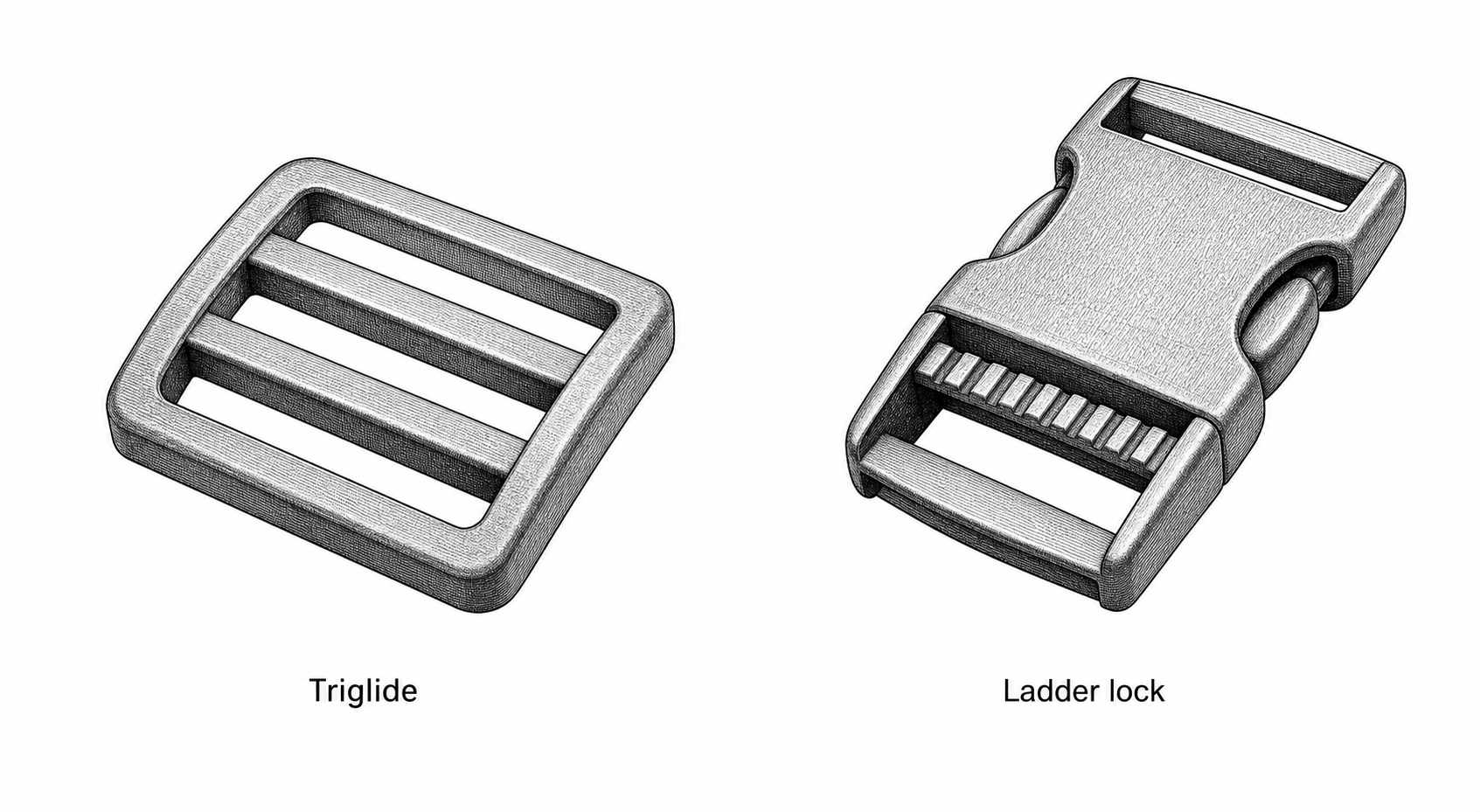 Adjustment geometry in plastic. Illustrative only.
Attachment
Where a shoulder strap terminates at the bag body, the load must transfer from webbing into panel fabric or frame. This is the highest-stress point in the strap system.
A bar tack is a dense cluster of thread passes, typically a zigzag pattern, laid over the webbing at the attachment zone. It is used where webbing meets panel fabric, where a buckle tab is folded, or at any point where a concentrated load needs to be spread across more thread passes than a standard seam can provide. Bar tacks are the correct terminology for this reinforcement method; the stitch pattern, thread, needle, stitch density, seam allowance, and load direction all matter. Stitch pattern alone does not determine strength [verify against specific application and test method].
A box-X stitch - a rectangular pattern with diagonal reinforcement - is common on luggage handles and on attachment points where the load is bidirectional. The geometry distributes peel load more evenly than a bar tack optimized for a single pull direction.
What tears out before the webbing breaks: in most bag-scale failures, the fabric around the attachment point is the first to fail. The webbing and the thread have more tensile capacity than the panel material at the attachment zone. This is why the stitch pattern matters less, at the margin, than the reinforcement patch beneath it - a secondary layer of heavier fabric or bartack tape under the attachment distributes the point load over more panel fibers.