The Part That Quit First
A three-year-old daypack with clean fabric, retired by a zipper.
- Volume
- 03
- Order
- № 01
- Read
- 2 min
- Tags
- prologue
- Published
The bag in question was a mid-size daypack, roughly three years out of the box. The face fabric was clean. The base showed some scuffing. The lining was intact. By every visible measure, the bag had life left.
The zipper on the main compartment had other information.
It did not fail dramatically. There was no catastrophic split, no sudden cascade of teeth. It started as a soft inconsistency - the slider required a slightly higher grip-force to complete the arc. Over the following weeks that became a noticeable drag. Then, one morning, the slider reached the midpoint of the run and simply stopped closing the chain behind it. The coil on one side had distorted enough that the interlocking geometry was gone. The chain was technically present; the engagement was not. The slider would travel; the zipper would not close.
The panel, which had been through the same three years of use, the same rain and sun and compression, was fine. Structurally unchanged. The zipper tape - the woven carrier that bonds the chain to the panel - was also intact. The coil itself, the continuous spiral filament that does the actual interlocking work, had deformed past the point of recovery. A few hundred dollars of panel material, a well-sewn lining, a functional frame - all of it made unusable by a part that costs, at scale, a fraction of a dollar.
That mismatch is the premise of this book.
It is not a surprising failure mode. Every zipper chain is a mechanical device: two rows of interlocking elements, each shaped to engage under lateral compression. The slider holds the geometry while it is in transit. When the slider is gone or the elements distort, the mechanical system loses its interface. The panel has no moving parts. It just sits there, absorbing load evenly across its face, doing nothing interesting. A woven or laminated panel can absorb years of abuse with only surface evidence. A zipper coil runs a far more demanding mechanical cycle every single time the bag is opened or closed. The part that cycles most frequently tends to exhaust first.
This is also true of the pull tab that fatigues at the pivot. The bar tack that slowly migrates from the buckle attachment point. The ladder lock that eventually stops gripping because its gate has worn past tolerance. The shoulder-strap foam that compresses past its elastic limit and never rebounds. Every one of these parts fails, on a statistical basis, well before the panel that surrounds them.
The bag’s age is written in its parts. That is what this book teaches you to read.
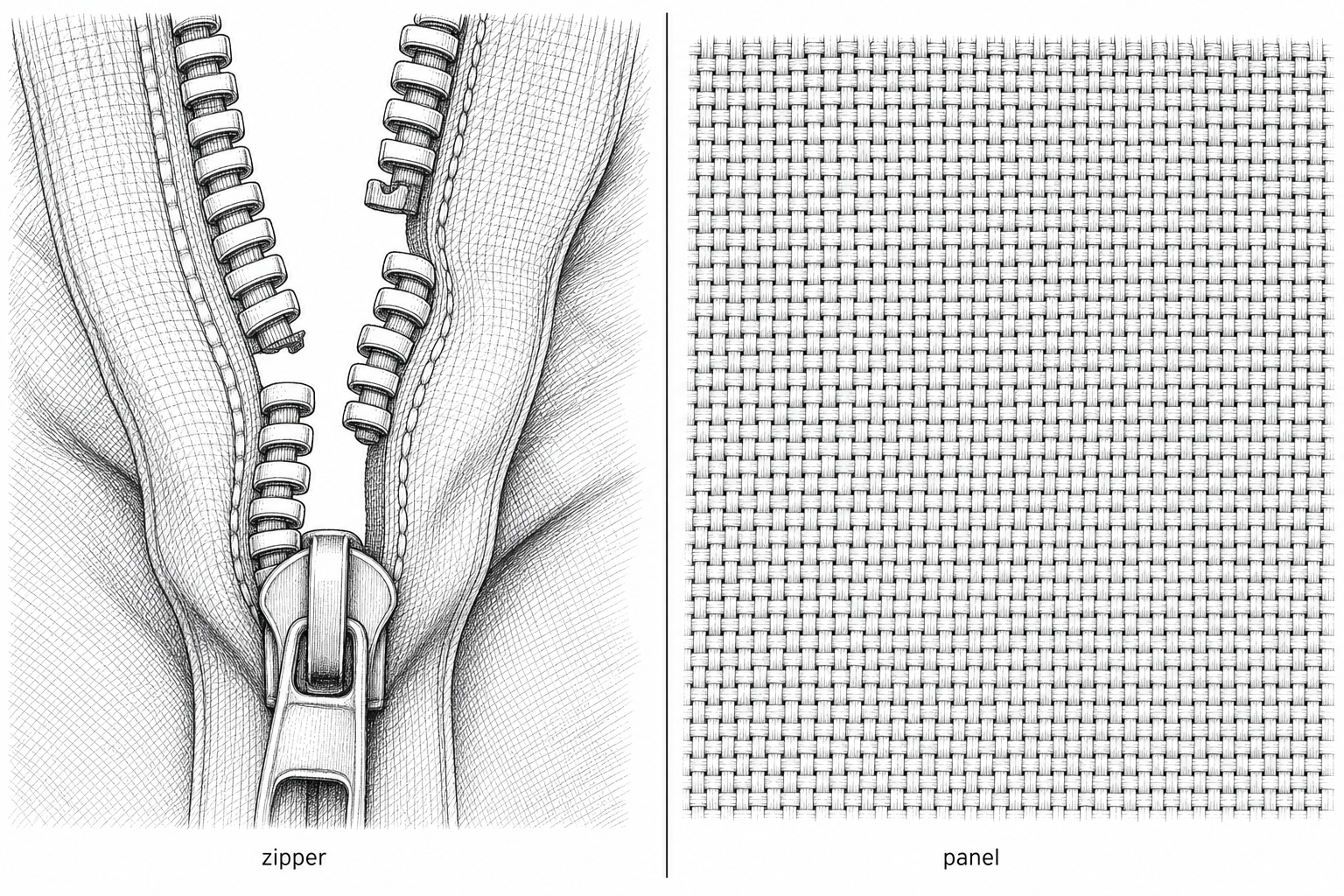 The panel markets; the part retires. Illustrative only.