Mesh
Cell geometry, spacer knits, and stretch blends - three fabrics hiding under one word.
- Volume
- 03
- Order
- № 05
- Read
- 4 min
- Published
Mesh in a bag is not a single material. It is a construction category that includes at least three functionally distinct fabric types, each suited to a different role. Treating them interchangeably - calling all open fabrics “mesh” and leaving it there - misses the actual engineering decisions in a bag’s design.
Cell Geometry
Hex/honeycomb mesh uses a repeating hexagonal cell, where each cell wall is shared between two adjacent cells. The geometry is stiff in the plane of the mesh and distributes point loads along cell walls rather than concentrating them at a single vertex. The cells are not circular, so drainage is directional - water follows the cell wall geometry rather than pooling uniformly.
Square-grid mesh uses right-angle intersections. The cell geometry is simpler to produce and easier to count for aperture consistency. Under distortion (stretch or peel), square grid mesh tends to shear more readily than hexagonal because the right-angle walls have less geometric resistance to racking.
Monofilament vs. multifilament construction is an independent variable from cell geometry. Monofilament mesh uses single-strand yarns at each position: stiff, uniform aperture, abrasion resistant, relatively predictable in drainage behavior. Multifilament yarns - bundles of finer fibers - are softer and more flexible but create a less uniform aperture because the bundle can compress and spread. Snag behavior differs: a monofilament broken by a sharp edge fails cleanly and locally; a multifilament broken at the same point frays across the bundle, creating a visible fuzzing before hole propagation.
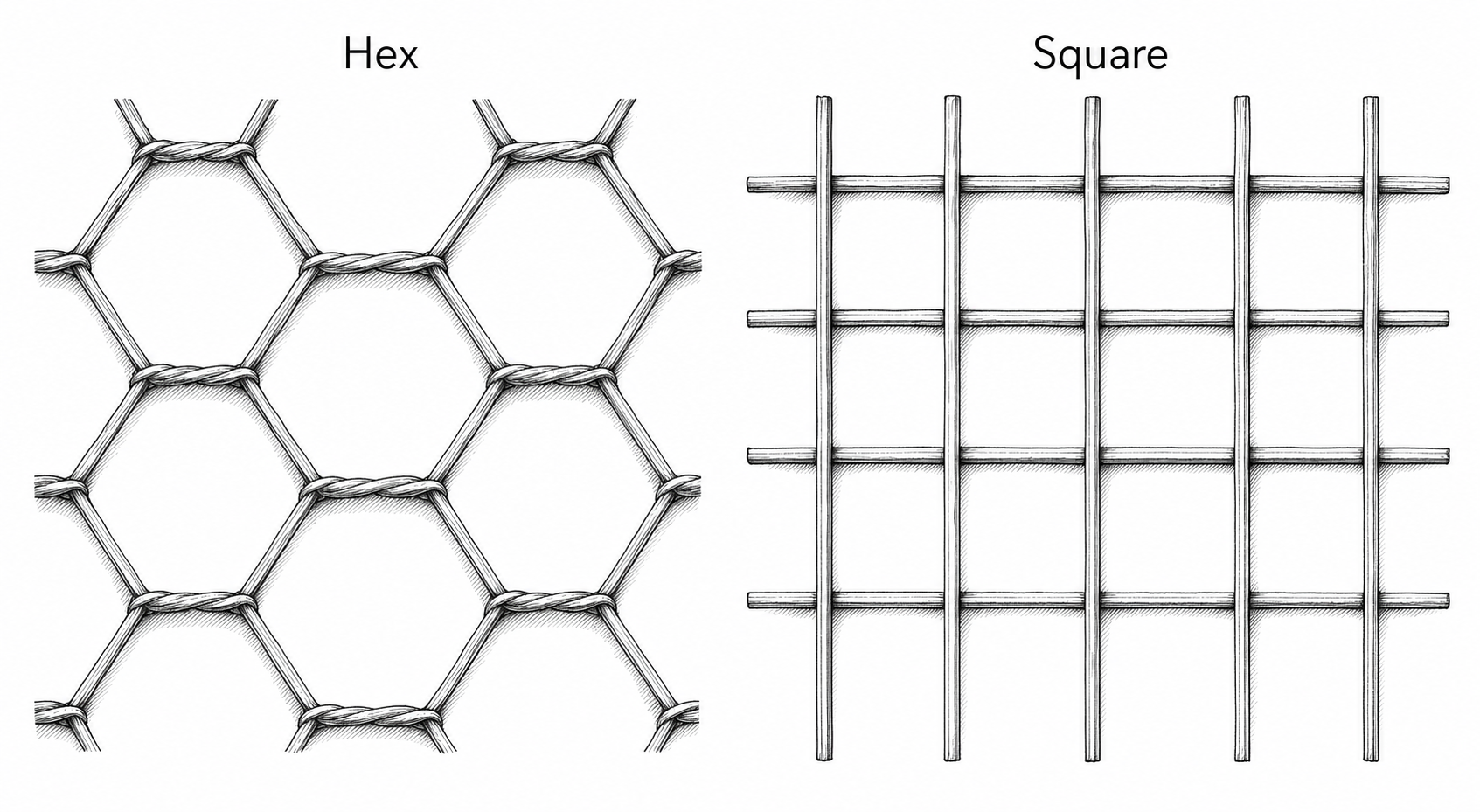 Cell shape changes snag and stretch. Illustrative only.
Spacer Mesh
Spacer mesh is structurally distinct from the flat meshes above. It is a 3D knitted fabric: two outer fabric layers connected by vertical spacer yarns that hold the layers apart. The result is a textile with inherent thickness - typically 1–5 mm depending on construction [verify against manufacturer] - and a compressed-air channel between the faces.
This structure serves two functions in bags. First, as a back panel material: the air channel permits airflow between the pack body and the user’s back, reducing the sweat-soaked contact surface. Second, as a strap underside: the spacer layer provides some compliance under load (similar to but less than foam) while maintaining better moisture transport than closed foam.
The spacer yarns can be monofilament or multifilament. Monofilament spacer yarns are stiffer and maintain their loft under sustained compression more reliably. Multifilament spacer yarns are softer to the touch. Thickness, weight, and loft recovery under sustained load are product-specific properties [verify against manufacturer for TVF’s 4–5 mm, 8.7 oz/sq yd spacer mesh specifications or equivalent].
Stretch Mesh
Stretch mesh adds elastane (spandex) to the base fiber, typically nylon or polyester. The elastic component allows the mesh to deform and recover, which is useful for bottle pockets, compression panels, and any application where the mesh must accommodate variable contents.
The trade-off is puncture and snag resistance. Elastane blends have lower resistance to sharp-point penetration than a pure nylon or polyester mesh at the same denier; the elastic fibers contribute stretch but not hardness. A nylon/spandex blend bottle pocket will snag on a key ring or rough surface more readily than a monofilament nylon mesh pocket of similar aperture. Some technical pack makers use UHMWPE/nylon/spandex blends to recover some abrasion resistance without giving up the stretch; these are specific material choices at the SKU level [verify against manufacturer].
Drainage
Drainage rate through a mesh pocket is a function of aperture size, aperture density, and the angle of drainage. A larger aperture drains faster than a smaller one, all else equal. This is basic fluid mechanics: the hydraulic resistance of an opening increases as aperture diameter decreases.
The cell geometry - hex versus square - affects drainage only insofar as it determines effective aperture for a given mesh repeat and filament diameter. A hex mesh and a square mesh with identical filament diameter and identical center-to-center spacing will have similar effective aperture and similar drainage behavior. Claims that hex mesh drains measurably faster than square mesh at equal aperture are not supported by general evidence. Drain behavior for a specific mesh requires the specific mesh [verify against manufacturer/test].
Failure Modes
Snag: an external point catches a yarn and pulls it. In multifilament mesh, the yarn bundles and creates a pulled loop. In monofilament mesh, the yarn breaks cleanly. Both degrade the aperture geometry locally.
Pilling: multifilament mesh surfaces, especially those with softer nylon or polyester fibers, pill under abrasion - the fiber ends ball up at the surface. Martindale abrasion testing (ASTM D4966) measures this; the standard covers knit, woven, and nonwoven fabrics with appropriate suitability limits.
Tear at binding: the edge binding of a mesh pocket is the failure initiation point for most pocketformat tears. The stiff edge binding concentrates peel load at its termination; tears propagate from binding ends into the mesh body. Reinforced bartacks at the binding corner points resist this.
UV degradation of dyes: mesh pockets are often the most sun-exposed part of a bag. Dye fading is cosmetic; UV degradation of the yarn itself - reduced tensile strength, increased brittleness - is structural. The timeline is exposure-dependent.