Insulation Linings
Closed-cell foam, metallized film, and PEVA - cold retention is a system property, not a layer.
- Volume
- 03
- Order
- № 06
- Read
- 4 min
- Published
An insulated bag pocket - the kind intended to slow temperature exchange with groceries or a lunch - contains a material stack that is worth understanding layer by layer. The stack is not complicated, but the marketing language around it usually obscures rather than clarifies what each layer actually does.
Foam Families
The structural insulation layer in a soft insulated bag is almost always a closed-cell polyethylene foam. Closed-cell means the gas pockets within the foam are discrete: each cell is sealed from its neighbors. This gives the material low moisture absorption (water cannot wick through a closed cell), predictable compressive behavior, and reasonable thermal resistance per unit thickness.
Within the closed-cell PE foam family, two subtypes appear most frequently:
EPE (expanded polyethylene foam) is formed by expanding polyethylene with a blowing agent. The cells are large relative to the cell walls, which makes EPE soft, low-density, and inexpensive. It is the foam in most commodity insulated bags.
XPE (cross-linked polyethylene foam) is chemically or physically cross-linked before or during expansion. Cross-linking creates molecular bonds between polymer chains, which makes XPE denser, firmer, and more resistant to compression set than EPE. A supplier comparison describes XPE as having higher density and better impact absorption and waterproof behavior compared to EPE, while EPE has cost advantages [verify against manufacturer: CYG TEFA comparison applies to specific commercial grades, not all EPE/XPE formulations]. The choice between EPE and XPE in an insulated bag reflects a cost versus durability trade-off.
EVA foam appears in bag padding (discussed in Chapter 2) but is less common as the primary insulation layer; EVA has higher elongation at break, which is useful in cushioning applications but not particularly relevant to thermal performance.
Reflective Films
Above the foam layer (on the interior face of an insulated bag), the common lining is a metallized film. Most commonly: metallized polyester (sometimes called Mylar-type, after DuPont’s Mylar® PET film, though Mylar® is a brand name) or an aluminum foil laminate.
Both materials reflect radiant heat. Radiant reflection is a real and measurable effect: a low-emissivity (shiny) surface absorbs less thermal radiation than a matte surface of the same temperature. However, it does not eliminate conductive or convective heat transfer. A shiny liner in direct contact with a warm environment transmits heat conductively; the radiant benefit requires an air gap between the film and the heat source.
The practical implication: a metallized film liner contributes to thermal performance only as part of a complete system. The foam must be continuous (no gaps or compressions). The closure must seal. The bag must be pre-chilled or the contents must be pre-cooled. The fill ratio matters. No single component delivers cold retention in isolation.
PEVA Film
PEVA stands for polyethylene vinyl acetate - a polymer combining polyethylene and vinyl acetate monomers in a single chain. Its relevance to bag linings is primarily that it contains no chlorine, which means it does not produce hydrogen chloride gas during manufacturing or incineration, unlike PVC. PEVA is frequently marketed as a PVC alternative on this basis.
The honest caveat: PEVA is not automatically “non-toxic,” “food-safe,” “BPA-free,” or “eco-friendly” as a universal product category. These claims depend on specific formulations, processing aids, plasticizers, and certifications. A product marketed as PEVA-lined should be evaluated against its specific food-contact compliance documentation, Prop 65 status, REACH/RoHS declarations, or whatever regulatory framework is relevant to the intended use. “No chlorine” is a factual and meaningful chemical statement. Everything else requires certificates [verify against manufacturer/regulatory documentation].
PEVA liners in insulated bags serve primarily as the interior moisture barrier - the surface that food and ice actually contact. They are cut and heat-sealed rather than sewn, which keeps them continuous except at the bag’s opening.
System Reality
The thermal performance of a soft insulated bag is a system property. The following all contribute: the foam type and thickness, the reflective film and its air-gap geometry, the PEVA or other moisture barrier, the outer shell material and its solar absorptivity, the closure design, the fill ratio (a half-empty bag loses temperature faster than a full one), and whether the bag was pre-cooled before loading.
A bag with a thicker XPE foam liner, a continuous welded PEVA interior, a good closure, and pre-chilled contents will outperform a bag with a thinner EPE liner, gaps at the seams, and contents loaded at room temperature - regardless of how much each bag’s marketing emphasizes the shiny film on the interior.
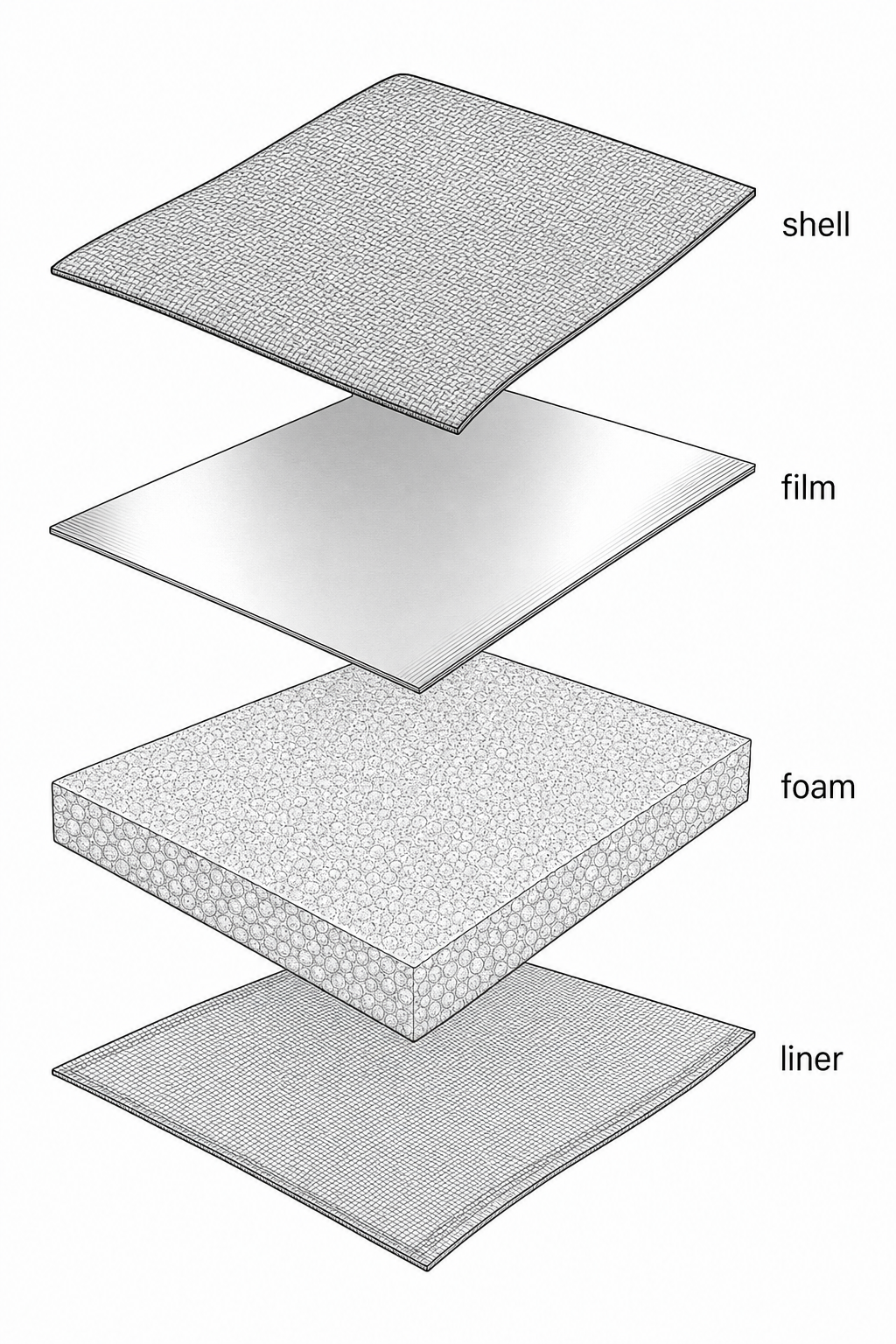 Foam, film, and shiny rejection layers. Illustrative only.
Where the Layer Fails
Delamination at seams: where foam and film are bonded by adhesive or heat, repeated flex stress initiates delamination. The seam between the floor liner and the side wall liner is the highest-stress delamination point in most insulated bags.
Compression set in foam: the same mechanism as in shoulder-strap foam. Closed-cell foam that is repeatedly compressed to a fraction of its natural thickness (from bag overpacking) does not fully recover. The compressed zone has lower thermal resistance than the original foam.
Pinhole tears in film: metallized polyester and foil laminates are not tear-resistant in the way woven fabrics are. A crease introduced by repeated folding creates a stress riser; subsequent cycling extends the crease into a pinhole. Once the film is punctured, moisture enters the foam layer.