Hardware
Acetal and nylon 6/6 buckles, cast rings, and why load ratings go unpublished.
- Volume
- 03
- Order
- № 04
- Read
- 5 min
- Published
Hardware is the vocabulary most bag copy gets wrong. “Metal hardware,” “plastic buckle,” “clip” - these are visual descriptions, not functional ones. The resin type, the load path, the attachment method: these are the things that determine how a buckle behaves after two years, not the color of the anodizing.
Plastic Resins
Most bag hardware is molded from one of two resin families: acetal/POM or nylon 6/6.
Acetal, also called polyoxymethylene (POM), is a crystalline engineering thermoplastic known for low friction, high wear resistance, dimensional stability, and very low moisture absorption. Delrin® is DuPont/Celanese’s acetal homopolymer - a specific branded grade of POM positioned for high-load mechanical applications. Delrin® is a brand name; not all acetal hardware is Delrin®, and the term should not be genericized. Generic POM and acetal copolymer both exist; properties differ by grade. Sailrite’s product listing for a YKK side-release buckle identifies the hardware material as polyacetal - which is accurate, but provides no numeric load rating [verify against manufacturer for any specific load data].
Nylon 6/6 absorbs more moisture than POM, which makes its dimensions and stiffness slightly variable with humidity. In high-humidity or repeated wet-dry cycling environments, nylon hardware can creep slightly under sustained load. This is rarely a practical concern at bag-use loads, but it is a real property difference.
UV degradation affects both resins. POM under prolonged UV exposure develops surface chalking and embrittlement; the degradation is real and observable over a multi-year outdoor product lifecycle. The specific degradation curve - slope, rate, onset point - varies by resin grade, pigmentation, UV stabilizer package, and exposure conditions. No generic curve slope is publishable without a primary material dataset and defined exposure conditions [verify against primary resin data]. The practical observation is that unpigmented or lightly pigmented POM hardware exposed to direct sun ages visibly within two to three years.
Buckle Anatomy
The side-release buckle is the canonical bag buckle. Its anatomy: two mating halves, one male (the insert) and one female (the receptacle), held in engagement by two spring-loaded beams on the female half. Pressing the beams inward compresses the springs and allows the male insert to withdraw.
The load path through a side-release buckle runs through the beam, not the spring. The spring holds the geometry; the beam transmits the tension. When a buckle fails under tensile load - not the common failure mode at bag-use loads - the beam fractures or the housing deforms past the engagement geometry. Under cyclic loading (repeated open-close) at bag-use loads, the more common failures are spring fatigue (reduced engagement feel, buckle feels loose) and housing wear at the pivot points.
No numeric load rating is published for most bag-grade side-release buckles. This is not a gap in documentation; it is a deliberate omission. Load ratings require defined test methods, defined webbing widths, defined thread paths, defined temperatures, and defined aging conditions. The manufacturer’s decision not to publish a number is accurate and appropriate for a component that serves bag applications, not life-safety harness applications [verify against manufacturer for any specific application rating].
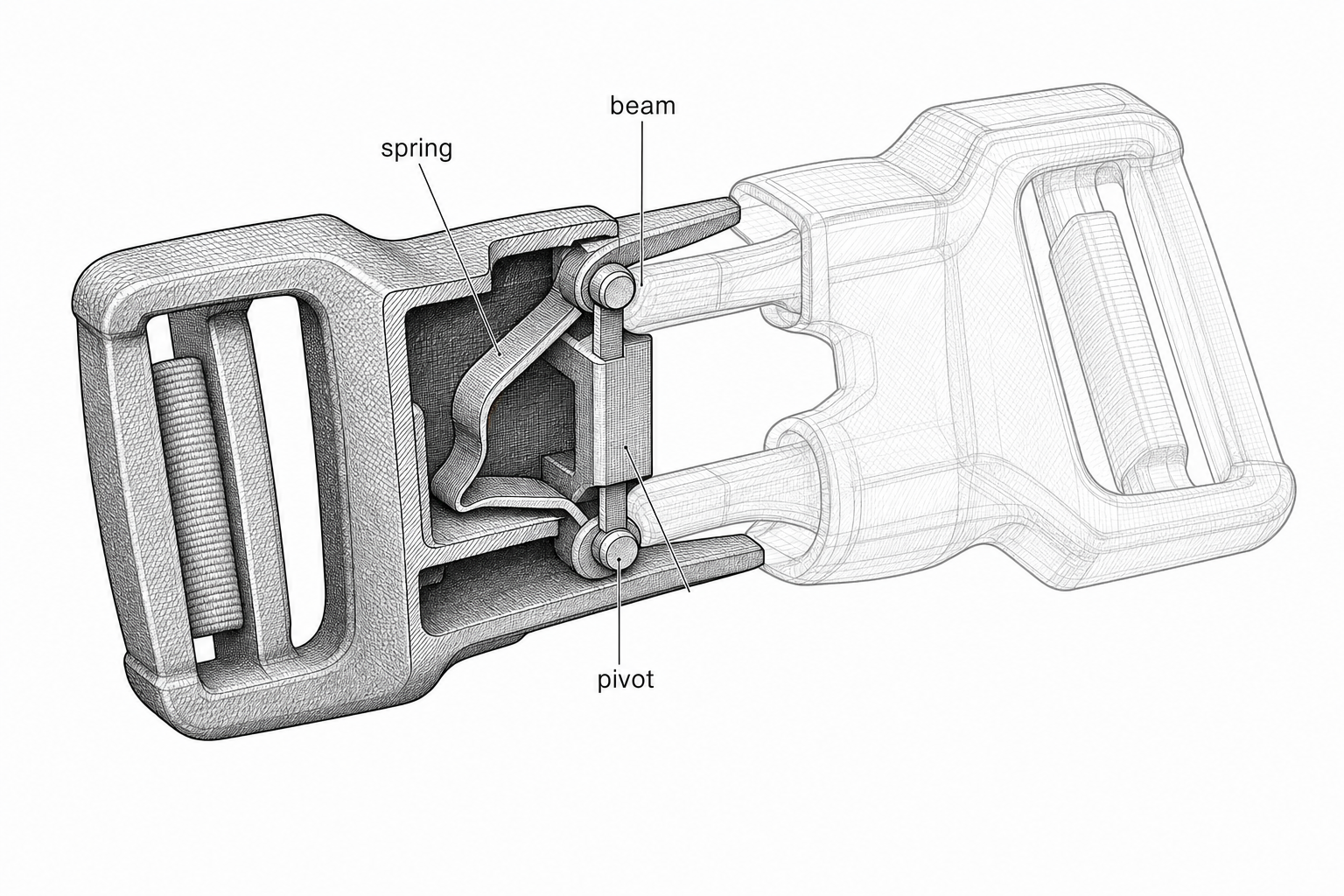 Spring and beam - all visible when you cut the housing. Illustrative only.
Rings and Connectors
D-rings are the workhorse connector: a flat steel or zinc-alloy ring with one straight edge (for webbing passage) and one curved edge. The straight edge makes webbing threading easier and ensures the load is carried by the curved arc in tension.
O-rings are symmetric rings without a straight edge. They are used where rotation of the connected webbing is desirable or where the attachment point needs to accommodate load from multiple angles without concentrating stress on one face.
Rectangular rings have four straight edges and are used primarily as belt-loop keepers and as adjustment hardware where webbing passes over and back.
Welded vs. cast: A welded ring is formed from a rod bent into shape and then joined at the seam. A cast ring is formed in a mold, which means the ring is one continuous piece but may have a visible parting line or flash from the mold. Zamak is the zinc alloy used for much of the cast hardware in bag fittings: it is composed of zinc, aluminum, magnesium, and copper. Cast Zamak hardware may show a thin casting seam; this is a manufacturing artifact, not a structural failure. Welded steel rings avoid the parting line.
Finish options - nickel plating, satin nickel, anodized aluminum, enamel - are surface treatments over the base metal. Plating thickness, adhesion, corrosion resistance, and color consistency are supplier-specific. Nickel contact sensitivity is a real concern for some users; antique brass and gold finishes that appear metallic may be coated zinc alloy. Color matching across a bag’s hardware, especially when rings and buckles come from different suppliers, requires explicit dye-lot control [verify against manufacturer].
Triglides in Hardware Context
Triglides were introduced in Chapter 2 in the context of strap adjustment. In the hardware context: triglides are plastic or metal pieces with three parallel bars, and their function is load relay. The webbing path through the three bars creates friction. The triglide itself is not a terminus - it transfers load into the bar tack or stitching that fixes it to the strap assembly. Metal triglides (cast zinc alloy or stamped steel) are heavier but resist deformation under higher sustained loads than their plastic equivalents.
Attachment Joints
Where hardware meets bag body, the joint method determines the failure mode.
Rivets - tubular or solid metal fasteners through the stacked webbing and panel - create a rigid mechanical connection. The failure mode at gear scale is deformation of the rivet head under cyclic peel load, which allows the rivet to work loose. Once the rivet is loose, the hole in the panel begins to elongate under load.
Bar tacks allow the attachment point to flex with the bag, which is why they are preferred for shoulder-strap attachment on soft bags. The failure mode is thread fatigue: the individual passes in the bar tack are each subject to the same cyclic tension, and failure typically begins at the outermost passes where stress concentration is highest.
Ultrasonic welding / thermoplastic bonding fuses thermoplastic materials together using vibration-generated heat. The failure mode is delamination at the fusion boundary, which is a cohesive failure in the thermoplastic rather than a thread failure. Welded joints are less repairable in the field than bar-tacked joints.
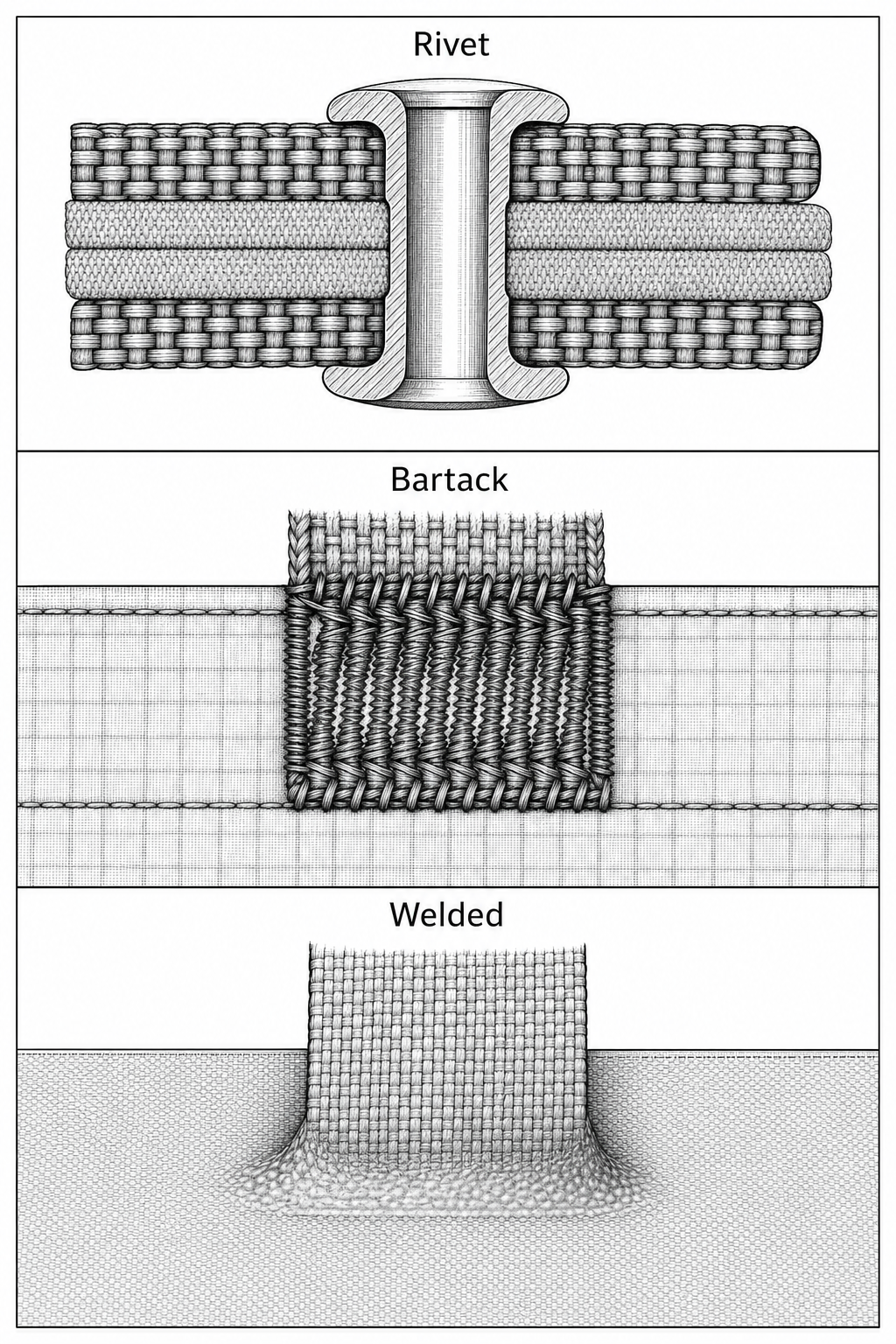 Three attachment grammars - gear scale. Illustrative only.