The Component System
The load path reaches the panel last, which is why the parts retire first.
- Volume
- 03
- Order
- № 09
- Read
- 6 min
- Published
Every chapter in this book has described a part. This chapter describes what the parts are doing together.
The insight is simple and counterintuitive: the load path in a bag runs from the handle or shoulder attachment inward, through stitching and hardware, through the zipper chain, and finally reaches the panel fabric last. The panel is the terminus of the force cascade, not the origin. This is why panels outlast the components that hold them.
Load Path
Trace a tensile load from the moment you pick up a loaded backpack by its top handle.
The force originates at your hand. It transfers to the handle webbing. The handle webbing terminates in a bar tack sewn through the top panel. The bar tack transfers load into the panel fabric at the stitch-penetration points. Those penetration points stress the panel fibers in the immediate vicinity of the attachment. If there is a reinforcement patch beneath the attachment, the load spreads to a larger panel area. The panel itself carries the remaining load, distributed across its face.
Now trace the same load through a different path: a shoulder-strap attachment on a pack. Force originates at the shoulder. It transfers to the padded strap. The strap terminates at a buckle or at a bar-tacked attachment loop. The buckle transfers force through its beam and housing into the webbing that constrains it; the constraining webbing is bar-tacked to the panel body. The zipper closure on the main compartment may or may not be in the direct load path, but if the zipper tape is under tension from bag fill, the zipper chain is carrying a distributed share of that panel stress.
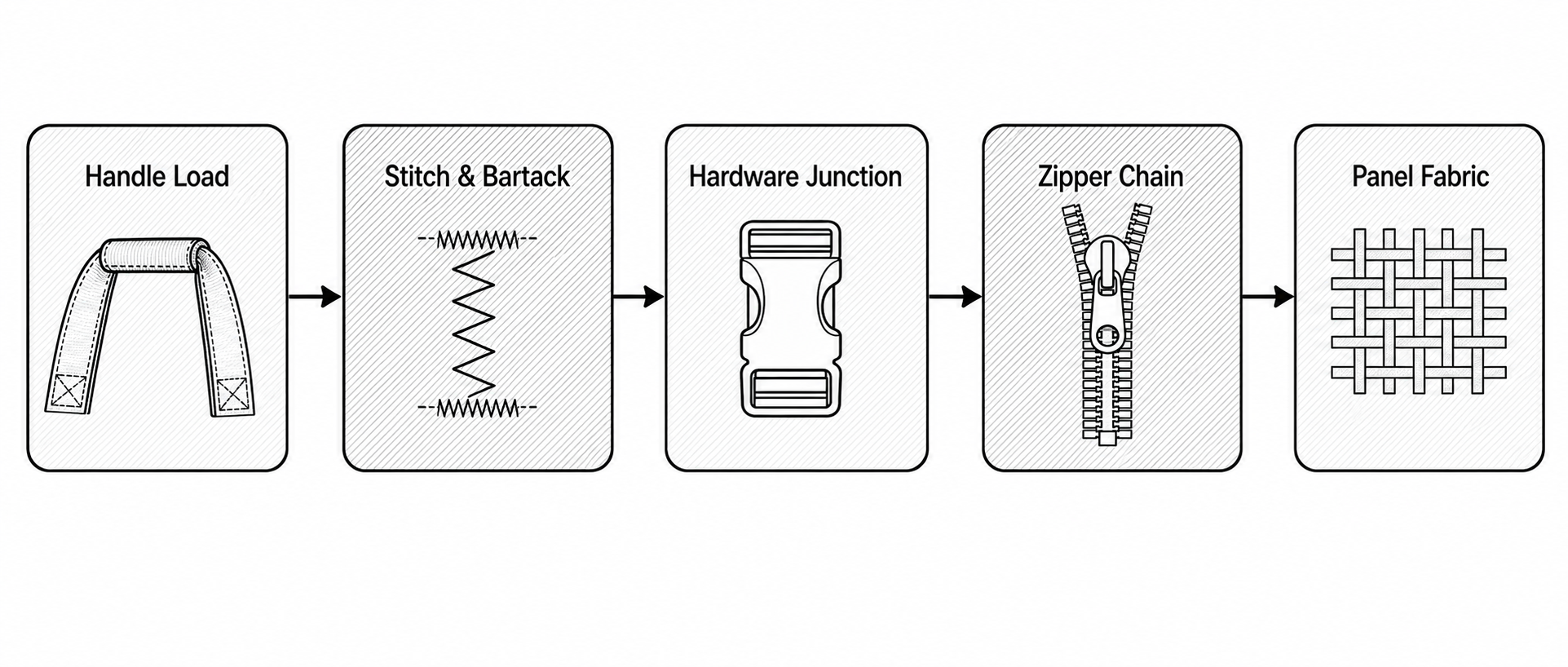 Load finds the weakest contractor. Illustrative only.
Weakest Contractor
The statistical argument for why parts fail before panels rests on three observations.
First, parts cycle. A zipper slider opens and closes hundreds or thousands of times over a bag’s life. A buckle snap engages and releases each carrying session. A bar tack at a handle attachment flexes each time the bag is picked up or set down. A panel fabric experiences these cycles too - as compressive and tensile fatigue - but its cycle count per use is lower than the cycle count of the mechanical interfaces.
Second, parts have smaller cross-sections. A zipper coil filament has a much smaller cross-sectional area than the panel fabric it runs through. A thread pass in a bar tack has a much smaller cross-section than a 25 mm webbing. Smaller cross-section under equivalent load means higher stress per unit area.
Third, parts are the tolerance-stackers. Manufacturing variation in a zipper slider, webbing weave density, buckle gate alignment, or foam compression set accumulates. No panel-fabric weave experiences the same tolerance stack as a mechanical assembly. The more parts in a failure mode’s chain, the more opportunities for dimensional variation to become functional failure.
The result: the most-cycled, smallest-cross-section link in the load path fails first. This is not a flaw in bag design; it is an inevitable consequence of how mechanical systems work. The insight is useful because it tells you where to look.
Diagnosis
Reading a bag’s age by its parts requires knowing what to examine and in what order.
Zipper sliders show wear at the internal channel geometry before they fail. Early indicator: increased drag at the midpoint of the run. Later indicator: chain that closes behind the slider but springs open. Final indicator: chain that will not close at all.
Pull tabs show wear at the pivot point. Wiggle the tab relative to the slider body. A loose pivot is a fatigue indicator; the tab will eventually separate.
Bar tacks at handle and strap attachments show wear as thread fraying or migration. Look at the outermost thread passes of the bar tack, not the center. Fraying periphery means load has been concentrated there.
Plastic hardware - buckles, triglides, ladder locks - shows UV degradation as surface dulling and chalking (the same mechanism as thread). A chalked buckle housing has reduced impact resistance and surface hardness. Test by pressing: if the housing gives slightly under thumb pressure where it did not before, the resin has degraded.
Foam padding in shoulder straps shows compression set as permanent thinning. No resilience when compressed means the elastic network in the foam has failed.
Foam and film in insulation linings show delamination as bubbling or rippling at seam edges. A bubbled foam layer has lost adhesion and the air pocket reduces thermal contact between layers.
Laminate adhesive in face fabrics (X-Pac, Ultra, ECOPAK, DCF Hybrid) shows the same delamination pattern at fold lines on the film side - surface haze first, localized blistering second, sheet delamination third. Inspect hipbelt folds, roll-top hinge zones, and shoulder strap attachment areas before assuming the bag is intact. The face fibers do not have to fail with the adhesive; a UHMWPE-faced bag with film lift is still structurally sound, just no longer film-waterproof at the lifted zones.
Maintenance Vocabulary
Some component failures are repairable in the field or by a competent maker; others are not.
Repairable: Zipper slider replacement - if the chain is intact and undistorted, a new slider restores function. This is a ten-minute repair with a slider pliers and a replacement slider of the correct gauge and tooth type. Webbing re-tack - a blown bar tack at a webbing attachment can be re-sewn if the panel fabric is intact and the webbing is undamaged. Pull tab replacement - bent or cracked pull tabs can be opened and replaced on most sliders without removing the slider from the chain. Laminate delamination on the film side - localized blistering or sheet lift can be bridged with PSA seam tape (Challenge Outdoor’s UltraTNT PSA Tape or equivalent) applied per manufacturer instructions, restoring waterproofness across the taped zone. This is a manufacturer-acknowledged repair pathway, not a workaround.
Not practically repairable: Delaminated insulation film - once the metallized film has delaminated from the foam and the adhesion has failed across more than a localized area, the assembly cannot be re-bonded cleanly without specialized equipment. Blown bar tack in an inaccessible location - a bar tack that has failed inside a finished seam, beneath a lining, or at a corner that cannot be accessed by a sewing machine presents a functional problem: the correct repair method cannot reach the failure point without more disassembly than the bag allows. UV-embrittled plastic hardware - once the resin has degraded to the point of crazing or cracking, replacement is the only option. Thread cannot hold a cracked buckle beam. Sheet-scale laminate delamination across an entire panel - seam tape can bridge discrete zones, but a panel-wide adhesive failure is beyond what consumer-grade PSA tape can recover; the laminate has reached the end of its bonded life. Failed welded seams on RF or ultrasonic welded waterproof bags - the original bond geometry cannot be re-established with consumer tools; seam tape over the failed weld is a partial mitigation, not a restoration.
Little Bag Buddy, Vol. III: Bag Components is written in the same spirit as this series: material vocabulary over marketing language. Nothing here is sponsored or affiliate-linked.
Every image in this guide is illustrative only. AI-generated. Not a substitute for manufacturer specs, primary literature, or hands-on examination.