X-Pac
Where single fabrics give up and laminates start showing seams.
- Volume
- 01
- Order
- № 04
- Read
- 11 min
- Published
Up to this point: single-material fabrics. Nylon yarn, woven, coated. Polyester yarn, woven, coated. From here on the materials get assembled: stacked in layers, bonded, treated as composites. X-Pac is the canonical example.
What is X-Pac?
X-Pac is not a fabric. It is a brand that makes laminates, and that distinction matters. Cordura is a brand that makes fabrics (woven textiles). X-Pac, made by Dimension-Polyant, makes something fundamentally different: a multi-layer composite material where several layers are bonded together permanently.
When you have nylon, you have one thing: a textile. When you have X-Pac, you have four things that have been fused into one.
Who is Dimension-Polyant?
Dimension-Polyant is the world’s largest manufacturer of sailcloth. The company traces its roots to 1966, and in its current form was created in 1991 from the merger of Dimension Sailcloth (American, founded 1977, known for innovation) and Polyant (German, known for craftsmanship). They operate manufacturing facilities in Kempen, Germany and Putnam, Connecticut.
Their core business is making high-performance laminate sails for racing yachts and super yachts. The “holy grail” in sailcloth, as their president described it, is dimensional stability: the ability to hold a precise shape under load without stretching.
At some point, they realized: a technical backpack faces the same engineering problem as a racing sail. Rain, shifting loads, repeated mechanical stress, abrasion. A sail handles all of it. So they took the same laminate architecture and adapted it for packs. That became X-Pac.
The construction: four layers
This is the core of it. X-Pac is a 4-layer laminate (in its most common form). Each layer does a specific job.
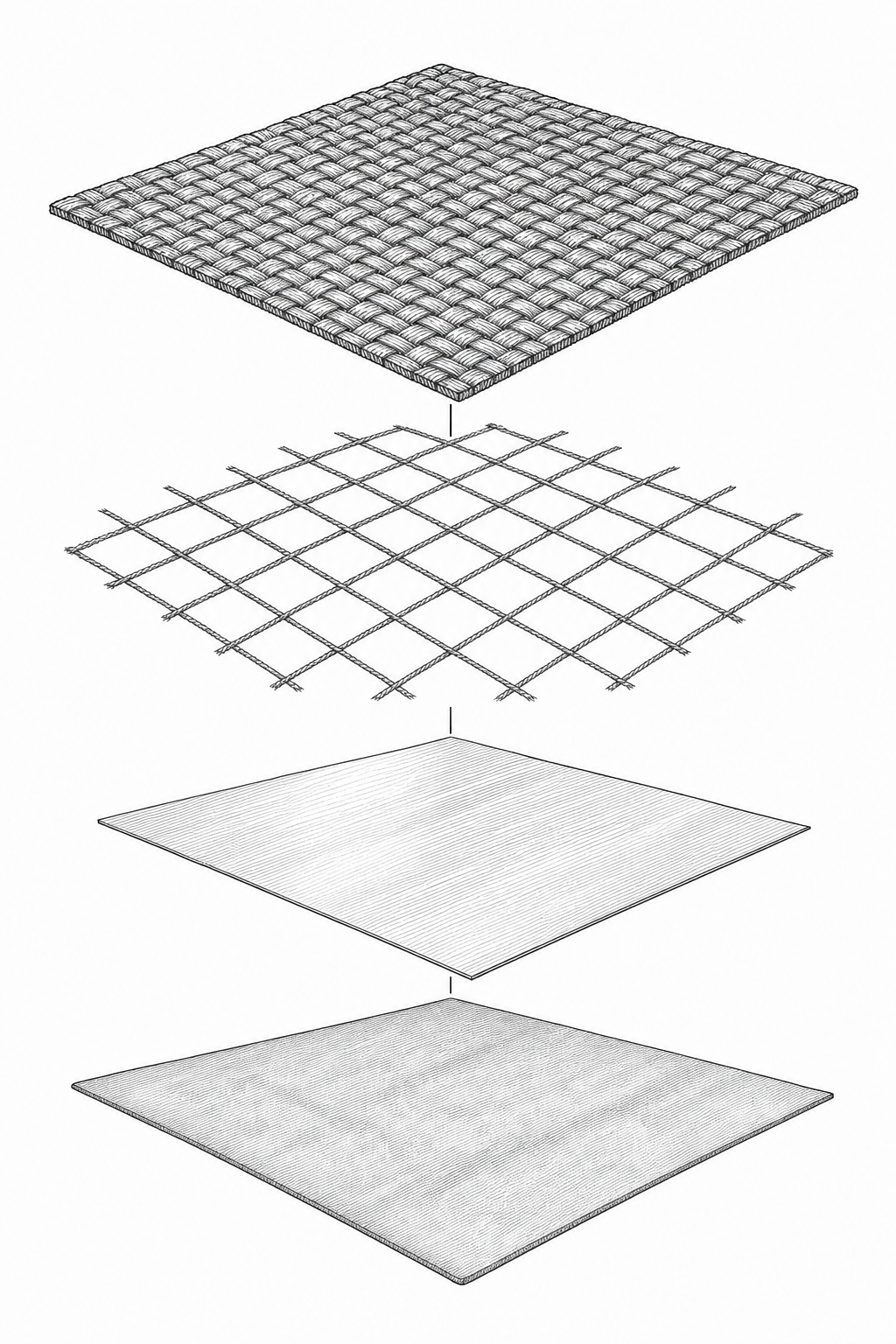
X-Pac is a sandwich. The PET film in the middle is the waterproof barrier. The X-PLY grid is the structural nervous system. Illustrative only.
Layer 1: The Face Fabric
The outermost layer is a woven textile (either nylon or polyester), and this is what you see and touch. It provides abrasion resistance, color, and texture. The denier of this layer is what gives X-Pac its model numbers: VX21 has a 210-denier nylon face, VX42 has a 420-denier nylon face, and so on.
The face fabric gets a DWR finish, the same chemical treatment used on PU-coated nylons. Water beads up and rolls off.
Layer 2: X-PLY®
The signature layer, and the reason the material has “X” in its name. X-PLY is a grid of polyester yarns laid at a 22° bias angle, diagonally, not aligned with the warp and weft of the face fabric.
Why diagonal? Borrowed directly from sail engineering. In a woven fabric, forces primarily travel along the yarn directions. A bias-placed grid catches forces from any direction and distributes them across the structure. Result: dimensional stability. The laminate resists stretching, holds shape under load, and stops tears from propagating. That signature diamond pattern showing through the face? That is the X-PLY.
In most current X-Pac products, X-PLY is made from post-consumer recycled polyester.
Layer 3: PET Film
Behind the X-PLY sits a thin polyester (PET) film, typically 0.25 mil thick on VX-series fabrics. This is the waterproof membrane.
Here is the key difference from nylon. On a standard bag nylon, water resistance comes from a PU coating painted onto the back of the fabric. PU coatings can wear off, absorb water over time, and degrade. The PET film in X-Pac is not a coating: it is a structural layer bonded into the laminate. Permanently waterproof. It does not wear off because it is not on the surface; it is inside the construction.
The rated waterproofing on X-Pac VX-series is 200+ psi (13.8+ bar), significantly higher than typical PU-coated nylons, which vary widely with coating thickness.
The tradeoff: PET film is not breathable. X-Pac is not a breathable membrane fabric. It blocks moisture transfer entirely.
Layer 4: Taffeta Backing (VX series only)
The innermost layer on 4-layer (VX) constructions is a 50-denier polyester taffeta. It protects the PET film from abrasion on the inside of the bag, provides a smooth interior surface, and gives the laminate a cleaner finished look.
This is what distinguishes VX from X constructions:
- VX (4-layer): face + X-PLY + PET film + taffeta backing
- X (3-layer): face + X-PLY + PET film (no taffeta)
The 3-layer X construction is lighter and more flexible, and allows seam taping since the film is exposed on the inside. The 4-layer VX is more durable because the taffeta protects the film from interior wear.
How it is made
Unlike nylon, which is extruded and woven, X-Pac is assembled from pre-made components and thermally laminated: bonded under heat and pressure. Layers are fed together, pressed, and fused. The result is a composite where layers cannot be separated without destroying them.
This thermal lamination is what gives X-Pac its characteristic stiffness and that slight crinkle sound, especially when new. The crinkle fades with use, but waterproofness does not, because the waterproofing is structural, not surface finish.
The product lines
Dimension-Polyant organizes X-Pac into three families: X4, X3, and LS.
| Name | Layers | Face | Denier | Weight (g/m²) | Notes |
|---|---|---|---|---|---|
| VX03 | 4 | Ripstop nylon | 30×40D | 140 | Ultralight |
| VX07 | 4 | Ripstop nylon | 70D | 165–167 | Lightweight, satin finish |
| VX21 | 4 | Plain weave nylon | 210D | 205 | Most popular, sweet spot |
| RVX25 | 4 | Polyester | 250D | 269 | 100% polyester version |
| VX42 | 4 | Plain weave nylon | 420D | 285–297 | High-stress areas, stiffer |
| X33 | 3 | Cordura nylon | 330D | 268 | No taffeta, more flexible |
| X50 | 3 | Cordura nylon | 500D | ~340 | Heavy duty, seam-tapeable |
| RX30 | 3 | Recycled polyester | 300D | - | 100% climate neutral, recycled |
| UX10 | 3 | Ultra-PE | 100D | - | Aramid X-PLY, extremely light |
Reading the codes: X means the X-PLY scrim layer; V (as in VX21) means a 4-layer construction with the polyester taffeta backer. The trailing digits encode the face yarn denier divided by ten (VX21 is 210D nylon, VX42 is 420D), not grams per square meter.
VX21 is the workhorse: 210D face, 205 g/m², used by Peak Design, Able Carry, and Aer. VX42 is heavier and stiffer and carries a higher published abrasion rating on the full laminate. Dimension-Polyant’s product pages (retrieved May 2026) list Taber abrasion (ASTM D3884) at 500 cycles for standard plain-weave VX21 and 1,700 cycles for VX42, comparable within their own datasheet family (see Appendix: Reading the Spec Sheet). Sub-variants tell a different story: VX21 Ciré, with a conditioned face for gloss and wear resistance, is listed at 2,000 cycles on the same test. Numbers cited elsewhere near ~50 cycles for VX21 usually reflect face-fabric–only or non-standard sampling, not the full laminate figure on the consumer spec sheet, which is why shortcut comparisons and lab shorthand can disagree without anyone lying.
The UX10 and ultra-light variants swap the nylon face for Ultra-PE (UHMWPE, see Chapter 5) and the standard polyester X-PLY for aramid (Kevlar) X-PLY. Result: about 60% lighter than VX21, closer to DCF/Dyneema territory but significantly cheaper to manufacture. The bridge between standard X-Pac and Dyneema Composite Fabric.
The RX series launched in 2021 uses a 100% post-consumer recycled polyester face fabric (from discarded PET bottles in the US) and is certified cradle-to-gate climate neutral. Dimension-Polyant’s Putnam facility runs on 100% renewable energy.
Denier in laminates: it gets complicated
In a straight nylon, a higher denier means a heavier fabric, roughly predictably. In X-Pac, the face denier is only one contributor to weight. The PET film, X-PLY, and taffeta all add weight independently of the face. This is why VX21 at 205 g/m² is heavier than a comparable 210D Cordura plain weave (150–180 g/m²). The extra layers add mass.
It also means that abrasion resistance does not scale the same way. Taber cycles measure how long the composite survives a standardized rub, not each layer separately. In real bags, the PET film is still often the weak link once the face is worn through: higher-denier faces (VX42, X33) buy time before that exposure.
Waterproofing: PET film vs PU coating
| Property | PU-Coated Nylon | X-Pac PET Film |
|---|---|---|
| Type | Surface coating | Structural layer |
| Waterproofing mechanism | Fills weave interstices | Continuous membrane |
| Durability | Wears off over years | Permanent (until torn) |
| Water column rating | Variable (low–high) | 200+ psi |
| Breathability | None | None |
| Re-waterproofable? | Yes (DWR re-application) | No (inherent) |
| Weight contribution | 30–50 g/m² | Lighter at comparable protection |
The practical implication: an X-Pac bag aged 5 years is still waterproof at the fabric level. A PU-coated nylon bag of the same age may have a degraded coating that lets water through, especially at stress points. The failure mode is different.
However (and this matters), the fabric being waterproof does not make the bag waterproof. Every seam, zipper, and port punches holes through that film. Unless a manufacturer tapes or seals those seams, rain still gets in.
Breathable waterproof laminates (why jackets obsess and bags shrug)
The PET film in X-Pac is a continuous barrier: liquid water stays out, but water vapor does not pass through in any meaningful way. Outdoor apparel has spent decades optimizing a different architecture: breathable waterproof laminates built around microporous PTFE (expanded polytetrafluoroethylene) or hydrophilic polyurethane membranes that allow controlled vapor transmission while blocking bulk liquid when the stack is intact and seams are sealed.1 Marketing bundles those stacks under familiar umbrella brands; the chemistry underneath is membrane physics and tape chemistry, not the face weave alone.
For bags, that entire conversation is usually peripheral. A shell jacket fails its job if sweat cannot escape; a backpack’s main compartment is mostly air space and packed goods, not skin-adjacent heat and humidity. Technical packs stay dry inside through geometry (roll-tops, storm flaps), coatings and film laminates like the ones already discussed in this chapter, and honest seam strategy, not through maximizing MVTR across the panel. Membrane hang tags on packs show up when a brand shares fabric lines with apparel, when a small panel (a wet pocket, a niche weather shell) borrows outerwear spec sheets, or when marketing wants outerwear credibility. None of that removes the rule above: openings beat chemistry. If the zipper gap or unstitched seam routes rain inward, the stack’s breathability score stops mattering first.
So treat membrane names on bags as secondary context. X-Pac’s PET film trades vapor permeability for structural simplicity and proven barrier behavior at the sheet, the tradeoff already stated a few pages back. Breathable laminates trade cost, complexity, and care (tape, compatible faces, washing constraints) for vapor movement that matters enormously on a jacket and much less on a sealed roll-top load. When a hang tag impresses you, read seam maps and zipper ratings first; the fine points of waterproof zippers, sliders, and stitch failure modes belong in the components volume, not here.
X-Pac vs nylon: the trade-offs
| Property | Nylon (500D Cordura) | X-Pac (VX21) |
|---|---|---|
| Weight | ~230 g/m² | ~205 g/m² |
| Waterproofing | PU coating (wears off) | PET film (permanent) |
| Abrasion resistance | High (especially ballistic) | Moderate (face-dependent) |
| Tear resistance | Good | Excellent (X-PLY reinforced) |
| Structure/stiffness | Soft, flexible | Semi-rigid, structured |
| Sound | Silent | Slight crinkle when new |
| Delamination risk | None (single layer) | Yes, over years of hard use |
| Cost | Lower | Higher |
X-Pac is lighter than comparable-performing nylon, not because the face fabric is lighter, but because the laminate construction achieves structural waterproofing at lower total weight than thick PU coatings on heavy ballistic weaves.
The delamination point is real. Long-term, all laminated fabrics delaminate at least cosmetically: the layers separate slightly, especially at stress points and fold lines. For most bags under normal use, this is aesthetic rather than functional. It is however worth knowing if you are planning to own a bag for 20 years: a 1680D ballistic nylon bag may simply outlast a laminate by virtue of being a single material.
The crinkle: why does X-Pac sound like that?
New X-Pac crinkles because the thermal lamination creates a rigid bond between layers that has not flexed yet. The layers “break in” with use, similar to how a leather boot softens. Importantly, the crinkle going away does not mean waterproofing is compromised: the PET film remains intact.
Heavy-denier X-Pac (X50 or X33 with 330–500D faces) is substantially less crinkly because the thick face fabric dominates the hand-feel, damping the PET film noise.
Brands
- Peak Design, Able Carry, Aer, Alpaka, GORUCK, Tom Bihn: VX21 and VX42 are the most common.
- Evergoods: uses their own proprietary laminate fabrics rather than off-the-shelf X-Pac.
- HMG, Zpacks, Seek Outside: DCF for ultralight builds, or X-Pac variants like X50 for durability-oriented ultralight.
- Ultralight backpacking brands: VX07 or UX10 where every gram counts.
X-Pac (VX21 specifically) was called out as being ~15% lighter than comparable Cordura by brands that have tested both.
X-Pac in the Inventory
Peak Design Wash Pouch (Coyote): VX21 Ocean Edition, recycled fishing-net nylon face, C0 PFAS-free DWR. Pouches get wet counters, toiletry spills, bathroom humidity. X-Pac handles it; the PET film means the interior stays dry.
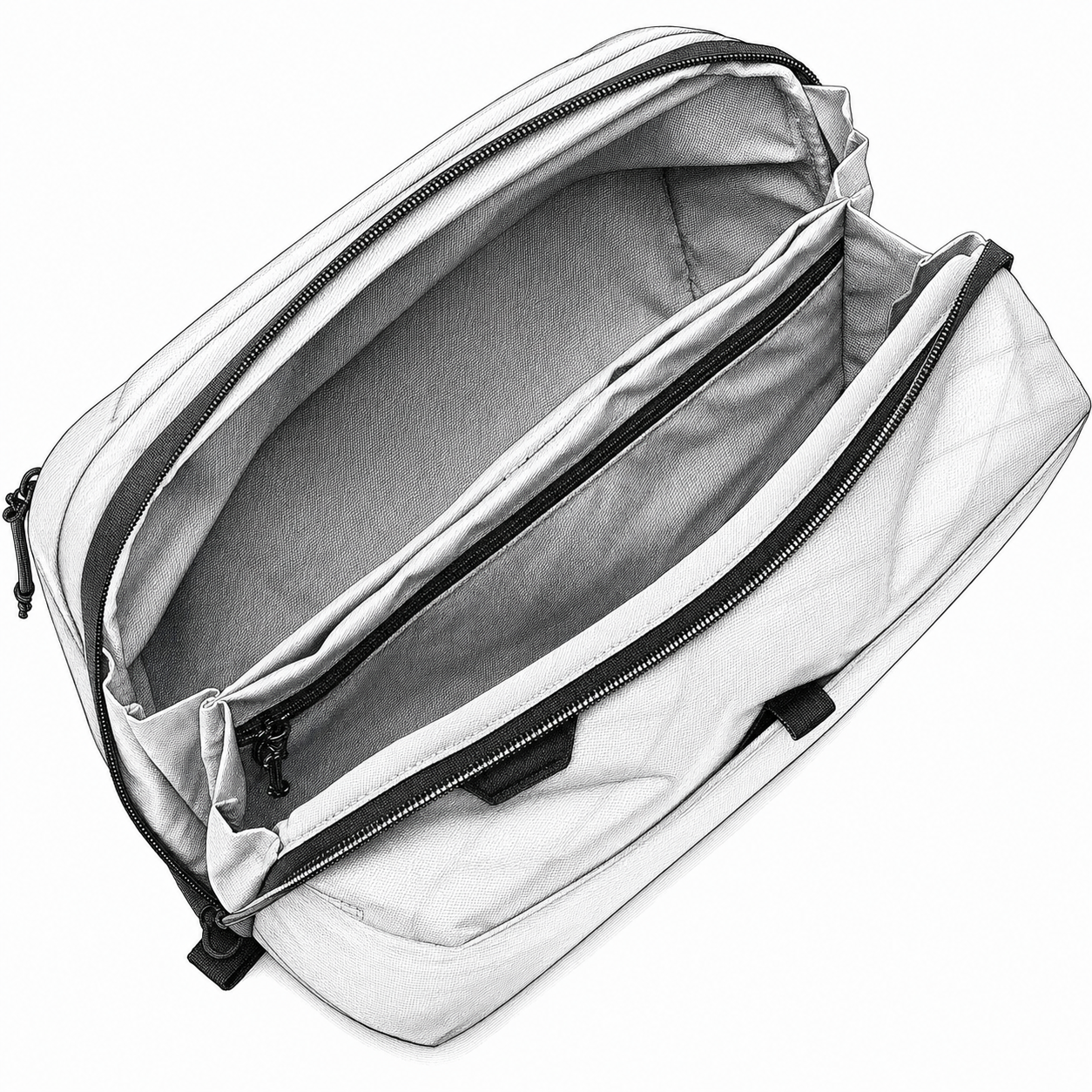 PD Wash Pouch, VX21 Ocean Edition, hanging hook, perimeter zip. Bathroom-environment-rated. Illustrative only.
Alpaka Elements Tech Case Max: X-Pac variants (RVX20 or RX30 depending on colorway) with 840D ballistic nylon back panel. The back panel takes contact abrasion; the X-Pac face handles structured form and waterproofing.
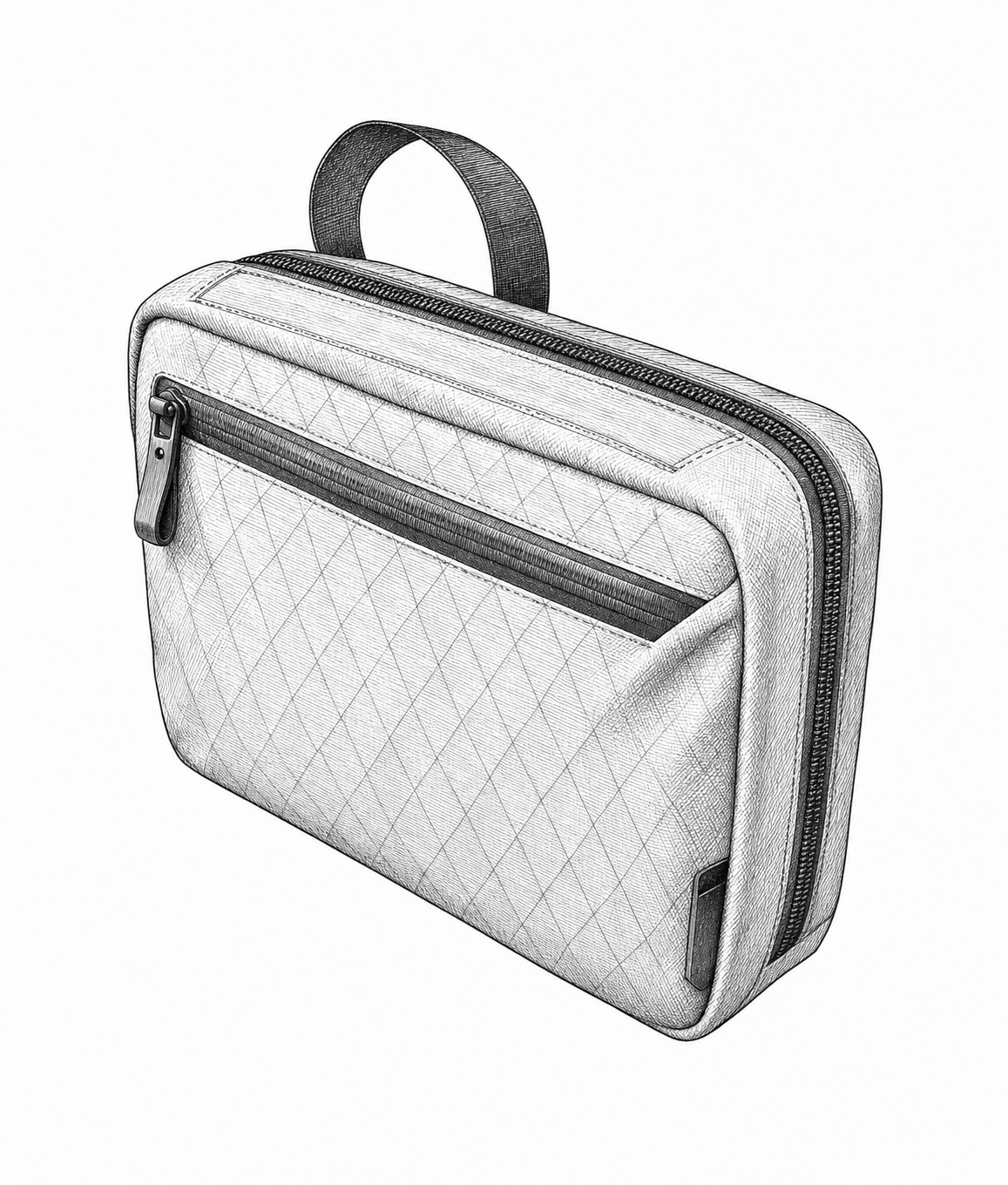 Alpaka Tech Max, X-Pac face, 840D ballistic back panel, structured tech organizer. Illustrative only.
ILE Apex 11L (lime, VX21 Ocean Edition): customized festival/events pack with breathable frame and reflective tape additions. VX21 means standard 4-layer laminate: 210D nylon face, X-PLY, 0.25 mil PET film, 50D taffeta backing.
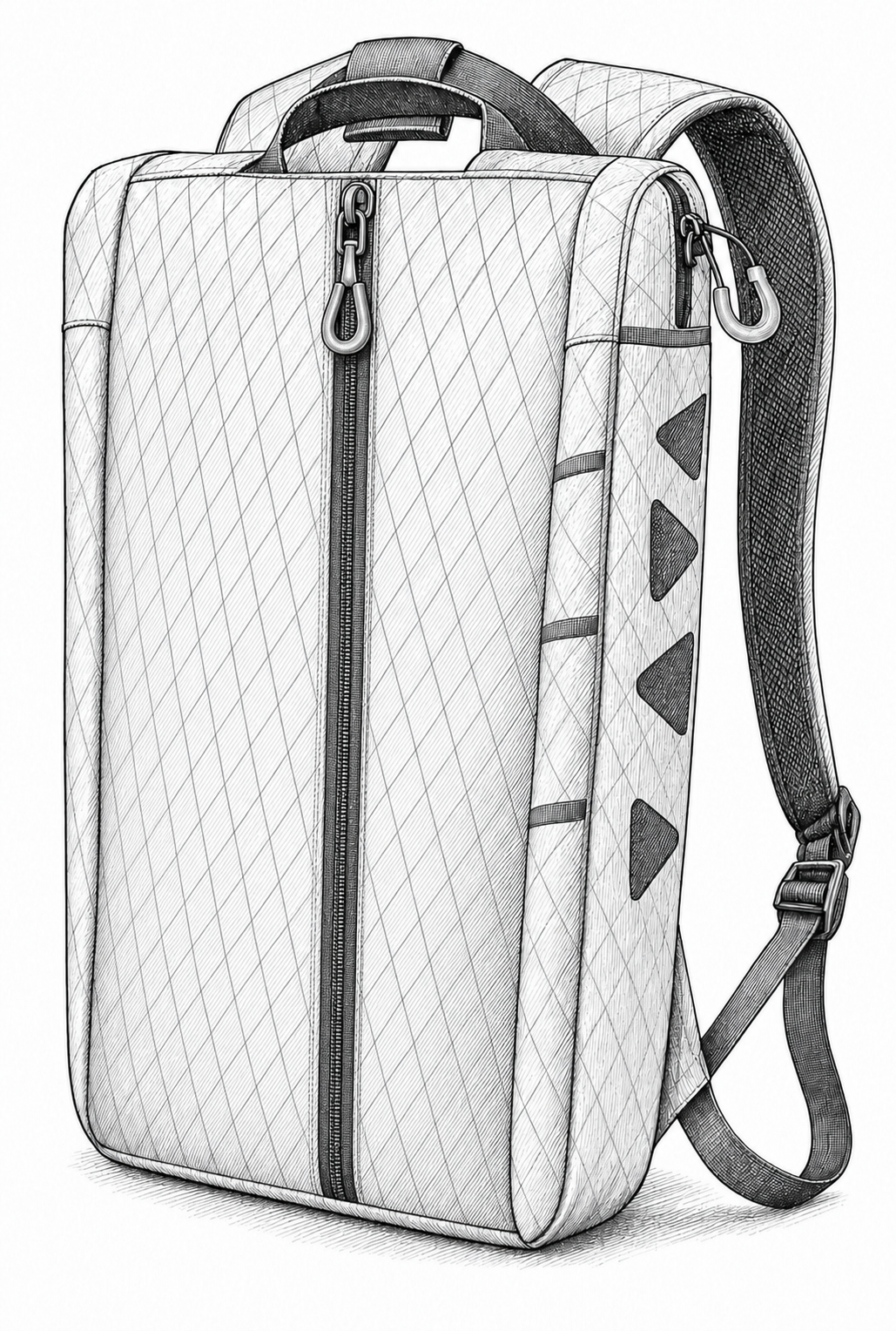 ILE Apex 11L, VX21 Ocean Edition, breathable frame, slim daypack. Illustrative only.
X-Pac is the laminate that taught the bag world to think in stacks instead of weaves. Most modern technical bag fabrics (EcoPak, Ultra, DCF hybrids) are variations on the same thesis: face fabric for surface duty, structural grid for shape, film for water, optional backing for finish.
Sailcloth, stacked into a pack.
Footnotes
-
This book does not catalog proprietary membrane stacks or trademark lineups, they change seasonally. The distinction that matters for reading specs is continuous film barrier (this chapter) versus engineered permeability (membrane products). ↩