Waxed Canvas
Five centuries of cotton and paraffin, before petrochemicals had a turn.
- Volume
- 01
- Order
- № 07
- Read
- 10 min
- Published
Everything to this point (nylon, polyester, X-Pac, EcoPak, Ultra, DCF) starts at an oil refinery. Waxed canvas does not. The base fiber is cotton, the treatment is wax, and the technology has been waterproofing sails, jackets, and bags for around five centuries.
The Base Material: Cotton Is Not Simple
Cotton gets treated as the boring baseline. Chemically, more interesting than that.
Cotton is cellulose, a polymer, just like nylon and polyester, but made by a plant instead of a petrochemical plant. The monomer is glucose (C₆H₁₂O₆), polymerizes into long chains via glycosidic bonds. A typical cotton fiber contains chains of 10,000 to 15,000 glucose units.
Three properties from this structure:
-
Hydroxyl groups everywhere: every glucose repeat unit has three hydroxyl groups (–OH). These form extensive hydrogen bonds between neighboring chains, the same inter-chain gripping that makes nylon chains sticky. Cotton chains are very sticky to each other, and also extremely sticky to water molecules. This is why cotton absorbs moisture so readily and strongly.
-
High crystallinity: chains pack into crystalline regions (over 60% crystallinity in mature fiber), giving cotton its tensile strength. Unlike synthetics, cotton fiber gets slightly stronger when wet because moisture swells the fibers, slightly increases crystalline ordering, and the inter-chain forces increase.
-
No melting point: cellulose decomposes at ~350°C before it ever melts. Cannot melt-spin cotton. Must be grown (as a seed hair), harvested, mechanically processed into fiber, fundamentally different supply chain from every synthetic in this series.
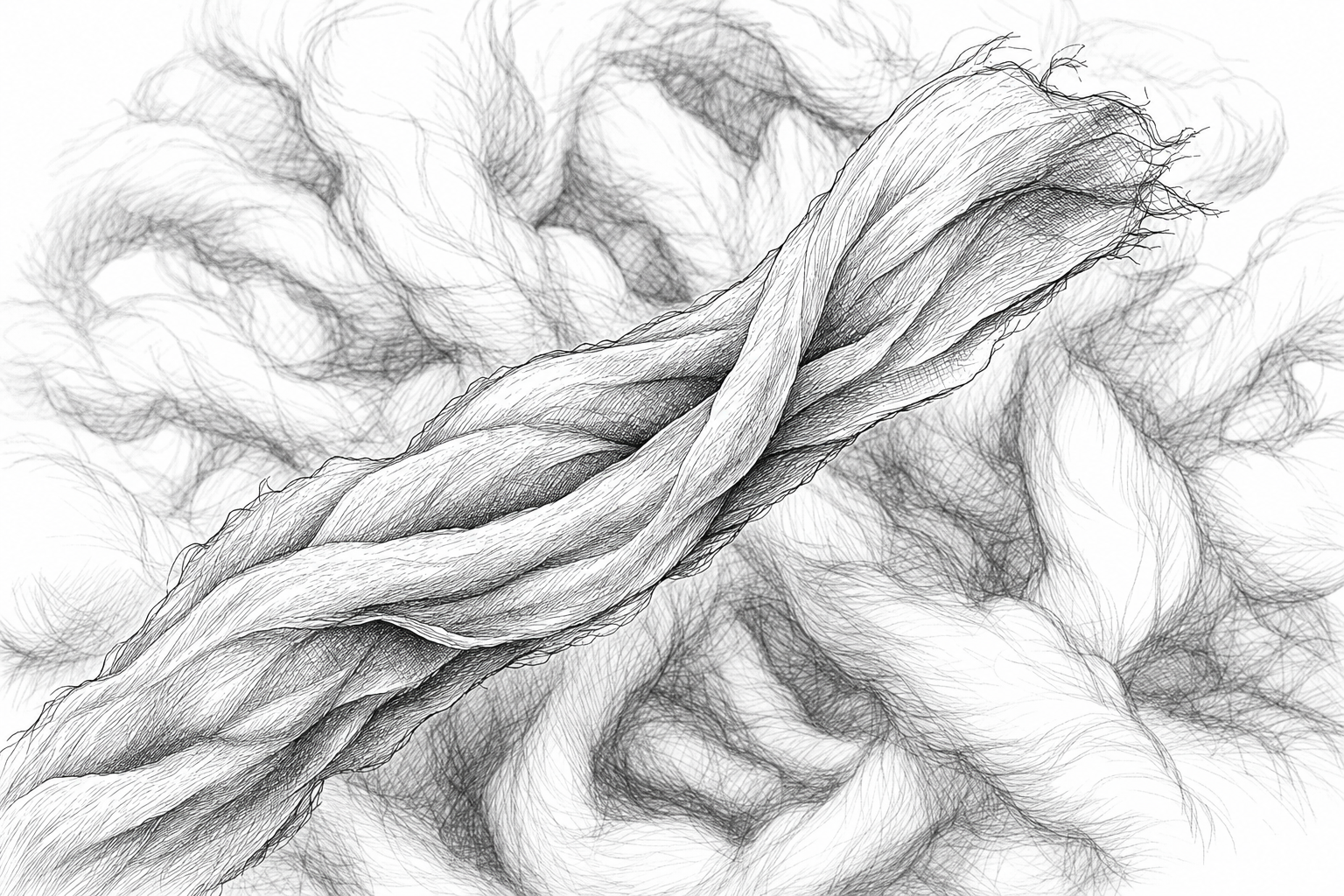 Cellulose. Plant-made polymer. Hydroxyl groups everywhere, they bond water aggressively. Illustrative only.
What Is Canvas?
Before the wax: canvas is a specific weave type, not a material. Canvas refers to a plain weave or duck weave in a heavy, tightly-woven construction, historically from hemp or flax, later from cotton. The word comes from Latin cannabis (hemp).
Two canvas weave variants matter in bags:
- Plain weave duck: warp and weft at 1:1, the same as plain nylon. The simplest possible weave. “Duck” refers to a specific high-thread-count plain weave construction (from the Dutch doek, “cloth”), optimized for tightness. Army Duck and Cotton Duck are both variants of this.
- Twill weave: warp goes over 2–3 weft yarns at a time, offset each row to create a diagonal pattern. Stronger than plain weave for the same weight, drapes better, more resistant to tearing because the diagonal structure redirects forces. Filson’s famous Rugged Twill canvas is a twill weave, made by Halley Stevensons.
Canvas weight is measured in ounces per square yard (oz/yd²), not denier. Conversion: 1 oz/yd² ≈ 33.9 g/m².
| Canvas Weight | GSM equivalent | Typical use |
|---|---|---|
| 7–8 oz | ~237–271 g/m² | Lightweight bags, apparel |
| 10–12 oz | ~339–407 g/m² | Standard everyday bags |
| 14–15 oz | ~475–509 g/m² | Heavy-duty bags, Filson-style |
| 18+ oz | ~610+ g/m² | Industrial, military-style bags |
Finished waxed canvas is heavier than dry weight because wax adds mass. A 10 oz dry canvas becomes roughly 13–14 oz finished, depending on wax depth.
What Is the Wax Doing Chemically?
Cotton is highly hydrophilic, it wants to absorb water, because hydroxyl groups attract water molecules via hydrogen bonding. So how does wax fix that?
Wax is nonpolar. Paraffin wax is a mixture of long-chain alkanes (CH₃–(CH₂)ₙ–CH₃), like a solidified version of petroleum. Beeswax is a blend of long-chain esters, hydrocarbons, and fatty acids, slightly more complex, but equally nonpolar.
When molten wax is applied to cotton canvas, it infiltrates the spaces between fibers and between the fibers and yarns. As it cools and solidifies, creates a physical barrier: wax fills the interstitial spaces that water would otherwise wick into by capillary action. Water cannot hydrogen-bond to the wax surface, beads up and rolls off rather than being pulled into the weave.
Crucially: the cotton fibers themselves are not chemically modified. Wax sits around and between fibers, not bonded to them. This is why waxed canvas is re-waxable: wax can be replaced when it wears out, unlike PU coatings on nylon which degrade the base fiber chemistry as they cure and crack.
Three main wax types in bag canvas:
- Paraffin wax (petroleum-derived): hard, durable, slightly waxy hand feel, moderate temperature range. Most common industrial choice. Creates firmer finish.
- Beeswax (natural): softer, slightly tacky, better at low temperatures (doesn’t crack), but migrates (blooms) more readily in heat. Softer overall hand feel.
- Proprietary blends: most serious canvas suppliers use blended formulas. Martexin Original Wax is a multi-component blend of food- and pharmaceutical-grade waxes designed for deep penetration and minimal transfer. Halley Stevensons’ C4X and Alchemy blends combine classic wax with softer additives. Their Alchemy blend “shines up rather than rubs off” when rubbed.
The Major Suppliers
Halley Stevensons
Founded 1864, Dundee, Scotland. Oldest of the three, widely regarded as the most technically accomplished. Halley produces both duck weave and twill constructions, in weights from 6 oz to 18 oz+. Their Alchemy and Hybrid wax formulas are modern developments on their classic C4X wax. Filson uses Halley Stevensons twill for most of their bags.
Martexin
Martin Corporation, est. 1838, New Jersey. Martexin is not a fabric manufacturer but a finishing process: Martin Corporation applies their proprietary original wax formula to cotton duck canvas sourced from mills, then distributes via Fairfield Textile. Martexin Original Wax is notable for being certified non-hazardous (food- and pharmaceutical-grade ingredients). Flint and Tinder uses Martexin canvas.
British Millerain
Founded 1880, Lancashire, England. Vertically integrated: they weave and finish in-house. British Millerain is positioned toward the technical/workwear end. Thursday Boot Company uses their canvas.
A note on Filson’s specific canvas: Filson bags say “Rugged Twill” on their specs, which is Halley Stevensons twill. Their “Tin Cloth” is a different product: a lighter proprietary canvas finish. The Rugged Twill at 14–15 oz Halley Stevensons twill is benchmark-level waxed canvas, not comparable to duck weave products at the same weight because the twill construction handles loads differently.
Wax Bloom and Temperature Effects
Wax bloom: in cold temperatures, paraffin wax contracts and can migrate to the surface as white or gray powdery crystals, the same phenomenon seen on the surface of old chocolate bars. On a bag, looks like faded patches or a dusty appearance. Does not damage the fabric (wax is still present and functional), disappears when fabric warms up.
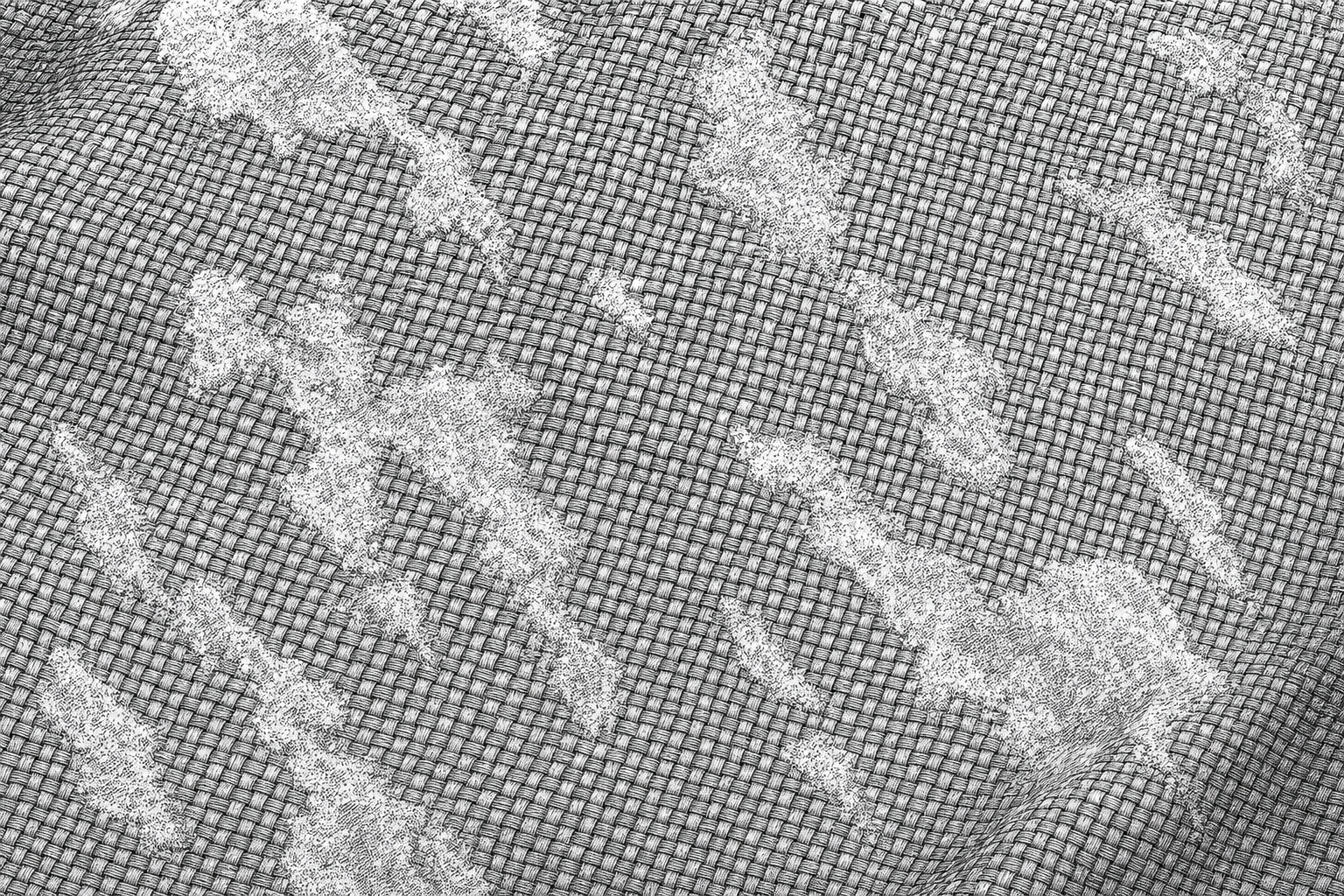 Cold-weather wax migration. Looks like damage. Isn’t. Illustrative only.
Heat migration: in hot conditions (car interior in summer, bag against a warm laptop), wax can liquify slightly and transfer to other surfaces: lining fabrics, leather straps, books inside the bag. Wax transfer, real practical concern. Halley Stevensons’ Alchemy formulation specifically targets reduced transfer.
Cold cracking: pure paraffin wax stiffens significantly at low temperatures and can develop hairline surface cracks in extreme cold. Beeswax and softer wax blends resist this better.
Waterproofing: Not as Absolute as Synthetics
Waxed canvas is water-resistant, not waterproof. Wax fills interstitial spaces and creates a hydrophobic barrier, but:
- Wax wears off from high-contact areas (handles, corners, straps, bottom panels) significantly faster than interior panels.
- Extended submersion or heavy, sustained rain will eventually work water through at stress points.
- Machine washing, detergents, and solvents strip the wax immediately. Bag will be completely unprotected after a washing machine cycle.
Compare to X-Pac (PET film) or DCF (PET films): rated 200+ PSI and 20,000+ mmH₂O respectively. A new 12 oz waxed canvas bag is roughly comparable to a DWR-treated nylon bag: good in a rainstorm, not suitable for submersion. After several years and some wax wear, considerably less protected.
Key functional difference from synthetic laminates: waxed canvas is user-maintained. When water resistance fails, you re-wax it. Bag doesn’t become “broken”, it becomes maintenance-required.
The Failure Mode: Mold and Mildew
Every synthetic in this series fails via mechanical stress, UV, or delamination. Waxed cotton has a unique failure mode: mold and mildew.
Cotton is cellulose. Cellulose is digestible by fungi. Many mold and mildew species are cellulolytic: they produce enzymes that break down cellulose chains directly. Stored damp, in warm environment, a waxed canvas bag can develop mold that:
- Stains the exterior (usually gray/green/black spots)
- Penetrates the wax layer into the cotton fibers themselves
- Degrades the cotton fiber structure over time, reducing strength
Wax layer delays but does not prevent this: wax is not a fungicide. Never store a waxed canvas bag while damp. Cardinal rule. Fundamentally different from synthetic materials, which are either mold-immune (UHMWPE) or mold-resistant (nylon, polyester) because fungi cannot digest them.
Treatment when mold occurs: diluted white vinegar (acetic acid) kills mold spores without stripping wax, followed by air drying and re-waxing the cleaned area.
The Things Synthetics Can’t Do
Patina: Cotton fiber develops a characteristic aged appearance with use: creases and scuffs “set,” color deepens or fades in characteristic patterns, surface develops visual depth unique to each bag’s history. Mechanically analogous to how leather develops character: material records its use. No synthetic laminate does this.
Re-waxability: Bag is repairable to original waterproof performance without professional intervention. A worn nylon’s PU coating cannot be restored to original spec at home; you can re-wax canvas yourself with a $15 tin of wax and a hair dryer.
Breathability: Wax fills spaces between fibers but doesn’t seal them completely. Waxed canvas breathes; water vapor can pass through at a slow rate. PET films in X-Pac, DCF, and EcoPak are vapor-impermeable.
Weight-adjusted durability: A 14 oz Halley Stevensons twill is approximately 475 g/m², heavy by laminate standards. But extremely abrasion-resistant, structurally self-supporting without backing films, can be repaired with basic needle and thread. Fabric is, in some meaningful sense, simpler than a four-layer laminate.
The Full Material Comparison (Updated)
| Property | Nylon (500D) | X-Pac VX21 | DCF Hybrid | EcoPak EPX200 | Waxed Canvas (12 oz) |
|---|---|---|---|---|---|
| Base polymer | Polyamide (synthetic) | Nylon + PET | UHMWPE + PET | rPET | Cellulose (natural) |
| Weight (g/m²) | ~230 | ~205 | ~83 | ~216 | ~407 |
| Waterproofing | PU coating (wears) | PET film (permanent) | PET films (permanent) | Coatings/film | Wax (user-maintained) |
| Abrasion resistance | 400–500 cycles | ~500 cycles (VX21 full laminate, DP spec) | Poor (bare film) | 500 cycles | Very high |
| UV resistance | Moderate | Moderate | Excellent | Good | Moderate–poor |
| Re-treatable? | No | No | No | No | Yes |
| Mold risk | None | None | None | None | Yes (cellulose) |
| Patina | None | None | None | None | Yes |
| Breathable? | Slightly | No | No | No | Yes |
| Repairable (DIY) | Limited | Limited | Limited | Limited | Yes |
| Recyclable/biodegradable | No | No | No | Partially | Yes (base cotton) |
| Cost | $$ | $$ | $$$+ | $$ | $$–$$$ |
| Weight penalty | Low | Low | Very low | Low | High |
Brands
- Filson (Seattle, est. 1897): most iconic American waxed canvas brand. Halley Stevensons Rugged Twill at 14 oz. Standard for the genre.
- Frost River (Duluth, MN): Duluth Pack heritage, uses duck and twill constructions. Classic North Woods aesthetic.
- Tanner Goods, Bradley Mountain, Makeshifter Canvas Works: smaller American makers, often using Martexin or Halley Stevensons canvas.
- Barbour (UK, est. 1894): iconic British waxed outerwear, British Millerain canvas. Originator of the modern waxed jacket.
- Belstaff (UK): motorcycle heritage, high-end fashion positioning, British Millerain or proprietary wax.
Waxed Canvas in the Inventory
Not currently in the active system. Worth explaining the absence.
For a bag system built around role clarity and travel efficiency, waxed canvas at ~407 g/m² is a weight penalty the system cannot currently absorb without displacing something else. Nearly twice the weight of X-Pac VX21. Four times Ultra 100.
That said: when a bag is meant to last 20 years, age with use, and develop personal character, waxed canvas is the only material in this guide that makes that promise credibly outside of leather.
A 20-year-old Filson bag in active use will outlast most laminate bags not because cotton is more durable, but because it can be maintained and repaired in ways that laminates cannot. Cotton soaked in whale blubber was the first X-Pac. The principles haven’t changed in 500 years.
Cellulose plus wax. Five centuries.