The Full System
Seven materials become a graph of roles, not a pile of bags.
- Volume
- 01
- Order
- № 10
- Read
- 7 min
- Published
A system of bags is not a collection of objects. It is a graph: which bag carries which role, which bag nests inside which other bag, which one moves freely between containers. The seven materials chapters described what the bags are made of. This chapter describes how they relate.
The system has three structural layers. On the body, always: the Toshi 5L sling. Inside whatever shell the day requires: Dragonfly for travel, Cicada 0426 for daily work and the laptop, Cicada 0826 for travel-leaning work days, the CT Laptop Tote for poolside reading, the Matador duffle for overflow, the WaterField for formal. And between containers, free-roaming: the Pioneer RTX global pouch, which lives in whatever bag is carrying the day’s tech.
That last layer is the one most systems get wrong. Most people treat pouches as sub-organizers permanently assigned to a parent bag: a tech case bonded to a backpack, a wash kit bonded to a duffle. The system as designed treats one pouch (the RTX) as infrastructure, not furniture. Cables, charger, audio, hygiene basics all live in the pouch and migrate with the day. Switching bags becomes a single transfer.
The roles
The system maps to roles, not to containers. Each named role routes to exactly one incumbent; backup specimens exist but are demoted. That is what makes the rotation legible.
On-body daily. Incumbent: Toshi 5L Sling V2. Pocket dump on body, never empty, never optional. The daily interface every previous bag system was trying to create.
Inner-bag organization, partner-day carry. Incumbent: Toshi 2.5L Sling V2. Smaller cousin of the 5L; redundant against it on most days, which is why it sits on the table for sale.
Onebag travel shell. Incumbent: ULA Dragonfly 36L. Laminate for airports, volume for onebagging, weight floor low enough that the overhead bin does not punish it.
Daily work, laptop-bearing. Incumbent: ULA Cicada Bespoke 0426. Softest hand of the two Cicadas, recycled face fabric, the bag that gets touched twenty times a day and should not feel like equipment. Day-to-day laptop home.
Daily / travel-work. Incumbent: ULA Cicada Bespoke 0826. Same chassis as the 0426, heavier travel-leaning build: dedicated laptop zip and luggage pass-through. The role for work days that also need airport-adjacent access; the material comparison with the 0426 is Vol. VI, Chapter 1.
Tech connective tissue, between bags. Incumbent: Pioneer RTX Global Pouch. Cables, charger, audio, hygiene basics. Migrates with the day; switching bags becomes a single transfer. The pouch is infrastructure, not furniture.
Formal, client-facing. Incumbent: WaterField Executive Leather Messenger. Used when the room rewards presence. The only bag in the system whose material is the point.
Travel and overnight, sub-onebag. Incumbent: Portland Gear Cascade Standard 21L. TPU-coated polyester, wireframe pop-top, packs flat against a luggage sleeve. Below the Dragonfly’s airport tier, above a daily backpack.
Overflow. Incumbent: Matador ReFraction Packable Duffle. Packs into itself, deploys when a day or trip exceeds what the chosen shell can hold, otherwise occupies almost no space.
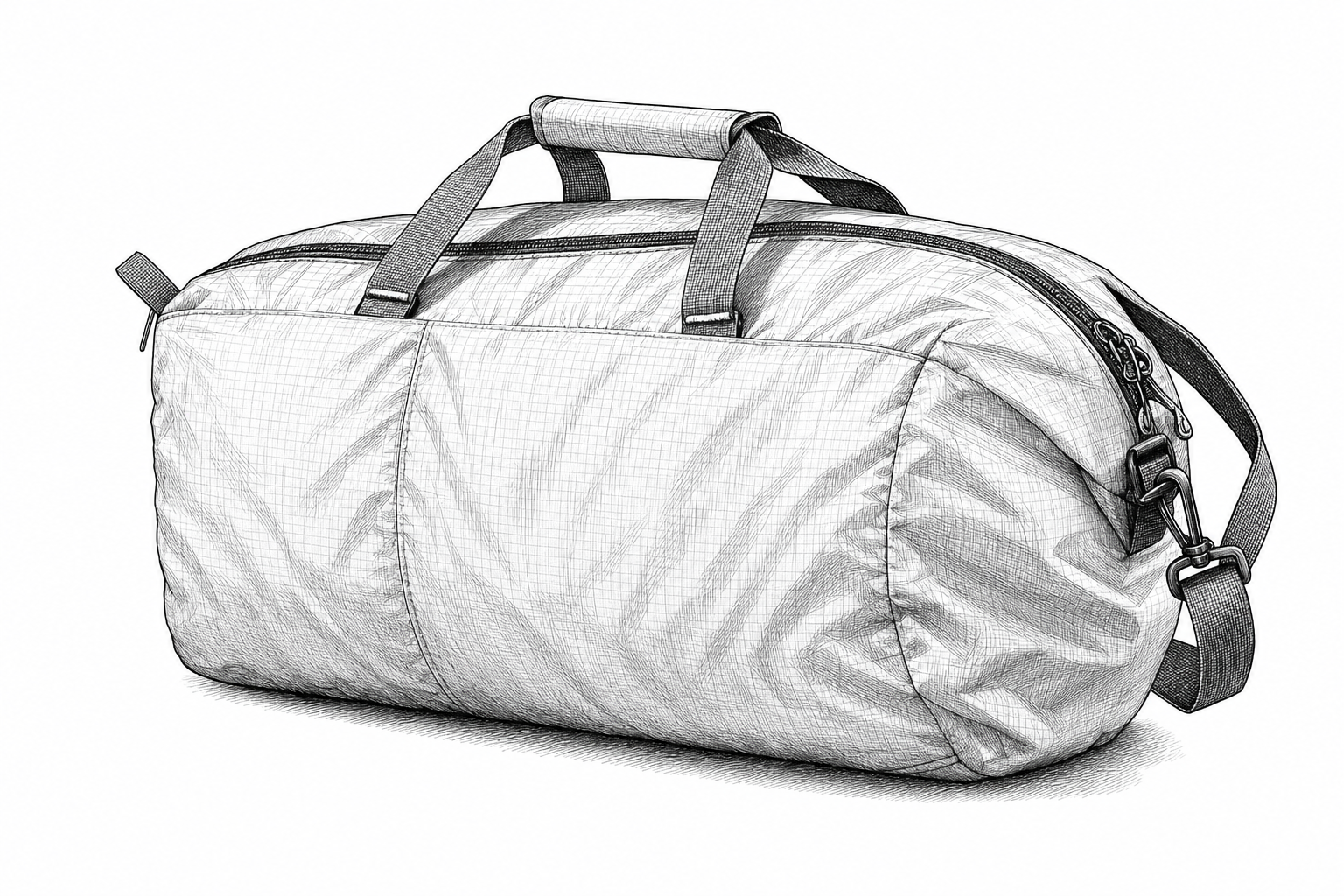 Matador ReFraction, 100D recycled nylon, packs into itself, deploys for overflow. Illustrative only.
Poolside, book carry. Incumbent: CTactical × The Perfect Bag CT Laptop Tote. Hang tag says laptop; the use settled on books, sunscreen, water bottle next to a wet lounger. Material thesis still earns its keep, just translated.
Toiletry, bathroom-environment tech. Incumbents: Alpaka Elements Tech Case Max, where X-Pac’s permanent waterproofing earns its keep, and Peak Design Wash Pouch for travel hygiene.
Couples-travel hub. Incumbent: MK × Orbitkey 2-in-1. Bifold body, integrated key holder.
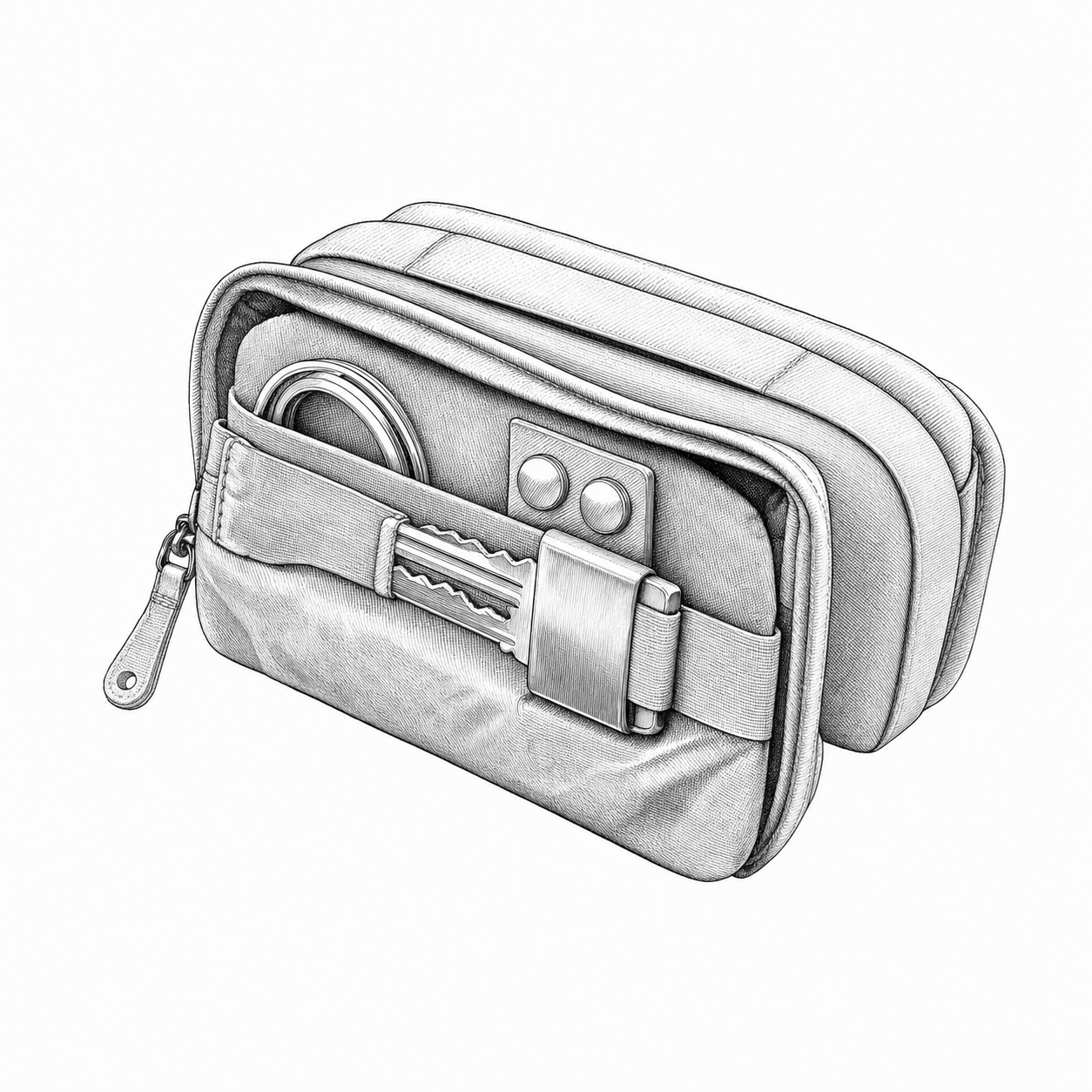 MK × Orbitkey 2-in-1, bifold body, integrated key holder. Couples-travel hub. Illustrative only.
Internal cable order. Incumbents: Think Tank Cable Management 5 and 10. Containers, not connective tissue; they do not move between bags.
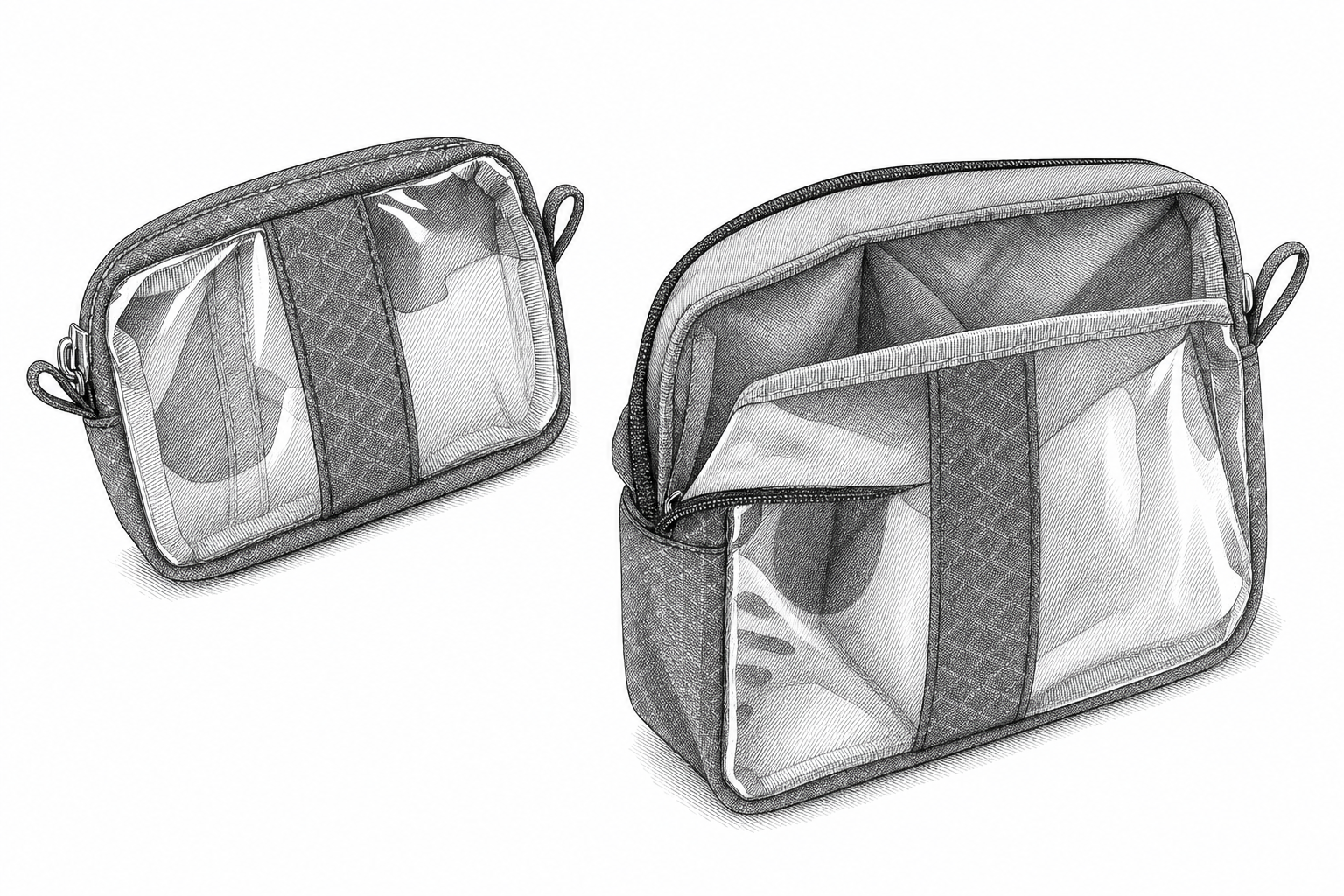 Think Tank Cable Management 5 and 10, mesh-window cable pouches, perimeter zips. Internal order. Illustrative only.
Gym, role retired. No incumbent. The Everest gym bag covered this role at 600D polyester; the workflow changed (gym-ready, drive home, no locker bag) and the role no longer needs a dedicated container.
One incumbent per role
Two incumbents per role create a choice; choice creates indecision; indecision routes back to “grab whatever is on top.” The role-by-role logic only holds because each named role has exactly one container that is good at it. Two backpacks for travel would create a choice. Two slings on the body would create indecision. The system is not large because the system has been edited.
Earned demotions
Demotion is the feature that distinguishes a stash from a system.
- The Everest gym bag was demoted out of the system when the workflow changed. The role was retired; the bag followed.
- The ILE Apex was demoted when high-output day carry was absorbed by the Cicada and the Dragonfly. Listed for sale.
- The Toshi 21L backpack was retired on organizational grounds: the admin pocket could not host the Toshi 5L sling, 21L was the cap rather than a cruise, and a flat-black silhouette read generic.
- The retired sling lineage (Alpaka Flow, Concept Collective, Unsettle Rush Hour, Heimplanet Transit) proved a geometry lesson before rotating out: a daily sling and a travel sling are not the same object, and you only need one of each.
- The PRVKE family (21L Black, 21L Sahara, 31L Sahara) was retired through the lessons documented in Ch. 9.
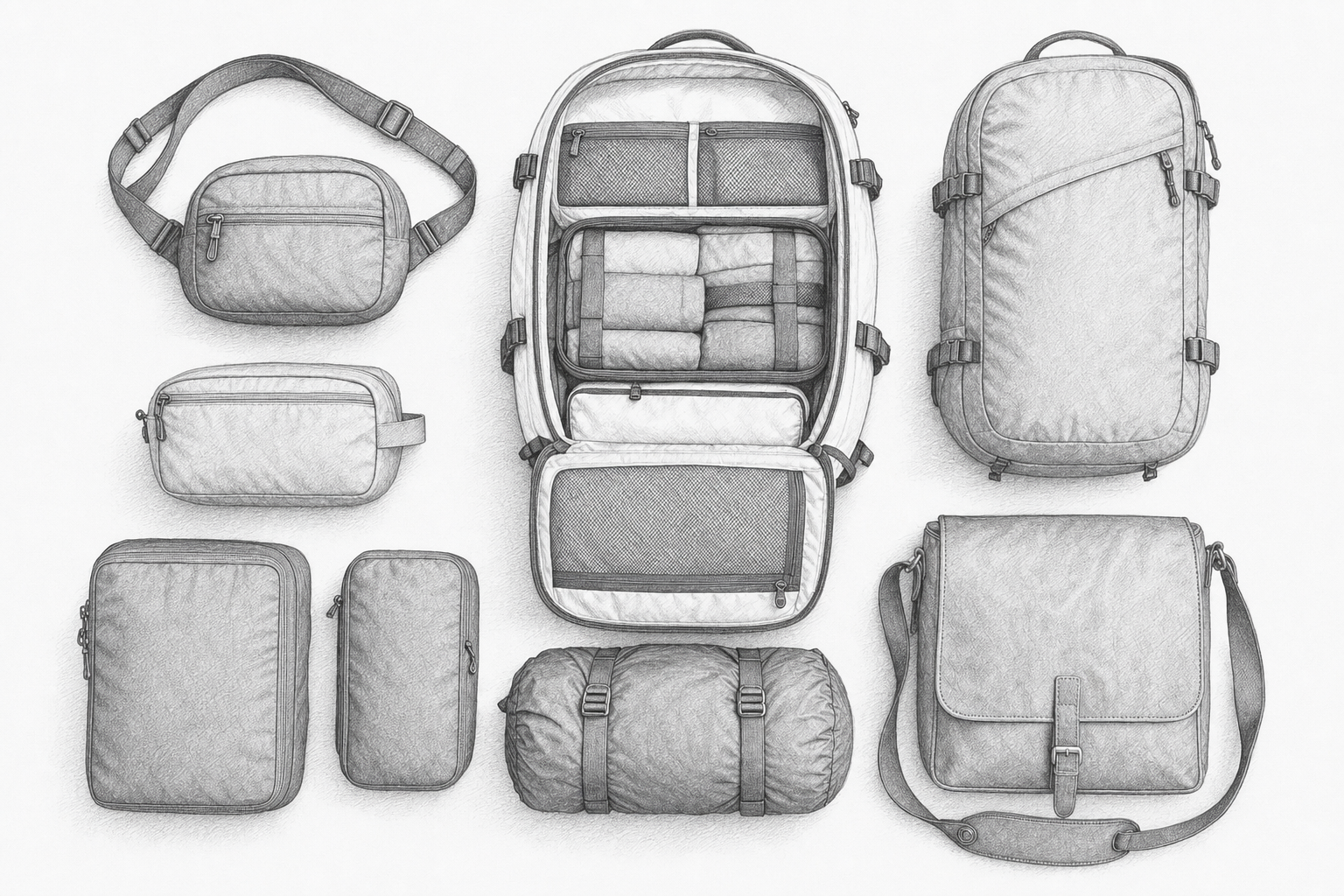 Not minimalism. Role-based clarity. Every bag has a job. No bag is doing another bag’s job. Illustrative only.
What breaks if a role disappears
The system has fragility points. Lose the Pioneer RTX and tech scatters: chargers and cables get duplicated across bags, or one bag becomes the de facto tech bag and stops being good at anything else. Lose the Toshi 5L and the daily interface collapses back into pant pockets, which is the state every previous bag system was trying to escape. Lose the Dragonfly and onebag travel forces a compromise: heavier laminate, smaller volume, or a non-laminate shell that does not survive the airport. Lose the Cicada 0426 and daily work loses its lighter recycled shell; lose the Cicada 0826 and travel-work loses dedicated laptop zip and luggage pass-through. Either can temporarily absorb the other’s volume because they share a chassis, but that is emergency coverage, not dual incumbency. Lose the CT Laptop Tote and the poolside book run goes into whatever rectangular synthetic happens to be on top of the closet: workable, not optimal. Lose the WaterField and the system has no answer when the room rewards presence.
The role-by-role logic only holds because each role has exactly one container that is good at it. Two backpacks for travel would create a choice. Two slings on the body would create indecision. The system is not large because the system has been edited.
The system at a glance
The matrix below synthesizes the system’s material posture across waterproof construction, patina capacity, and re-treatability. Read it as a single picture: most of the system is laminated synthetic (water handled at the fabric level, no patina, no re-treating), anchored at one end by the leather messenger, the only object in the system that gets better with use rather than worse.
| Bag | Material | Weight tier | Waterproof | Patina | Re-treatable |
|---|---|---|---|---|---|
| Dragonfly 36L | Ultra (UHMWPE laminate) | Ultra-light | Yes (RUV film) | No | No |
| Cicada EcoPak | EcoPak EPX 400 (rPET laminate) | Light | Fabric yes, seams conditional | No | No |
| Cicada X11 / Ultra | X-Pac X11 + Ultra 200X + leather | Medium | Fabric yes, seams conditional | Leather panels only | Leather only |
| ILE Apex 11L | X-Pac VX21 (nylon laminate) | Light | Yes (PET film) | No | No |
| CT Laptop Tote | Ultra 400X + EcoPak EPX200 | Light | Yes (laminates) | No | No |
| Toshi 5L sling | 840D nylon | Medium | DWR + PU coating | No | Partial |
| Toshi 2.5L sling | 840D nylon | Medium | DWR + PU coating | No | Partial |
| Pioneer RTX | 10XD UHMWPE/nylon woven | Light | DWR only | No | No |
| Alpaka Tech Max | X-Pac + 840D nylon | Medium | Yes (X-Pac face) | No | No |
| PD Wash Pouch | X-Pac VX21 Ocean | Light | Yes (PET film) | No | No |
| MK Orbitkey 2-in-1 | Recycled textile + PU trim | Medium | Weather-resistant | No | No |
| Matador Duffle | 100D recycled nylon | Ultra-light | PU coating + sealed zippers | No | No |
| Think Tank Cable/Tech | Padded nylon | Light | DWR varies by unit | No | No |
| WaterField messenger | Full-grain leather | Heavy | No (treatments needed) | Yes | Yes |