EcoPak
X-Pac's architecture rewritten to a sustainability brief.
- Volume
- 01
- Order
- № 05
- Read
- 9 min
- Published
If X-Pac is what laminate bag fabric looks like with a sailmaker’s brief, EcoPak is what it looks like with a sustainability brief. Same architecture, different inputs: recycled polyester face, recycled polyester X-grid, recycled film backing, and chemistry that drops PFAS and PVC out of the build. Made by Challenge Sailcloth in Connecticut, X-Pac’s direct competitor.
Who makes it?
EcoPak is made by Challenge Sailcloth, a Connecticut-based manufacturer. Like Dimension-Polyant (X-Pac), Challenge Sailcloth’s heritage is in marine textiles: they supply sailcloth for performance sailing and kiteboarding. That is not a coincidence. Laminate construction originated in sail engineering, and both companies apply the same technology to bags.
Challenge Sailcloth debuted EcoPak in 2021, explicitly positioning it as a sustainability-first alternative to X-Pac. The pitch: same laminate architecture, 100% recycled inputs, no toxic coatings.
What is it? (Construction)
EcoPak is a 3-layer laminate, structurally analogous to X-Pac. From outside to inside.
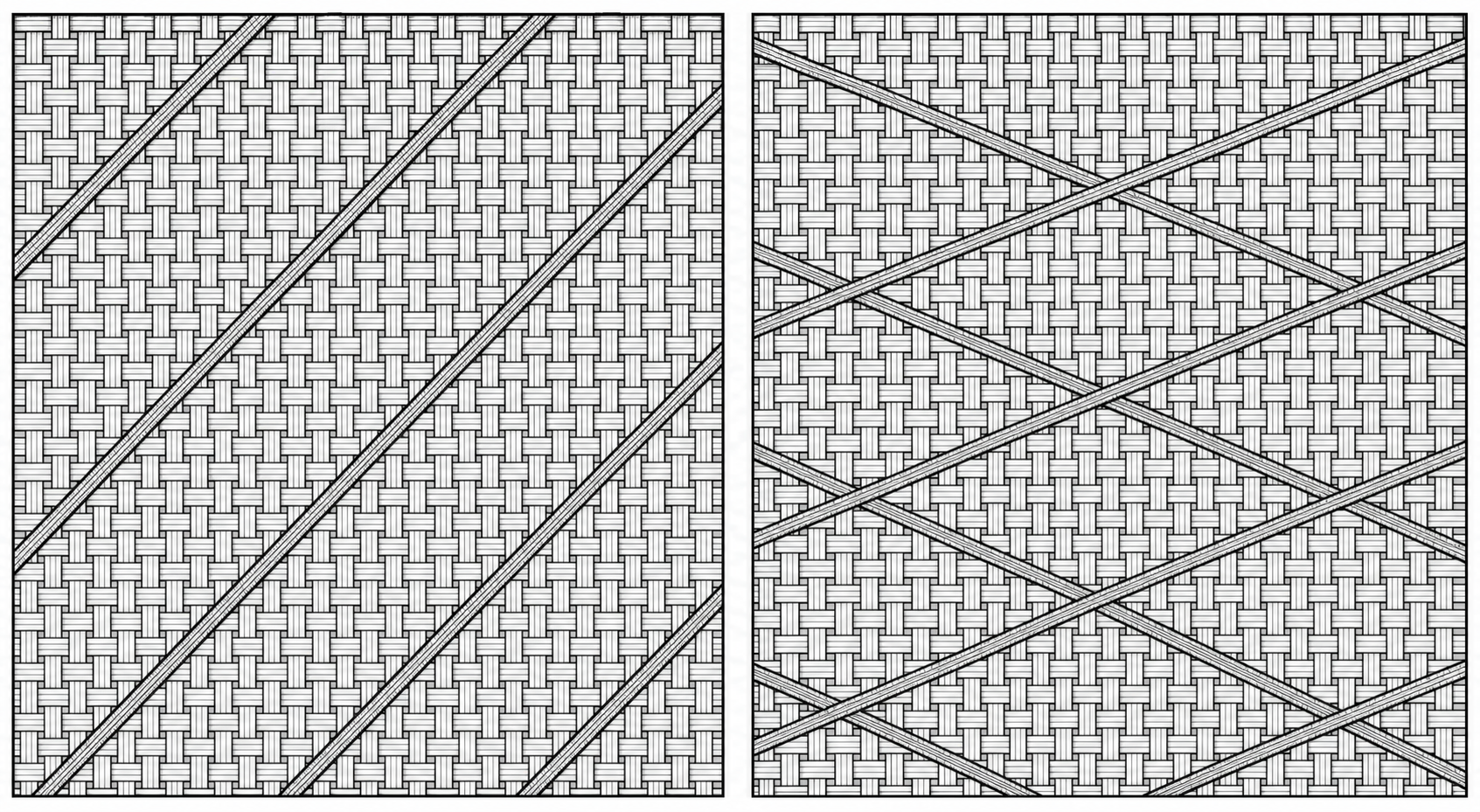
EcoPak’s CrossPly grid is laid at 45°, not 22°. Both create diamond patterns; the angle and spacing differ. Illustrative only.
Layer 1: Recycled Polyester Face Fabric
Woven from REPREVE® yarn: recycled polyester fiber made from post-consumer PET bottles, manufactured by Unifi. REPREVE is one of the most well-certified recycled fibers on the market (GRS-certified, Bluesign-approved).
The face denier determines the product variant number: EPX200 has a 200D face, EPX400 has a 400D face. The face gets a C0 DWR: a Durable Water Repellent finish with zero fluorocarbon content, meaning no PFAS. A meaningful chemistry upgrade over many older DWR treatments, which used long-chain C8 fluorocarbons now phased out due to persistence in ecosystems.
Layer 2: Blue CrossPly®
The structural grid layer. Like X-Pac’s X-PLY, EcoPak’s CrossPly is a grid of yarns laid at a 45° bias angle (vs X-Pac’s 22°), also made from recycled polyester.
Two things differ from X-PLY:
- 45° vs 22°: At 45°, the yarn grid is at the maximum shear-resistance angle: it resists forces that try to distort the fabric into a parallelogram. At 22°, X-Pac optimizes for multidirectional load distribution from sailing geometry. For bags, 45° is arguably more intuitive.
- Color: Challenge’s CrossPly is dyed blue and is visible through light-colored face fabrics, giving EcoPak its characteristic diamond grid pattern. X-PLY on X-Pac is black polyester.
- Waste reduction: The 45° orientation aligns with standard rectangular cutting patterns, reducing cutting waste by approximately 10% compared to X-Pac’s 22° bias.
Layer 3: Backing (EPX vs EPLX)
Where the two main EcoPak sub-families split:
- EPX series: Backing is a 70D recycled polyester ripstop fabric, a woven textile, not a film. Not seam-tapeable because there is no exposed film on the inside. However, the ripstop backing provides excellent stitch-holding and durability for sewn constructions.
- EPLX series: Backing is a 0.5 mil Challenge RUV™ matte film, a recycled, UV-resistant polyester film (97% UV resistant). The film is exposed on the inside, making EPLX fully seam-tapeable. EPLX is the choice when you need a fully waterproof bag system with taped seams.
The RUV film also appears in Challenge’s Ultra fabric line (Chapter 5).
The waterproofing, and the important asterisk
EPX series: Challenge states EPX fabrics are waterproof to 200+ PSI at the fabric level. But EPX has a woven ripstop backing, not an exposed film, so waterproofing comes from coatings within the lamination and CrossPly adhesive layers, not a continuous film membrane. A field-tested EPX200 bag leaked at the seams when seams were unsealed. Waterproof fabric ≠ waterproof bag unless seams are taped or otherwise sealed.
EPLX series: The exposed RUV film backing makes seam taping straightforward and the system genuinely waterproof end-to-end when seams are taped.
EPX vs EPLX decision rule: If your maker is taping seams, use EPLX. If the construction uses bound seams (cannot be taped), EPX is fine for heavy rain resistance but not submersion-proof as a system.
Abrasion and durability
Reading EcoPak codes: EPX is the woven ripstop–backed line (Green Mountain), not seam-tapeable because no film is exposed inside. EPLX inserts Challenge RUV™ recycled polyester film as the inner layer (Blue Ocean); the L marks the film-backed construction, which is seam-tapeable. The digits are the face denier: EPX200 / EPLX200 = 200D rPET face, 400 = 400D.
The published Taber Abrasion (ASTM D3884) numbers from Challenge’s specs (see Appendix: Reading the Spec Sheet for how Taber cycles are reported):
| Variant | Face | Backing | Weight (oz/yd²) | Abrasion Cycles |
|---|---|---|---|---|
| EPX70RS | 70D ripstop | 70D ripstop | 5.05 | 300 |
| EPX200 | 200D | 70D ripstop | 6.4 | 500 |
| EPX300RS | 300D ripstop | 70D ripstop | 8.8 | 1,000 |
| EPX400 | 400D | 70D ripstop | 9.1 | 3,000 |
| EPLX200 | 200D | RUV film | 4.3 | 500 |
| EPLX400 | 400D | RUV film | 6.9 | 3,000 |
For context (from Chapter 3, aligned to Dimension-Polyant’s published laminate figures): standard VX21 lists 500 Taber cycles on the full composite; VX42 lists 1,700. Ripstop-faced X-Pac variants (where listed separately) score higher than plain-weave at the same denier because the weave reinforces the wear surface.
EPX200 at 500 cycles lands in the same band as standard VX21 on Challenge’s and Dimension-Polyant’s respective datasheets, not comparable across mills without identical fixtures. EPX400 at 3,000 cycles is remarkable within Challenge’s lineup. Challenge’s own claim: EPX400 has “almost twice the abrasion resistance compared to 420D nylon” in the standalone face fabric. The reason is polyester’s density and crystallinity: denser fiber packing per unit area means more fiber to abrade through per cycle.
The full EcoPak lineup
EPX (Green Mountain): woven ripstop backing, no seam taping
- EPX70RS, EPX200, EPX300RS, EPX400, EPX600
EPLX (Blue Ocean): RUV film backing, seam-tapeable
- EPLX200, EPLX200RS, EPLX400, EPLX450RS, EPLX600
Hybrid: mixed denier/colorway constructions, some with non-recycled components for camo patterns and specialty finishes that are not achievable with pure recycled inputs
How EcoPak differs from X-Pac
| Property | X-Pac VX21 | EcoPak EPX200 |
|---|---|---|
| Face material | Nylon 6,6 (virgin) | rPET polyester (REPREVE) |
| CrossPly angle | 22° | 45° |
| CrossPly material | Recycled polyester | Recycled polyester |
| Film layer | 0.25 mil PET | Coatings within laminate (EPX); 0.5 mil RUV (EPLX) |
| Backing | 50D polyester taffeta | 70D ripstop polyester (EPX) or RUV film (EPLX) |
| Weight | 205 g/m² (~6.0 oz/yd²) | 216 g/m² (~6.4 oz/yd²) |
| Abrasion (ASTM 3884) | 500 cycles (VX21 full laminate, DP specs) | 500 cycles |
| Recycled content | Partially (CrossPly only) | 100% |
| DWR | Fluorocarbon DWR | C0 DWR (no PFAS) |
| Seam-tapeable | EPLX only | EPLX only |
| UV resistance | Moderate (nylon face) | 97%+ (polyester face + RUV film) |
| Color range | Many | 20+ colors |
| Odor retention | Low | Higher (polyester face) |
Structural face performance: EcoPak EPX400 publishes ~3,000 Taber cycles on Challenge’s sheet versus ~1,700 for VX42 on Dimension-Polyant’s, same test name, still not strictly comparable across mills, but the gap is real at published weights. EPX200 and standard VX21 both land near 500 cycles on their respective datasheets. Where X-Pac holds an edge is in its 22°-bias X-PLY, which Dimension-Polyant claims provides better multidirectional tear propagation resistance, though the CrossPly at 45° provides comparable shear resistance for typical bag loads.
Sustainability story is unambiguous: EcoPak is fully recycled, X-Pac is not (the nylon face and film in VX-series are virgin materials). EcoPak is also PFAS-free with its C0 DWR, while X-Pac uses conventional fluorocarbon DWR on most variants.
The sustainability numbers
Per linear yard of EcoPak:
- ~20 PET bottles recycled per yard
- >1 lb (450g) CO₂ savings vs virgin nylon pack fabric
- CO₂ manufacturing emissions ~50% lower than virgin nylon
- No VOCs in production: all adhesives are solvent-free
- No fluorocarbons, no PVC, no harmful TPU coatings
One honest caveat from the polyester chapter: rPET is not truly circular, the fabric cannot easily be re-recycled into fiber after use. Challenge claims it is recyclable, and the mono-material (all polyester) construction does make chemical recycling more tractable than mixed-fiber laminates, but industrial chemical PET recycling infrastructure is not yet at scale. Better than virgin nylon, but “fully circular” is aspirational.
Durability issues in the wild
EcoPak is young as materials go (2021 debut), limited long-term data. A few real-world durability signals:
- An Evergoods MPL 22 in EcoPak had a PU coating failure within normal use, attributed by Evergoods to a manufacturing defect in the coating layer. A laminate failure mode, not structural, but it illustrates that EcoPak’s waterproofing in the EPX series is coating-dependent in a way that EPLX (film-backed) is not.
- The 45° CrossPly at higher deniers (EPX400, EPLX400) has received uniformly positive durability feedback from cottage gear makers, particularly for bottom panels.
- No structural delamination failures have been widely reported at the scale of X-Pac or DCF, but the fabric is newer and the sample size is smaller.
Brands using EcoPak
- Tortuga (Travel Backpack V4 uses EcoPak EPX200 as “SHELL200”)
- Flowfold (flagship bags)
- Rockgeist (cycling bags)
- Evergoods (MPL 22, though with noted QC concerns)
- Various cottage MYOG brands, popular among makers because the 45° CrossPly reduces cutting waste
EcoPak in the Inventory
ULA Cicada Bespoke 0426 “Forest”: EcoPak EPX 400 shell. The forest colorway with custom S-curve straps, Fidlock sternum, and hipbelt is a limited-run bespoke build. EPX 400 means 400D recycled polyester face with woven ripstop backing: firm, slightly quieter than Ultra fabric in motion, matte finish. This is also where the laptop lives day-to-day: the Cicada absorbed the laptop role from earlier work backpacks, leaving the CT Laptop Tote (Ch.5) free to drift into a different job entirely.
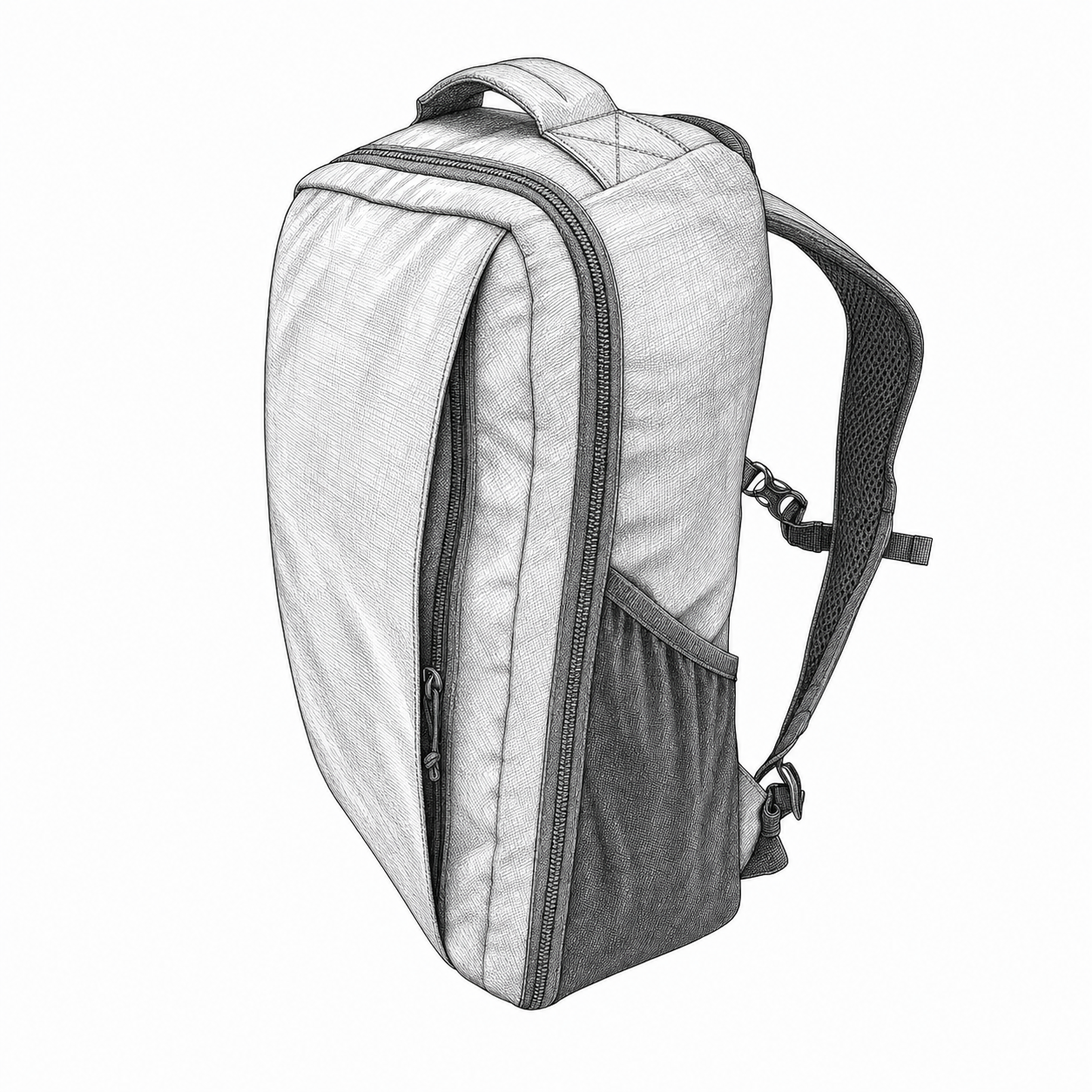 ULA Cicada Bespoke 0426 “Forest”, EPX 400 shell, vest harness, S-curve straps, Fidlock sternum. Daily work bag. Illustrative only.
The EPX series uses woven ripstop backing rather than a film, which makes it less straightforward to seam-tape for fully waterproof constructions, but improves sew-ability and durability in built bags. For a daily EDC backpack, this tradeoff makes sense.
A later bespoke build on the same Cicada chassis, the 0826, replaces nearly every material decision: X-Pac X11 shell, Challenge Ultra 200X liner, full-grain leather top and bottom panels. Same 22 liters, same footprint, different aging curve and different access logic. Vol. VI, Chapter 1 reads the pair side by side as a controlled comparison; the short version is that holding the chassis still is what makes the material choices legible.
The honest assessment
EcoPak solves a real problem: the laminate bag fabric market was almost entirely virgin petrochemical. Challenge filled that gap with a technically competitive product.
The legitimate wins:
- Best sustainability profile of any laminate pack fabric
- Outstanding abrasion resistance at 400D+, better than equivalent-denier nylon
- No PFAS DWR, no solvents, no PVC
- Wide, saturated color palette (polyester dyes better than nylon)
The legitimate trade-offs:
- 200D variant slightly heavier than X-Pac VX21 at equivalent denier
- EPX series waterproofing less certain than EPLX or X-Pac’s PET film layer
- Polyester face retains odors more than nylon face over long use
- Younger material, less long-term real-world durability data
If sustainability is a key spec, EcoPak is the clear choice over X-Pac. If you are optimizing purely for mechanical performance in a heavy-use bag with no sustainability constraint, X-Pac VX42 or EcoPak EPX400 are comparable and the choice comes down to specific use geometry.
The same laminate, rebuilt from bottles.